‘Octopus BrainStorming’
Victoria Vesna, Ph.D., is an Artist and Professor at the UCLA Department of Design Media Arts and Director of the Art|Sci center at the School of the Arts and California Nanosystems Institute (CNSI). Trained as a painter, her curious mind took her on an exploratory path that resulted in work can be defined as experimental creative research residing between disciplines and technologies. With her installations she investigates how communication technologies affect collective behavior and perceptions of identity shift in relation to scientific innovation. Her work involves long-term collaborations with composers, nano-scientists, neuroscientists, evolutionary biologists and she brings this experience to students.
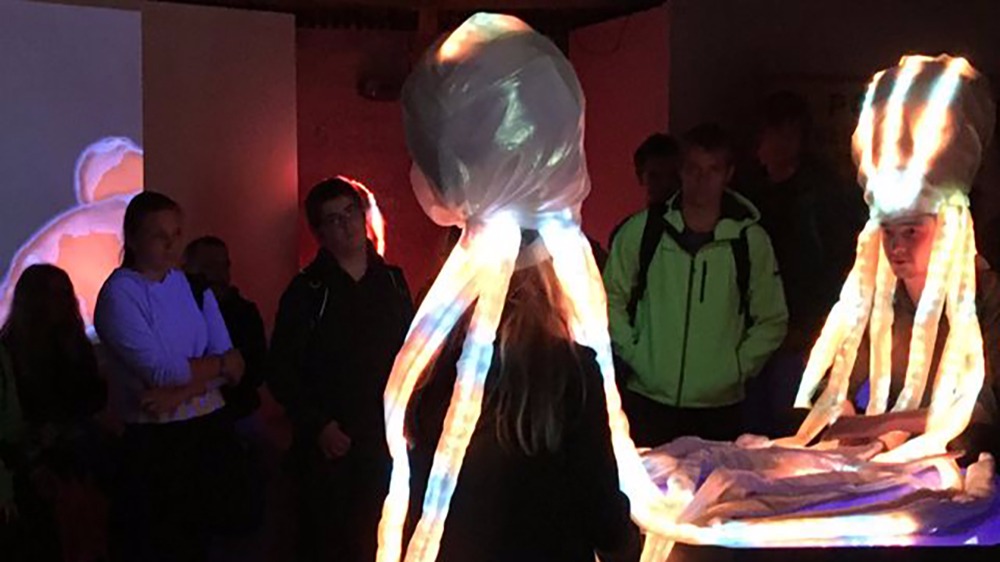
"For the last year, two professors from UCLA have been inviting people to take part in one of the most interesting conversations of their lives. The most recent setting was at a technology and art convention in Slovenia. In a darkened room two people each wore a ceremonial crown that resembled a fluorescent octopus, which covered brain-wave–reading electrodes attached to their heads. But the strangest part? The participants never uttered a word to each other.Welcome to “Octopus BrainStorming,” a participatory performance art installation that combines the technology of neuroscience with an artistic interpretation of the type of communication exhibited by octopi.
“I have always been fascinated with the octopus as the most complex animal that is the most distant common ancestor to humans. Their intelligence is fascinating and I find it important to connect to these aliens in our midst and appreciate another type of consciousness,” said Victoria Vesna, UCLA professor of design media arts and director of the UCLA ArtSci Center. Vesna created the project over five years with UCLA neuroscientist Mark Cohen, a pioneer of the use of magnetic resonance imaging to study human cognition.
In “Octopus BrainStorming,” which debuted at the opening of UCLA’s Luskin Conference Center in October 2016, Vesna and Cohen are trying to show the power of non-verbal communication using live performance.
“The octopus is a symbolic way to represent another type of consciousness that exists among us,” Vesna said in an email interview. “The octopus crowns are meant to connect the public to the idea of a fully embodied consciousness rather than residing in the brain alone.”
Vesna said she was inspired by octopi when she learned about their full-bodied consciousness. Growing evidence indicates that cephalopods exhibit higher intelligence and are potentially fully conscious beings — traits that previously were thought to be exclusively human. What fascinates scientists and individuals such as Vesna and Cohen are differences between human neural circuits and cephalopod neural circuits that result from thousands of years of divergent evolution and demonstrate that conscience communication can occur through means other than talking. Octopi and their kin are the only example outside of vertebrates that have complex clever brains.
“I could go on and on about the many reasons that I am interested in the octopus, but in the context of the project, it is the embodied intelligence that is particularly fascinating to enact — brainstorming with the entire body rather than in a centralized, anthropocentric manner we are thought to think,” Vesna said."— Valerie Sommer, Nov. 14, 2017

Read the full article at the UCLA Newsroom website.