Nostalgia for the Lost Subject of Technology in the Work of Casey Reas
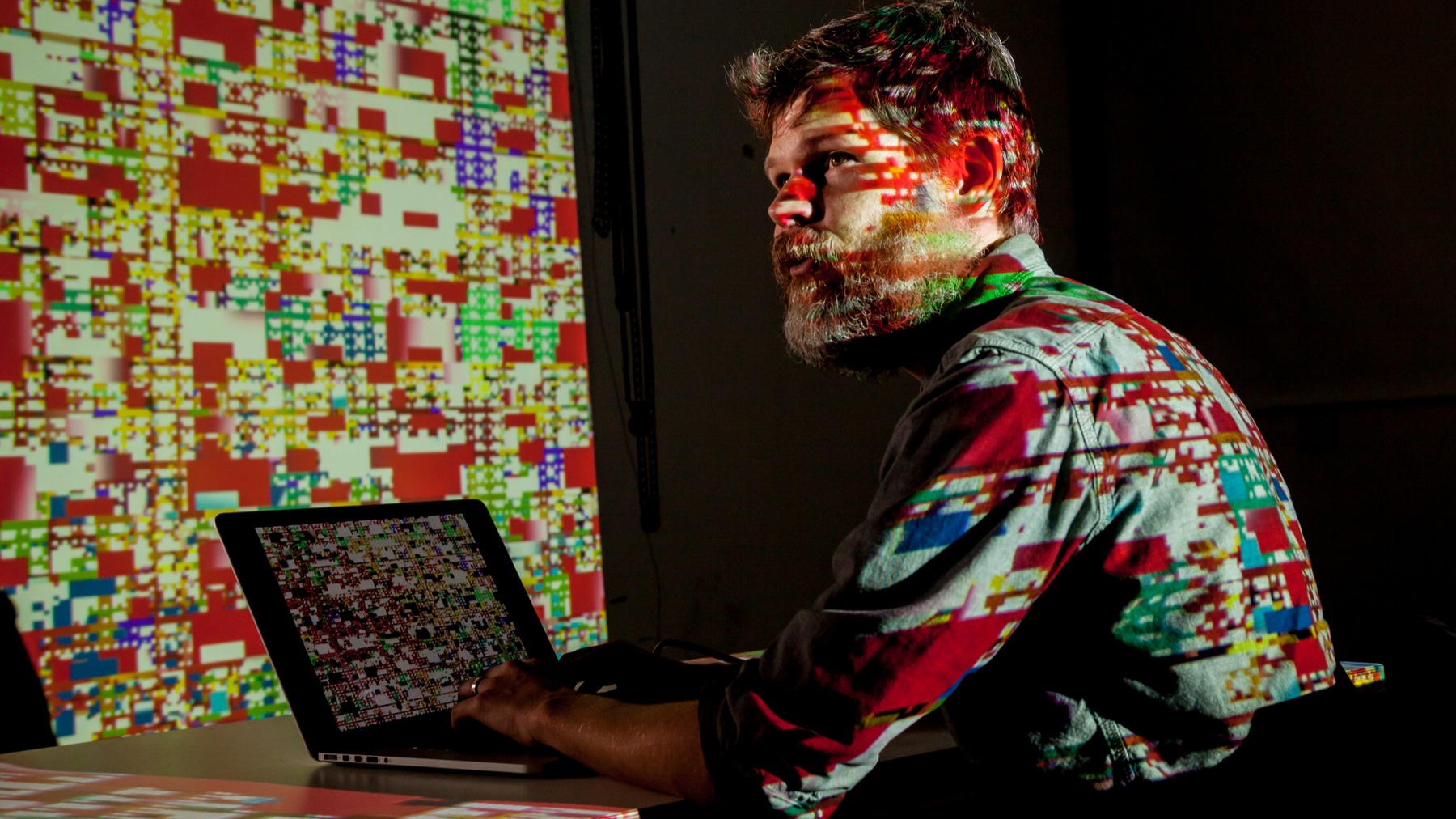
Casey Reas, professor in the department of Design Media Arts, writes software to explore conditional systems as art. Through defining emergent networks and layered instructions, he has defined a unique area of visual experience that builds upon concrete art, conceptual art, experimental animation, and drawing. Johanna Drucker, Professor of Bibliographical Studies in the department of Information Studies at UCLA writes about Reas' work for the Los Angeles Review of Books.
IN SEPTEMBER 2015, my colleague Casey Reas showed several new large-scale digital works in an exhibit titled Linear Perspective at Charlie James’s gallery in downtown Los Angeles. Though each piece on display was very distinct, they were all made from remediated images, captured from mass and social media sites, that streamed nonstop in the projections and displays.
The lush, visually complex, high-level stimulus of the works evoked an unexpected response — nostalgia. Their inherently ephemeral quality created a longing for something irrecoverable. For all their contemporary state-of-the-art style, these works seemed to speak of a lost human subjectivity, as if Reas were trying to reference a moment in which humanity and technology were more innocently bound to each other, a moment now irrevocably lost. Looking at the flickering, drifting, reworked images, I felt I was getting a glimpse of machines’ notions of who we are, or were — as if the signal streams were returning their algorithmic image of us for reflection. Paradoxically, these instants of time, sliced from recent media streams, felt far removed from the present, as if only a trace memory remains of the lives we are living.
This might seem like an odd response to such a visually rich installation, in which the pieces were displayed on poster-sized screens, in projections, and on monitors. They used standard hardware — cool, neutral, basically soulless — to display a visualized data feed of information signals processed into graphical files. I sat down with Reas to discuss his thoughts about visual technology, and the way the melancholic impact was aligned with his larger interests. Several concerns have threaded through all of his work: interest in the personal appropriation of cultural media images, a technical engagement with the manipulation of signals, and a persistent sense of the relevance of Plato’s Allegory of the Cave, which continues, he thinks, to provide a useful framework for reflecting on visual experience and collective illusions. How, he asks, do media images configure our relations to ourselves in current circumstances? What is gained and lost in our daily encounters with these masses of graphical information?— UCLA Professor of Bibliographical Studies, Johanna Drucker, Jan. 29

Read the full article at the Los Angeles Review of Books website.