New York City’s Latest Exhibition Space Is Located Underground
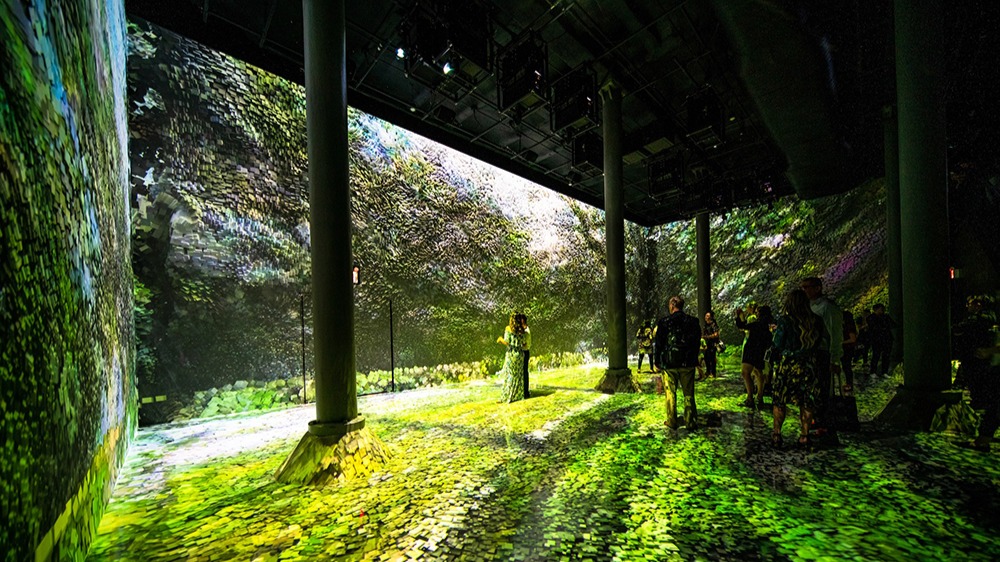
Alum and Visiting Assistant Researcher Refik Anadol (Design Media Arts, MFA '14), works in the fields of site-specific public art and live audio/visual performance with an immersive installation approach, particularly his works explore the space among digital and physical entities by creating a hybrid relationship between architecture and media arts. Now, Artechouse, a technology-focused art exhibition platform conceived in 2015, is presenting an exhibtion of Anadol's work.
"As a child, Refik Anadol would joyously envisage alternate spatial realities: a version of his bedroom without a ceiling, another version without a floor. So it’s fitting that the Istanbul-born, Los Angeles–based data artist spends his grown-up days ideating at the vanguard of new media where architecture, art, and technology converge. Anadol’s latest project, entitled Machine Hallucination, is an AI-generated vision of New York City. The immersive installation serves as the first Manhattan-based exhibition organized by digital art space ARTECHOUSE, which has recently opened its new outpost below Chelsea Market, which is located in and named for the popular neighborhood.
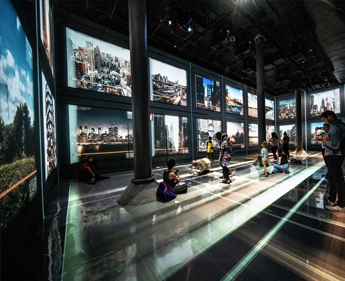
Scenes of the city are pulled from targeted archival images and Instagram posts without human subjects for privacy. ARTECHOUSE was cofounded by Tatiana Pastukhova and Sandro Kereselidze in 2015 as a platform for the development and presentation of new media projects like Machine Hallucination. Noting the lack of resources available to artists experimenting with sophisticated technologies in their work, the husband-and-wife team established ARTECHOUSE to be what Pastukhova calls “a home where new media artists are free to create and show their work without limitations.”
Positioned within the subterranean walls of the 6,000-square-foot boiler room beneath Chelsea Market’s main concourse, Machine Hallucination is the culmination of Anadol’s tenacious research into generative adversarial networks (GANs), a kind of machine-learning technology engineered to realize simulated realities derived from “real-world” imagery. “These networks train each other, and their dialogue can be captured to create a story,” Anadol explains. “So let’s say it’s the near future. A machine has taken over a space, and dreams about the city it’s inside. In this case, that city is New York. What would that machine’s dream look like?”
With over 100 million public photographs of New York—the largest mass of raw data gathered for an artwork to date—Anadol created an algorithm trained to target archival images and Instagram posts without human subjects in protection of their privacy. The machine subsequently processed a subset of 8 million pictures across a mind-bending 1,000 dimensions, and what Anadol refers to as “enormous, unimaginable worlds” thereafter. Think an otherwise inconceivable, never-before-seen interpretation of New York, but which is rooted in genuine human snapshots of the city’s innumerable landmarks.
Anadol, who participated in Google’s Artists and Machine Intelligence Program, is among the first generation of visual artists to create with AI. Which is exactly why the Turkish maverick was tapped by ARTECHOUSE, a cutting-edge enterprise outfitted with the forefront technologies essential to producing immersive, sensory works of digital art. ARTECHOUSE’s radical ethos eschews the traditional museum format by inviting viewers to step inside the artwork, rather than away from it—“a kind of engagement that most people have never experienced,” Pastukhova notes."— Rachel Gould, Sep. 27, 2019


This post is an excerpt. Read the full article on the Architectural Digest website.
Stay engaged. Use #UCLAarts to stay connected.


