New symposium blends narratives of riots, city planning
Salon 02 is organized and curated by a group of alumni from the UCLA Urban Humanities Initiative. Its aim is to foster continued engagement with urban humanities theory, pedagogies, and community both within and outside the academy. Part symposium, part exhibition, part celebration, SALON 02 showcases the making of urban humanities in Los Angeles, presenting projects blurring the edges of our respective disciplines in the humanities, urban research, and design. A event spanning three days, SALON 02 collectively represents the ongoing work of urban humanists engaged in remaking and reimagining the city.
"Jacqueline Barrios used a Charles Dickens novel to retell the history of the 1992 Los Angeles riots.
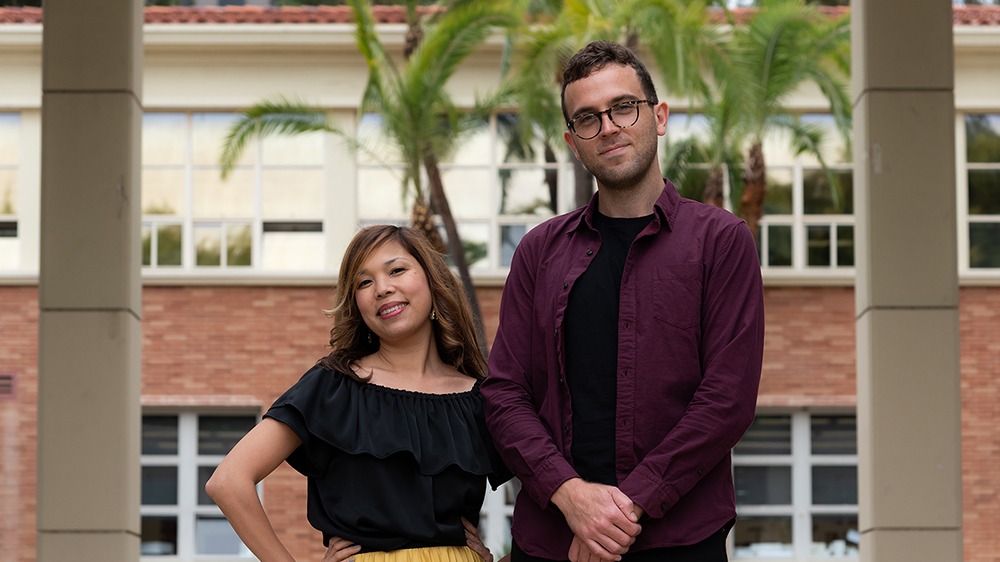
English graduate student Jacqueline Barrios and Urban Humanities Initiative alumnus Gus Wendel worked to create a symposium exploring the riot-impacted neighborhood of South LA. (Daniel Leibowitz/Daily Bruin staff) Using the 1780 Gordon Riots in London as depicted in Dickens’ “Barnaby Rudge,” the English graduate student taught her high school students from the James A. Foshay Learning Center to explore their riot-impacted neighborhood of South LA. Students collected sounds including background noises from the city and interviews with community members. Barrios’ curriculum was eventually transformed into an exhibit titled “LA 1992/London 1780: Sounding Out the Crowd,” which will be on display May 24 at the Salon 02 symposium in Perloff Hall.
The Salon 02 symposium will span three days with exhibits May 24, panels May 25 and a picnic May 26, all centered around the word “plan,” which conventionally encompasses listing out actions to achieve goals, Barrios said. Organized by alumni and current students in the Urban Humanities Initiative, the symposium aims to showcase interdisciplinary, collaborative work while challenging the concept of a plan, the co-organizer said.
“When I say plans are normative, they are meant to organize a whole bunch of diverse energies into some material reality. But we know from our studies that plans go awry,” Barrios said. “What we’re asking people to think about is how do we continue to live with plans and how do we – people who live in cities, make cities – how can we challenge that.”
In the panel “Mapping the Plan,” panelists will discuss how maps can disrupt plans, such as gentrification, and challenge the status quo, said Gus Wendel, an Urban Humanities Initiative alumnus, event co-organizer and panel moderator. Policies that facilitate gentrification will transform neighborhoods. But a map that adds information to data sets about eviction rates, for instance, can slow the process by informing planners’ conversations or sparking action from advocacy groups, Barrios said."— Ethan Pak, May 12, 2019


This post is an excerpt. Read the full article on the Daily Bruin website.
Stay engaged. Use #UCLAarts to stay connected.


