New Miracles
Dr. Dana Cuff issues a challenge on the occasion of UCLA's centennial
On the occasion of UCLA’s Centennial, UCLA Arts is proud to present 100 for 100—a collection of stories that celebrate the rich history of the arts at UCLA over the past century. Each monthly newsletter throughout the yearlong celebration will feature a new story that reflects on our past and imagines what’s possible for our future. We invite our community to explore these stories and contribute their own to the collection.
This month's contribution is by Dr. Dana Cuff, director, UCLA cityLAB & professor, UCLA Department of Architecture and Urban Design
When I arrived at UCLA to join the faculty of Architecture and Urban Design in 1993, architecture was in an extraordinary place vis-à-vis culture at large. The Guggenheim in Bilbao was underway, and would open four years later with a New York Times Magazine cover that announced Frank Gehry had produced “A Miracle in Bilbao.” Then Dean Richard Weinstein joined the profession’s swoon over the power of architecture and the attention from the glitterati. It was a work of groundbreaking, creative genius that was credited with regional economic development in the rusted industrial Basque Country. The ties of architecture to the city, with its economic, social, and political complexities, were not lost on Weinstein, an architecture-trained urban designer who cut his teeth in Mayor John Lindsay’s Manhattan. Meanwhile, the fresh terrain of digital technologies overtook the academy in 1994 with the advent of the paperless studio at Columbia, soon embraced at UCLA. Simultaneous with my arrival, the Graduate School of Architecture and Urban Planning broke apart, the departments administratively divorcing in 1994. With the split, UCLA abandoned the theory that architecture should be united with planning to create an integrative architecture of the city. Instead, it was the Guggenheim-as-monument that gave architecture its grandest public stage, and there was a strong sense that individuals—particularly older white men—would be performing the miracles. As for me, I was stealthily nursing my second child between interviews with the faculty I hoped would hire me.
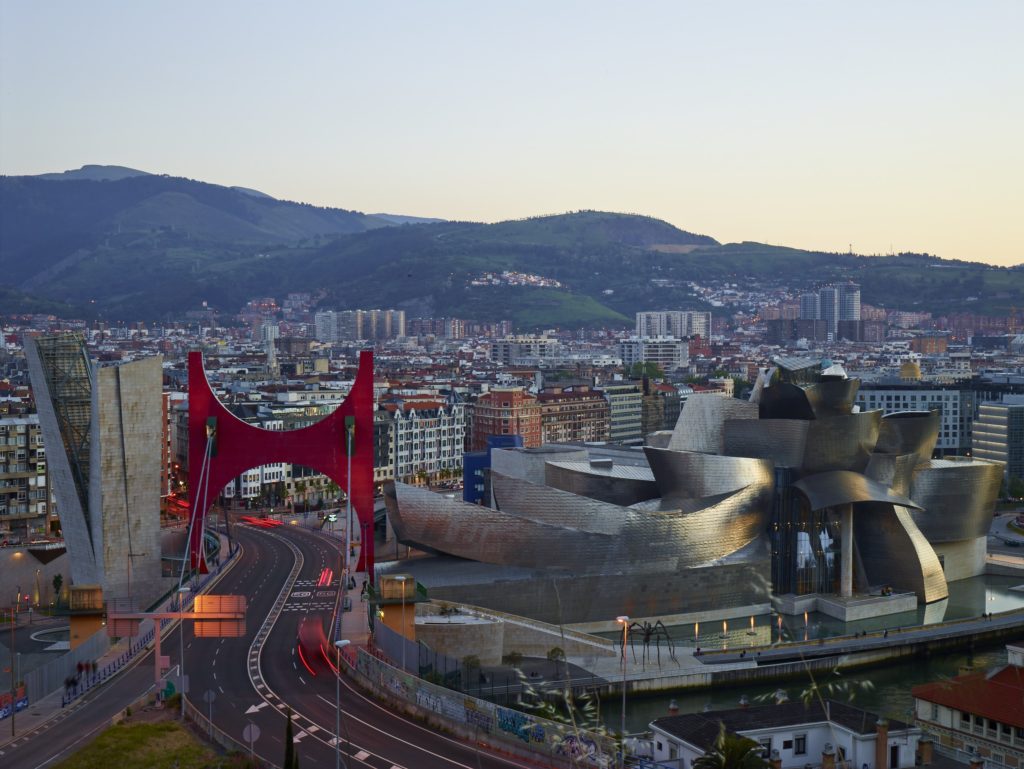
Aerial view of The Guggenheim Bilbao, designed by Frank Gehry. ©FMGB, Guggenheim Museum Bilbao, 2017.
Gehry’s home town, Los Angeles, couldn’t have been further removed from the Bilbao narrative. The city had been rocked by the 1992 Uprising, racially exposed for its spatial and social injustices that were as prevalent as the 1200 fires that burned over five days in May. The fires didn’t reach UCLA in its westside Brentwood preserve, where Police Chief Daryl Gates retreated during the conflagration to fundraise against police reform. That UCLA’s neighborhood was the site of such egregious contradiction has long been part of the campus’s struggle. UCLA may have been located at an intentional remove from the heart of L.A., but a world-class public university in a global megacity is an overpowering recipe for important work. The world’s attention to the architecture and urbanism of Los Angeles, justifiable by my account, sears more brightly upon UCLA than our sister institutions by the very fact that we are the people’s university, with the people’s design program.
Over my 26 years at UCLA, the Department of Architecture and Urban Design has strengthened its deep roster of noted practitioners, as well as its history-theory faculty who critically engage the discipline, which makes it all the more difficult to imagine how a program so clearly at the cutting edge, can remain insulated—autonomous, in disciplinary parlance—from the world beyond campus. We collectively built UCLA’s international academic standing, yet our wider impacts have been the work of individuals. Why hasn’t our collective intellectual and creative genius produced a greater impact on Los Angeles and the public interest? If our public role in this global city is a foreordination, how do we leverage design to make Los Angeles a more equitable, more sustainable, more beautiful place? If it can be done in L.A., a place outsiders use as a worst-case scenario, it might stand as an urban design demonstration for other cities (and other architecture programs). As our current dean, Brett Steele, put it during his early weeks, as if asking for directions: In the Department of Architecture and Urban Design, where is the urban design happening at UCLA?
On this 100-year birthday of the university (though architecture at UCLA was born just a half century ago, in 1964), I’d like to issue a challenge for a new miracle. The two most pressing problems of our era have deep roots in architecture: global warming and the housing crisis. Two data points represent the tip of an iceberg that is by now well-known: buildings account for more than a third of all global greenhouse gasses; California alone needs to build 3.5 million homes to solve the current housing shortage. Each crisis manifests historic, systemic, structural inequities of race, poverty, and gender; each is a knotted, multifaceted problem, which invokes the highest calling of the university; and if that thinking is to be guided toward action, each will require genuine partnerships with communities, public agencies, and experts from many fields.
At just this point in the discussion, architects will throw up their hands claiming that such problems extend far beyond their discipline or training. But who is it, after all, that is specifically charged with delineating new futures? How can we, the public, work toward the world we want to live in without being able to envision it? Read the applications of prospective architecture students and you’ll find they are filled with deeply held convictions about a sustainable future, affordable housing, the dignity of all communities, and technologies harnessed for social good. These novices in architecture are asking to be trained to work on the problems of our times, so that they can develop their agency as engaged, creative, collaborative practitioners for whom spatial justice is their guide.
Just as a growing number of architectural firms, non-profits, and university programs began to grapple with these issues, in 2006 Roger Sherman and I founded our department’s research and design center, cityLAB. It is just one demonstration, but for obvious reasons, it’s the one I know best. A proudly scrappy, effective, and action-oriented entity, cityLAB is currently producing affordable housing demonstrations that range from full-scale prototypes to State land use policy. California legislation that cityLAB co-authored in 2016 effectively ends single-family zoning statewide, and it was only possible after years of student and faculty design experimentation in partnership with public agencies, lenders, and community leaders. Departmental and School of the Arts and Architecture support for cityLAB has helped change not just the face of Los Angeles but the entire State to create 8.1 million new, “free” housing sites, which offer 8.1 million potentially affordable homes, and 8.1 million small projects for young designers. Not every architect needs to take a cityLAB-stance toward the discipline, but it is not surprising that a diverse cadre of students flock to its mission, and a wide range of faculty have found it a platform for alternative practices. If we next spawned a “greenLAB,” UCLA Architecture and Urban Design would cement its place in history.
1919 marked the birth not only of UCLA, but of the Bauhaus in Weimar, Germany, the most significant school of modernist art and architecture. Though Modernism’s failures remain a cautionary tale, the Bauhaus demonstrated that the arts were fundamentally political, and that its ideals could survive in the face of heinous intolerance. Today, we face challenges that require even bolder thinking and action if we are to reimagine our shared future. Where better to begin assembling our collective urban future than in the Department of Architecture and Urban Design located within the great public university that is UCLA, in Los Angeles, a megacity of the Pacific Rim? The DNA of urban transformation lies in the buildings and public spaces we’re training the next generation of architects to design, so that together, they can perform the next generation of miracles.
Accessory Dwelling Unit (ADU) Guidebook
Stay engaged. Use #UCLAarts to stay connected.


