Nam June Paik at the Whitney: A Work of Dizzying Complexity
The artist incorporates the work Design Media Arts Professor Rebecca Allen as his primary source mat
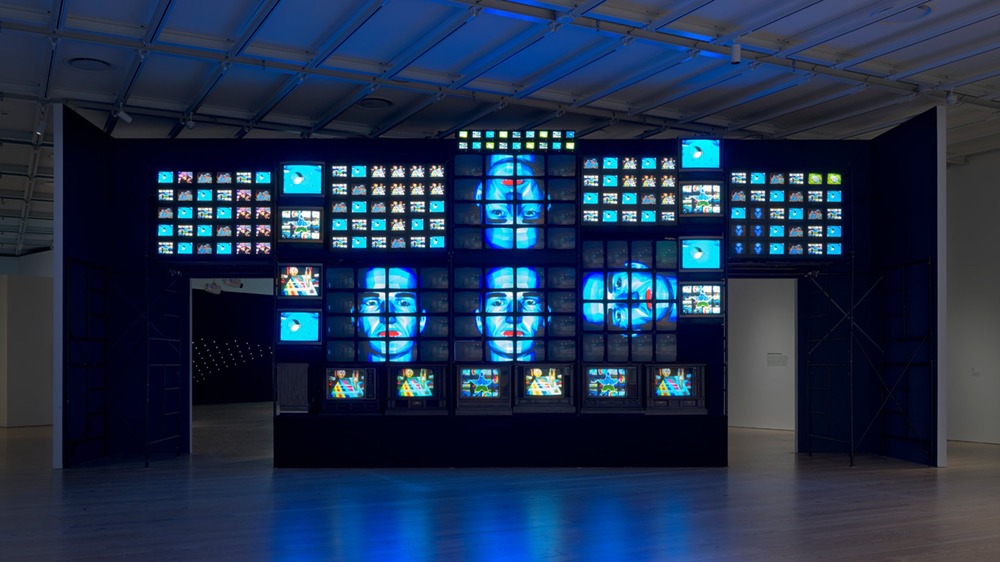
Naim Jun Paik's monumental video wall, featuring a flood of imagery and music from David Bowie, Kraftwerk and others, is on view in “Programmed: Rules, Codes and Choreographies in Art, 1965-2018.” Paik’s most extensively used source was Kraftwerk’s 1986 music video for “Musique Non Stop,” a pioneering early example of computer-generated animation by Design Media Arts Professor Rebecca Allen.
"Many of the works in “Programmed: Rules, Codes and Choreographies in Art, 1965-2018,” an exhibition at the Whitney Museum, require an electrical outlet. The presentation — drawn mostly from the museum’s collection — involves much in the way of video projections, lights, television sets, voice-overs, soundtracks, computers, computer programs and, in the most recent efforts, touch screens.
Yet regardless of whether power sources are needed, all the artworks use algorithms. That is, they are executed according to plans, instructions, numerical systems, or, as the show’s subtitle indicates, rules, codes and choreographies. The analog examples tend to be foundational works of Minimal and Conceptual Art: Donald Judd’s 1965 aluminum relief based on the Fibonacci numerical sequence; a Sol LeWitt wall drawing from 1976 executed to written directions applicable to walls of any dimension; and Joseph Kosuth’s string of five words in green neon that reads “Five Words in Green Neon” (1965).
Then there is the show’s most plugged work in several senses: Nam June Paik’s 1989 “Fin de Siècle II,” a monumental video wall of dizzying complexity formed by 207 television monitors of varying sizes arranged in adjoining grids. They emit a disorienting, enrapturing flood of images and music taken from broadcast television and video art and programmed to repeat relentlessly, mutate wildly and change abruptly, although a driving, danceable beat is constant.
All kinds of culture, high and low, pass before our eyes and into our ears. David Bowie pirouettes in a white suit with Louise Lecavalier, a former soloist with the acrobatic Canadian dance troupe La La La Human Steps, while singing “Look Back in Anger.” Merce Cunningham, in a red leotard, dances a solo and is shadowed by his own outline, in black. An image of a nude woman is put through numerous paces, multiplied different ways, in different colors, sometimes looking like an early Warhol painting, and is accompanied by an ecstatic blast of Philip Glass’s music.

We see the head of Joseph Beuys performing in his signature hat, growling into a mike. His face appears on the central grid of monitors and then goes big, one massive image spread across them all. Especially complex are the machinations of a series of robot-like animated heads, both wireframe and solid blue with red lips. They start small, expand and then zoom in for grids of eyes or mouths. Metallic-looking piano keyboards, musical notes and a vast recording-studio control console twist and churn.
These animations are all from Paik’s most extensively used visual and aural source: Kraftwerk’s 1986 music video for “Musique Non Stop,” a pioneering early example of computer-generated animation by Rebecca Allen. (Her name appears in part of the piece, as does that of Paul Garrin, who, as Paik’s assistant, was responsible for the variations on the female nude.) “Musique Non Stop” also supplies the main soundtrack; its mechanized sound and distorted voices, like its animation, are of a piece with Kraftwerk’s robot aesthetic." —Roberta Smith, Apr. 4, 2019

This post is an excerpt. Read the full article on the New York Times website.
Stay engaged. Use #UCLAarts to stay connected.


