My Lai massacre, 50 years later: Jonathan Berger's opera captures the madness
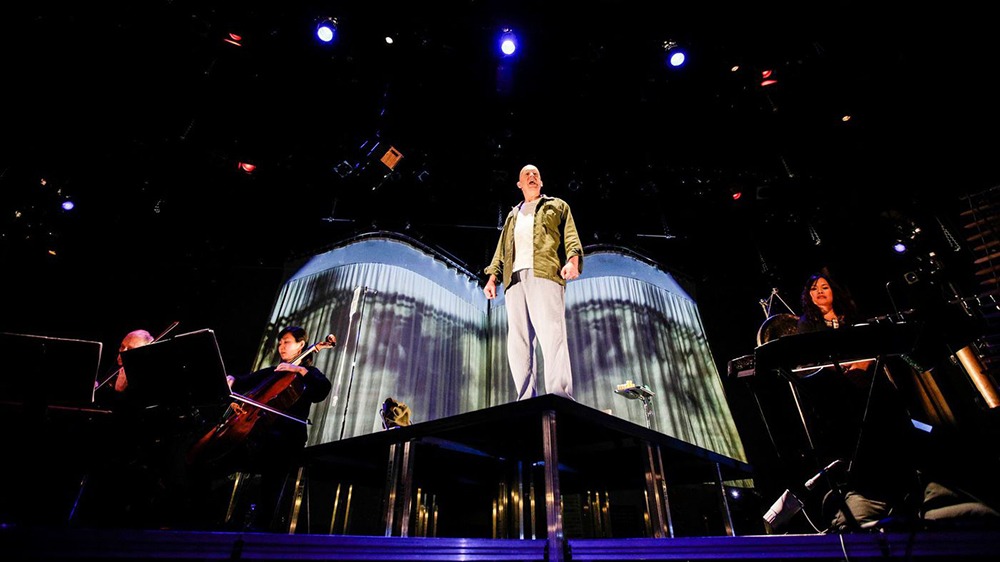
For more than 40 years, the Kronos Quartet has pursued a singular artistic vision, combining a spirit of fearless exploration with a commitment to continually reimagining the string quartet experience. Kronos revisits the inspiration for the founding of the group with My Lai. The infamous 1968 massacre of unarmed Vietnamese villagers by American soldiers provides the context for this gripping new work written by composer Jonathan Berger and librettist Harriet Scott Chessman for the Kronos Quartet, tenor Rinde Eckert and Vietnamese multi-instrumentalist Vân-Ánh Võ. My Lai, which features traditional Vietnamese instruments and digitally processed sounds, is told from the perspective of the heroic helicopter pilot Hugh C. Thompson, Jr. who tried to stop the slaughter and was vilified for reporting it.
"Where in God's name is the medic?" the dying hospital patient demands. He's not asking for help for himself. He's frantically trying to save a boy's life. It's a scream, one of the important screams in American history, that has haunted him for 38 years.
Jonathan Berger's opera "My Lai" — written for the Kronos Quartet, tenor Rinde Eckert and Vân-Ánh Võ, a virtuoso player of traditional Vietnamese instruments — takes place during the last hallucinatory days of Hugh Thompson Jr. He was the U.S. Army helicopter pilot in the Vietnam War who flew over the massacre in My Lai. Above the fray, he could see the mass hysteria below that warped the minds of Charlie Company. Those men were infamously commanded to wipe out everything walking, crawling or growing. More than 500 civilians, mostly women, children and the elderly, were slaughtered. There was no evidence of Viet Cong activity.
The Center for the Art of Performance at UCLA brought Berger's powerful 2-year-old opera to Royce Hall on Friday night, exactly one week before the 50th anniversary of the massacre. When Thompson's whistle-blowing was finally reported in 1969, the public perception of the Vietnam War began to change.
Rather than try to express the horror — "Bodies piled on bodies," Thompson recalls in Harriet Scott Chessman's penetrating libretto, "like fish caught … no, not fish, just people caught" — Berger places everything in Thompson's clouded mind as he tries to piece together the three helicopter landings he made trying to stop the killing. In the meanwhile, a quiz show blares away on the hospice television.
In his dying delusion, he thinks himself a contestant on the show, which itself becomes an arena of public opinion, a show trial. It took three decades for Thompson's heroism to be rewarded by President Clinton. The pilot had been threatened with court-martial, pilloried by Congress and by Richard Nixon for testifying against the Army coverup. Dead animals were left on his porch. He suffered from PTSD throughout his life.
It was a brilliant stroke to illustrate the My Lai massacre through the shameful victimization of Thomson. It was another brilliant stroke to write this opera for Eckert, who is incomparable in making the mind matter in modern opera and performance art, as he did in his own compelling "And God Created Whales," about a composer trying to write an opera based on "Moby-Dick" while losing his memory.
For Kronos, this too is essential territory. Violinist David Harrington formed Kronos for the express purpose of playing George Crumb's "Black Angels," the first (and still the greatest) classical Vietnam War protest score, a ritualistic "electric string quartet" for amplified instruments and added percussion that is a psychedelic meditation on death. My Lai was one of Crumb's inspirations when composing it.
Like Crumb, Berger writes music with underlying sacred and folk sources but also with the vividly evocative presence of music in time of war. In "My Lai," Death stalks but one man, but that man stands for all the innocents who died in the village, and they stand for the tens of thousands who died in the war.
The percussion instruments are Võ's Vietnamese folk instruments. Most notable is the dan bau, a single silk string along a bamboo tube. There is no more beautiful instrument for playing lullabies, as Võ does with a profound mixture of sweetness and sadness, innocence and alarm.
For his part, Berger seamlessly combines traditional Jewish and Vietnamese melodies that seem as eternal as they are universal. Although no mention is made of this, the gongs Võ strikes are made from U.S. Army mortar shells, and the bamboo spikes she hits are Viet Cong war remnants. These onetime weapons stun with their physical as well as sonic beauty."— Mark Swed, Mar. 11, 2018

This post is an excerpt, read the full article at the Los Angeles Times website.
Read more about Kronos Quartet here.
Stay engaged. Use #UCLAarts to stay connected.


