‘Mute Icons' by Marcelo Spina and Georgina Huljich is beyond a futurist monograph
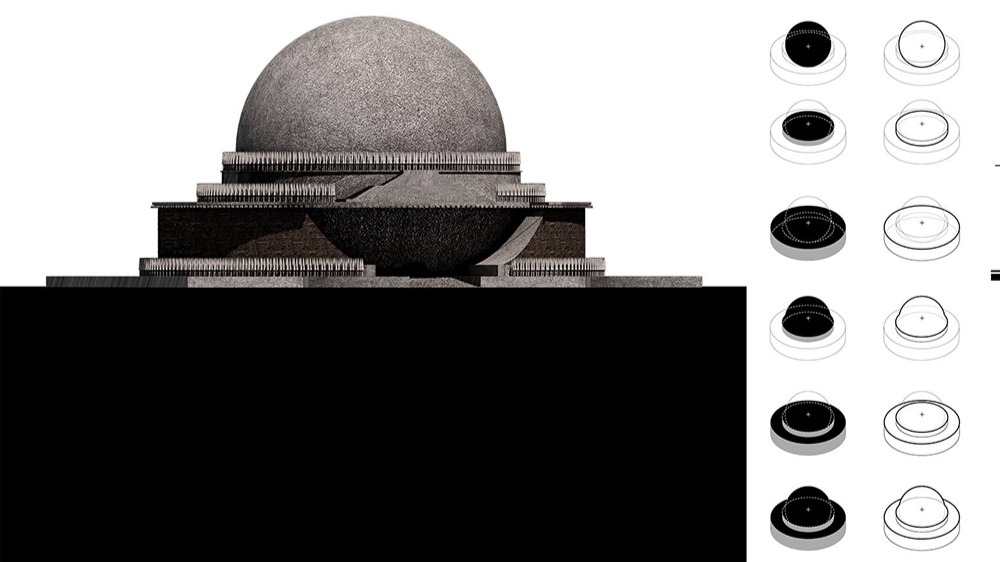
Marcelo Spina and Georgina Huljich's new book, "Mute Icons-and Other Dichotomies on the Real in Architecture," brings alive the meanings of architectural form in new and unexpected ways. Huljich is an associate professor in the UCLA Department of Architecture and Urban Design.
Museum of Ethnography (Plan Oblique) in Budapest, Hungary. Image: Courtesy of PATTERNS, Marcelo Spina and Georgina Huljich "The icon is not going away. The iconic (image, form, architecture) is here to stay, in its obvious and vividly comprehensible form. The architectural image has been one of legibility, awe, representation, always fulfilling a very specific expectation of (self-established) iconicity. These image tropes—rife in our culture—have a keen existence today, given their extensive proliferation through social media. In a world under incessant turmoil—social, political, environmental—the value, truth and perception of images become critical in their collective understanding, and hence the shaping and disruptions in culture. Arguing for a redefinition of the project of the icon and therefore the image in architecture, Mute Icons by Marcelo Spina and Georgina Huljich from P-A-T-T-E-R-N-S (a design and architectural practice based in Los Angeles), published by Actar Publishers, aims to construct a viable alternative to the icon’s simple cliché and exhausted form of communication, positing one that is decidedly introverted and withdrawn.
Mute Icons, an oxymoronic title, is positioned to neither clearly communicate, nor be silent. The work argues for a radical redefinition of the icon, and therefore of the image in contemporary architecture, as a ‘cultural and social irritant’ that facilitates a critical postulation of varied readings of its image. The book is contending with the ‘icon’ in multiple ways; as a dreaded term from art history’s iconography, tools of religious propaganda, as a provocation in the architectural generalised expectation of a project to ‘appear iconic’, as a cliché, a one-liner, an expectation of exuberance, a fiercely autonomous representation of a collective, and other ideas entrenched in social and cultural naivete. To dismantle and reorganise the ‘iconic’ through this book, the writers urge us to reject and shed all preconceived notions associated with it, and begin to look at the icon in conjunction with muteness, where the two in their dichotomies do not cancel each other out, but produce a sense of perpetual irritation.
Mute Icons is organised in five large sections - concept, history, discipline, projects and culture. The introductory section, Concept, advocates for the mute icon taking from the icon’s many trajectories—postmodernist theorists, icons as vehicles of wielding geopolitical power, unnecessary excesses in architecture, political declarations of ‘no more weird buildings’, literary theory and monolithism as muteness." — Aastha D., Jun. 20, 2021


This post is an excerpt. Read the full article on the Stir World website.
Read more about Georgina Huljich.
Stay engaged. Use #UCLAarts to stay connected.


