Museums are closed, but you’ll find respite in UCLA’s remarkable sculpture garden
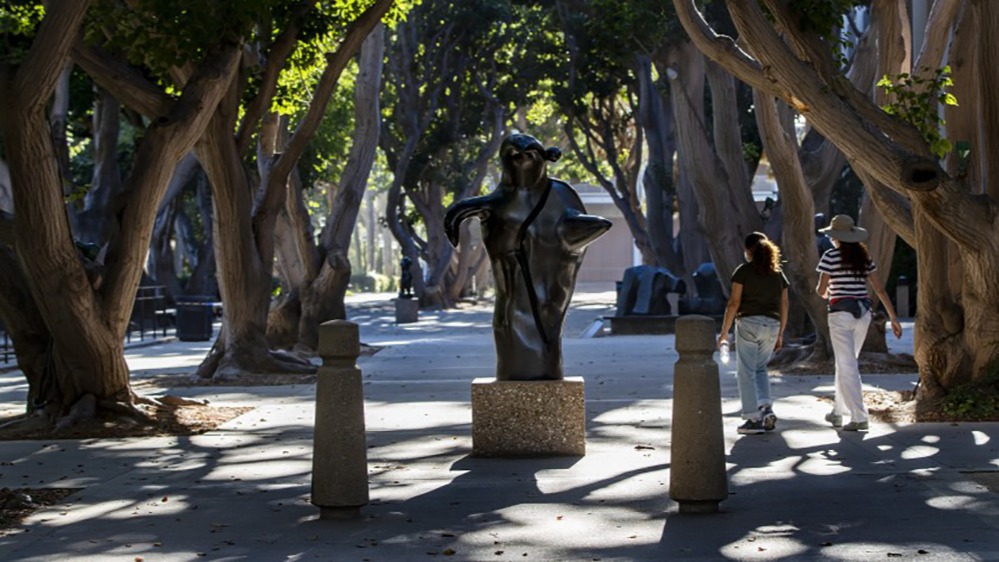
One of the most distinguished outdoor sculpture installations in the country, the Franklin D. Murphy Sculpture Garden spans more than five acres of UCLA’s campus with over 70 sculptures by artists such as Hans Arp, Deborah Butterfield, Alexander Calder, Barbara Hepworth, Jacques Lipchitz, Henry Moore, Auguste Rodin, and David Smith.
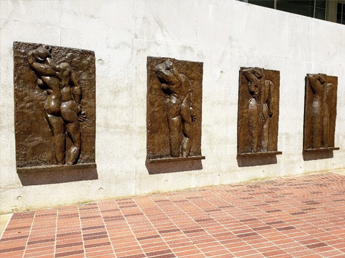
"The four monumental bas-reliefs of a woman’s back that Henri Matisse finished between 1909 and 1930 are among the most enigmatic sculptures of the 20th century. They show him refining the figure’s forms — head, limbs, torso, spine — one after the other over the course of two decades.
But they’re a painter’s sculptures. Matisse’s formal progress in his paintings was one inspiration for them, which I stopped by to see the other day at UCLA’s Franklin D. Murphy Sculpture Garden. They’re the pinnacle of that remarkable public collection of some 70 Modern works, which rambles over five acres of the school’s North Campus.
Effectively two-dimensional, the shallowness of the reliefs is primarily a means to control the play of light across the surface of modeled clay, which was then cast in plaster and finally bronze. The tactile modeling-marks Matisse left on the figures with his fingers and tools are like brushwork. Light approaches what a painting’s adroitly handled color could achieve.
African sculpture, which Matisse regularly saw in the window of a Paris gallery on frequent walks through the Rue de Rennes, was another stimulus for the backs. A third was classical Chinese art, which he encountered in the large collection of San Francisco ex-pats Sarah and Michael Stein, his friends and patrons.
And what of the chosen subject — a woman’s back? Paintings by Cezanne, Courbet, Gauguin and other artists surely had an influence. Plus something more."— Christopher Knight, Aug. 12, 2020


This post is an excerpt. Read the full article on the Los Angeles Times website.
Read more about UCLA Franklin D. Murphy Sculpture Garden.
Stay engaged. Use #UCLAarts to stay connected.


