Mr. Wash: No making up for lost time
The LA-based artist will address the UCLA School of the Arts and Architecture Class of 2021
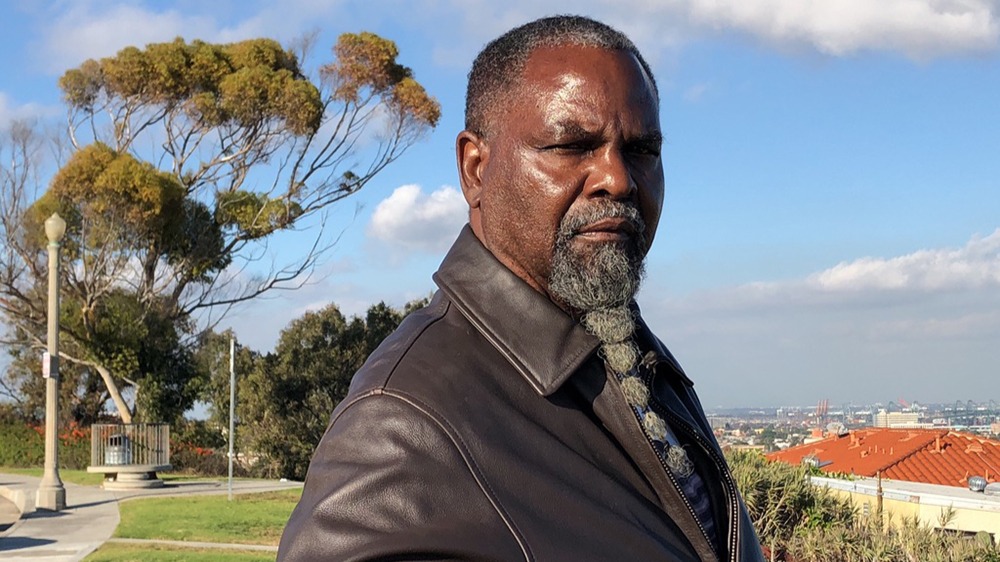
In the late ‘90s, Fulton Leroy Washington, also known as Mr. Wash, was convicted of a nonviolent drug offense and sentenced to life in prison. He has always maintained his innocence. He served 21 years, until President Obama commuted his sentence in 2016.
Washington learned how to paint in prison. Several of his teardrop paintings – which show photorealistic portraits of people with big tears rolling down their faces and miniature scenes inside the teardrops – are part of the Made in L.A. 2020 biennial, now on view at the Hammer Museum and at The Huntington Library, Art Museum, and Botanical Gardens.
Washington will deliver the commencement keynote address to the UCLA School of the Arts and Architecture graduating class of 2021 on Saturday, June 12. The self-taught artist and social justice advocate will share anecdotes from his journey and lessons learned along the way.
Washington currently lives in a Compton apartment filled with boxes of documents connected to his legal case, jars holding paintbrushes, and artworks from his time in prison.
The paintings are “precious family heirlooms... that tell the story of the journey of the last two decades for me," he said. “The artwork actually keeps me grounded. It keeps me in remembrance of what has happened and what can happen.”
Washington’s early years
Washington was born in Tallulah, Louisiana. By his account, his mother packed up the family in 1955 and moved to California, where they lived in the Nickerson Gardens projects in Watts for a decade. After the 1965 Watts riots, his mother remarried and moved them to the suburbs of Gardena. As a teenager, he bought a house in Carson, lost it, and then bought another house in Compton, where he spent most of his young adult life.
Washington remembers taking an early liking to art. He painted with watercolors and made mosaics with beans and rice. He recalls looking at paintings in history class and wondering how the artists captured so much energy and emotion. He began building his own toys and learned how to make cars and airplanes out of wood. That eventually led to an interest in bicycles, motorcycles, and hot rods.
“With that ability to see things from other people's perspective and from perspectives that they don't see, I think that helped really develop my art.” - Mr. Wash
By high school he’d already founded his own business, a handyman service, and made money as a mechanic. He built motorcycles; a skill he says was helped by learning drafting in high school.
“So, when people would come and tell me things that they want, I could draw sketches of it and then work those sketches and I could see the different perspectives," he said. “With that ability to see things from other people's perspective and from perspectives that they don't see, I think that helped really develop my art.”
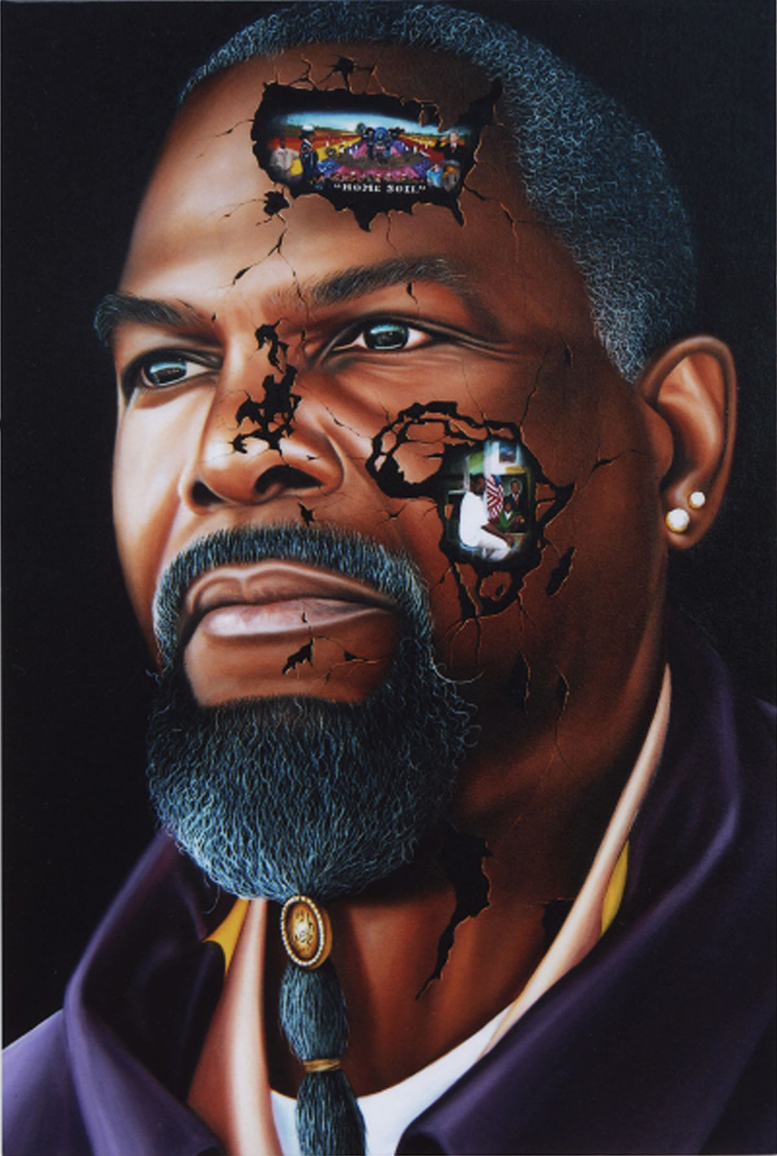
Fulton Leroy Washington (aka Mr. Wash), "Deteriorating." Courtesy of the artist.
Arrest and imprisonment
At the time of his 1996 arrest, Washington was overseeing the construction of an equestrian center in Compton that was being developed to teach Black and Hispanic kids how to ride horses and rope bulls.
He was also doing cleanup jobs in the San Fernando Valley following the Northridge earthquake. One day when all his trucks were being used for the Northridge cleanup, he went to pick up a truck to use at the equestrian center. While going to pick up this truck with a friend, the two were arrested for allegedly trafficking chemicals used to manufacture phencyclidine, or PCP, also known as angel dust. He was charged with conspiracy to manufacture PCP, possession of the materials used to manufacture PCP, and attempted manufacture of PCP. Because he had prior nonviolent drug convictions, and this was during the era of mandatory minimum sentences, he was given two life sentences.
“You could be doing everything right in your life, you get derailed and it's hard to bring it back,” he said. “Once you have a prior of anything, then that's going to always be compounded and used against you.”
Washington has eight children with seven mothers, and a large extended family.
“I realized that when it don't work, it don't make sense to linger. You know, you have to just keep moving forward, but you also support whatever you leave behind. You know, you create it, it's your responsibility,” he said.
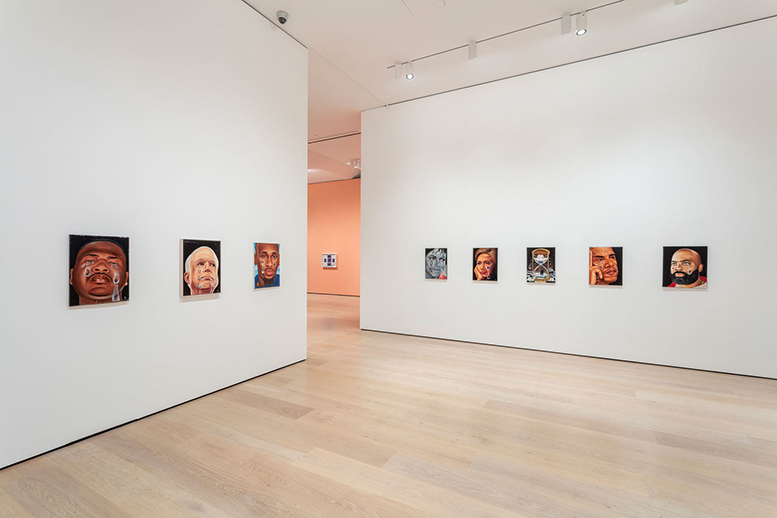
Fulton Leroy Washington (aka Mr. Wash), (left to right) "Adrian Tears," 2008; "Political Tears McCain," 2008; "Eric Tears," 2011; "Michael Jackson Tears," 2010; "Political Tears Hillary," 2008; "The Sands of Time," 2011; "Political Tears Obama," 2008; "Mr. Rene # MAN POWER," 2011. Installation view, "Made in L.A. 2020: a version," Hammer Museum, Los Angeles. Photo: Joshua White / JWPictures.com.
He first served time at prison in Leavenworth, Kansas, and Florence, Colorado, and didn’t get many visitors, mostly letters and phone calls. When he was transferred to Lompoc, in Santa Barbara County, "it almost seemed like it was so many visits that I couldn't get no work done, because I'm always in the visiting room,” he laughed. “But I loved every moment of it. And I had more visits than the average inmate, both from people in the public and from my family.”
During those long years in prison, Washington turned to his faith to keep hope alive, but also persevered in trying to clear his name. That long struggle to prove his innocence has made him passionate about criminal justice reform.
"I believe that faith without works is dead. So, while I maintained my faith all the way through the prison experience, I also provided work. I worked toward and was diligent to support the legal team that was trying to help me, and at the same time, share my time with the community in which I live, to try to help the other people who didn't have hope, to give them hope that it can be all right.”
Getting serious about art
In prison, Washington began drawing small doodles and characters, mostly animals or portraits of other inmates, on cards and envelopes. His sentencing attorney, Karen Smith, a longtime faculty member of Southwestern Law School who passed away in 2013, suggested that he try sketching the people he encountered the day he was arrested, as a way to collect more evidence and avoid sentencing following his conviction.
Washington sketched one of the plumbers he had worked with that day, and Smith passed copies of it around the construction site. A local child recognized the figure and brought Smith to him. That meeting led to more witnesses testifying in support of Washington’s plea of innocence. Nevertheless, the judge sentenced him.
Even though the drawing wasn’t able to clear his name, Washington vowed to continue making art. He taught drawing and drafting to fellow inmates, then got a spot in a painting class.
He first painted his fellow inmates. In these paintings, the inmates are dressed in civilian clothing and are free. Large teardrops run down their faces, and inside the teardrops he painted miniature scenes or characters from the person’s past. The series grew to include figures from politics and pop culture, from John McCain and Hillary Clinton to Michael Jackson and Kobe Bryant.
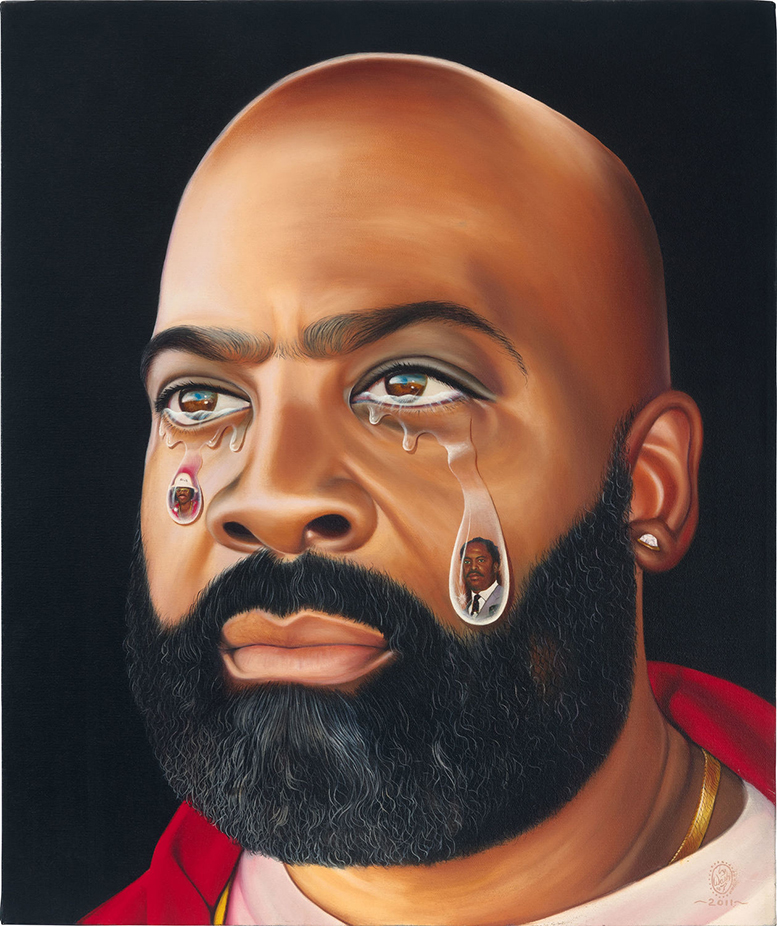
Fulton Leroy Washington (aka Mr. Wash), "Mr. Rene # MAN POWER," 2011. Courtesy of the artist.
As Washington’s painting skills improved, inmates clamored for him to paint their portraits. The wait for a portrait eventually became a year or longer. Inmates wanted to send portraits home to their families, so they wouldn’t be forgotten. Many were afraid of getting in trouble and being sent to solitary confinement because they did not want to lose their place in line.
While in prison Washington made countless paintings on commission. Many were lost, destroyed, or mailed to their owners and, to this date, have not been retrieved.
One such painting, “Mondaine’s Market,” depicts fellow inmate John Mondaine and one of the many businesses he owned before his conviction. The painting was thought to be lost, and so Mr. Wash made a copy of it in preparation for Made in L.A. 2020. Washington eventually reconnected with Mondaine and located the original as well. Both versions are included in the Made in L.A. show.
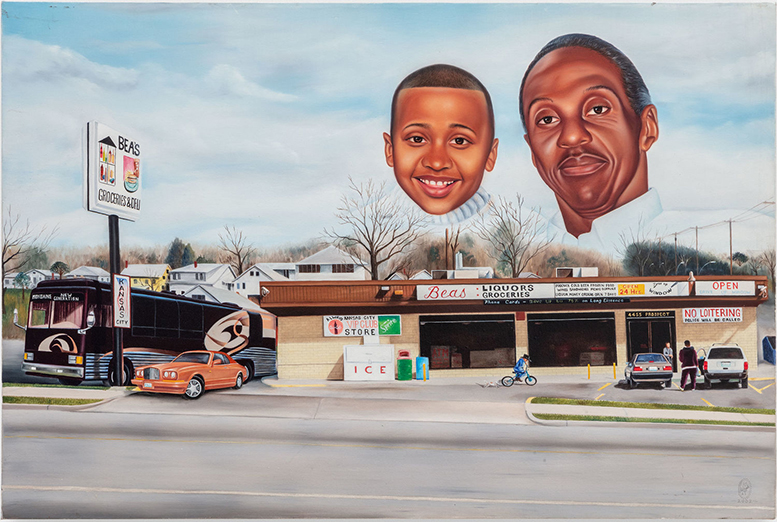
Fulton Leroy Washington (aka Mr. Wash), "Mondaine's Market," 2005. Collection of John and Juanita Mondaine.
In 2014, Washington completed a large painting that proved to be prophetic. “Emancipation Proclamation” shows Washington in his khaki prison scrubs, handcuffed and chained at the ankles, and seated at a table surrounded by federal officials. Seated at the head of the table is President Barack Obama, granting him clemency.
The painting was modeled on Francis Bicknell Carpenter’s 1864 painting “First Reading of the Emancipation Proclamation by President Lincoln.” Washington discovered that painting by accident. He was visiting the prison’s law library, and asked the clerk to hand him an encyclopedia. It opened to that picture, and Washington was inspired.
He began emailing Obama administration members asking for their official photos. Some agreed, some declined, and most didn’t respond. He completed "Emancipation Proclamation” with images he was sent, and others he found online. His attorney asked for a copy of the painting to take on a trip to Washington, D.C. Three weeks later, he received a phone call. Obama had commuted his sentence.
“It was unbelievable. I really didn't even accept it as being real. I was still ready to go teach my classes, I went back to work out,” he said. A couple of days later, the warden told him he had to leave.
“Emancipation Proclamation” was the last painting he made in prison.
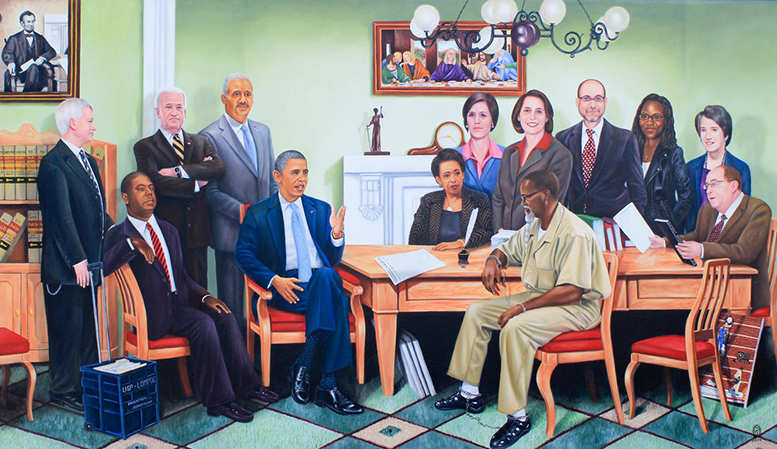
Fulton Leroy Washington (aka Mr. Wash), "Emancipation Proclamation," 2014. Courtesy of the artist.
Life after prison
Since his release in 2016, Washington has not stopped making work. Some of his recent work is on view at the Hammer and the Huntington, and also at Jeffrey Deitch in Los Angeles, as part of a group show called Shattered Glass.
One of the pieces in Shattered Glass, "Targeted - Insurrection," 2021, shows a young Black boy looking at the viewer, stadning against a wall, and in the wall are the silhouettes of the shapes of the state of Oklahoma and Washington DC. Inside the shape of Oklahoma is a scene from the 1921 Tulsa Race Massacre, and inside the shape of Washington DC is the Capitol insurrection. The Tulsa Race Massacre Centennial Commission is using the artwork as part of an awareness campaign.
“In reality, 20 years of experience in painting in prison is equivalent to 20 years of painting in any other institution. The prison is an institution, no different than a college or a university or whatever." - Mr. Wash
His work is now shown alongside contemporary artists who, for the most part, followed the traditional art school route. But Washington doesn’t see a big difference.
“In reality, 20 years of experience in painting in prison is equivalent to 20 years of painting in any other institution. The prison is an institution, no different than a college or a university or whatever. And the learning that you get by experience sometimes is greater than that rigid controlled learning that you get when a person teaches you how to be like them or how to be like the world,” he said.
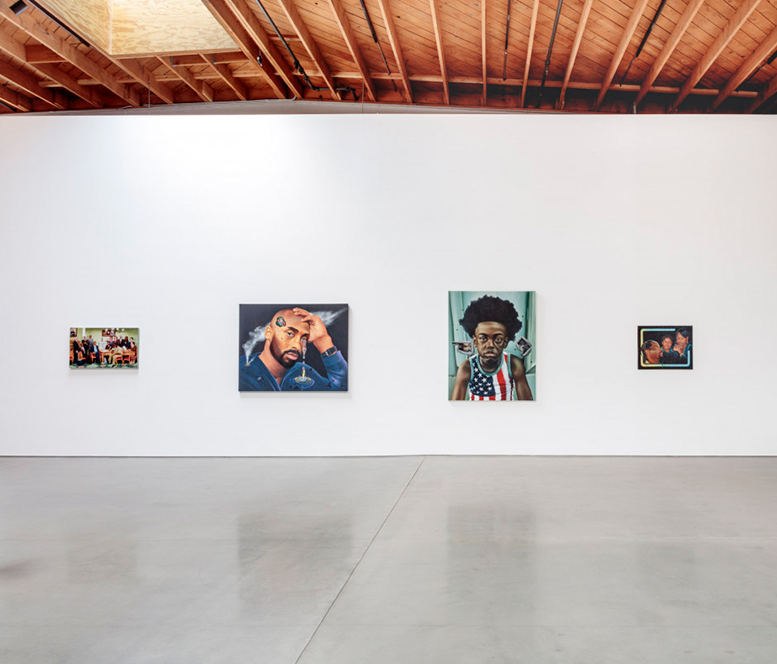
Fulton Leroy Washington (aka Mr. Wash), from left, "Emancipation Proclamation," 2014; "Shattered Dreams," 2020; "Targeted - Insurrection," 2021; "NEONLOVE/First Born," 2005. Installed in the exhibition "Shattered Glass" at Jeffrey Deitch in Los Angeles. Installation photo by Joshua White.
Washington is now focused on several projects. His case is currently in the U.S. District Court for the Central District of California, where he’s presenting evidence to prove his innocence and clear his name.
His fashion line, Wash Wear, prints his artwork on t-shirts, sweatshirts, dresses and hoodies, and is now branching out to sheets, pillowcases, and even rugs.
He’s also establishing a nonprofit that helps artists who are incarcerated transition into life after prison. Wash Wear will help distribute their work and use some of the proceeds to support criminal justice reform.
He has many commissions to look forward to, including a mural inside the National Air and Space Museum in Washington, D.C. that celebrates women aviators.
But is Mr. Wash making up for lost time? He says there’s no such thing.
"There's no making up time. That's why it's so important not to waste the time,” he said. “I didn't do Rip Van Winkle. I didn't go in there and sleep for 20 years.”
He can’t travel back in time and raise his children, he said, but he can help to raise his grandchildren, to educate others, fight for criminal justice reform, and make new work.
“I'm not making up. I’m only constantly getting the best out of every 24 hours,” he said.
Story by Avishay Artsy
You can tune into Mr. Wash’s commencement address on Saturday, June 12 at 5 p.m. by visiting commencement.arts.ucla.edu, where it will be streaming live.
Mr. Wash, 2018, co-directed by writer Marisa Aveling and filmmaker Sean Mattison, supported by WeTransfer.
Stay engaged. Use #UCLAarts to stay connected.


