M.F.A. students’ choreography conveys empathy through math, vegetables
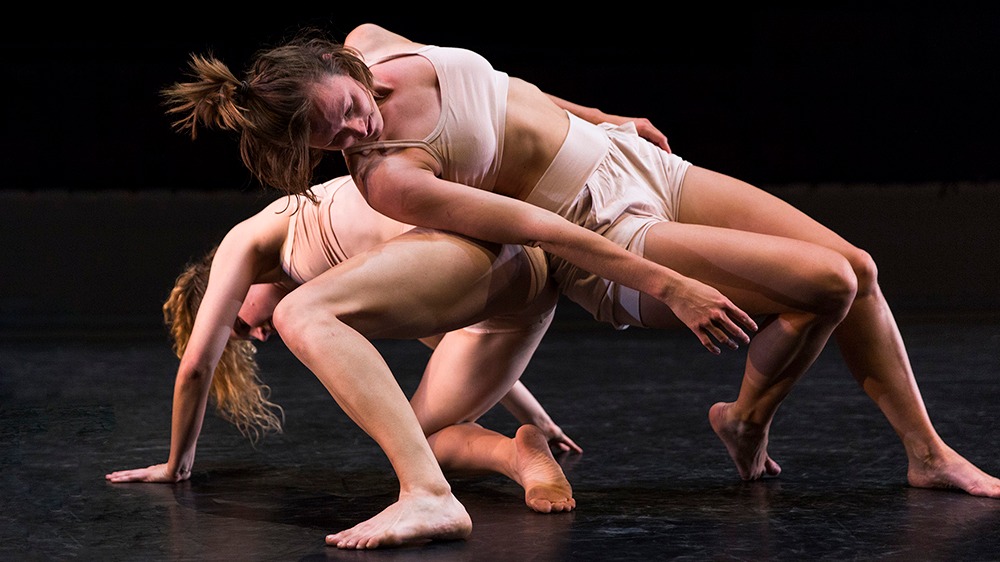
The MFA3 Upstarts Series is an annual presentation of new work by the current World Arts and Cultures/Dance MFA candidates. This performance of Sai / In Between will consist of four separate dance pieces choreographed by Chantal Cherry and Daeun Jung, two M.F.A. students. Each of the choreographers will showcase their two original pieces, which include solos and a quartet.. Sai / In Between will be performed April 27 & 28 in Kaufman Hall. For ticket information, please visit the UCLA Arts online calendar.
“Invitation”
Jung dances with a yellow pepper and a big pumpkin in her solo performance, “Invitation.”
Jung, who choreographed the piece, said the vegetable props act as a supporting cast. She hopes the interactions between her and the vegetables, like mourning the death of an eggplant and using lettuce to wipe away her tears, show the necessity of providing comfort for people in today’s society.
“I just made the individual relationships, having us share each other’s stories and listen to each other,” Jung said. “I think that the power is in empathically uniting with each other.”
Dan Froot, one of Jung’s academic advisors and a professor of world arts and cultures/dance, said Jung’s work on “Invitation” helped her develop a comedic side to her dance style. Jung stepped away from her traditional Korean dance training in exchange for a more narrative approach. At the end of the performance, actors will come onstage and start speaking to vegetables.
“For me, (Jung’s) vision is so quirky and eccentric that … it broadens my own thinking about what community can be … and how imaginatively we can envision that,” Froot said.
However, although the world she’s created through the dance routine is whimsical, Jung said she wanted the audience to garner a deeper understanding of the piece. Though the visual of her listening to a vegetable is quite comical, she said she hopes audiences garner a better understanding about the importance of empathetic relationships with other people.
“As an artist or as a human being, I’m not an outgoing social activist. So I was thinking, how can I play my role to make the world better?” Jung said.
“43152”
Jung rolled a die five times to randomly pick numbers for the rhythmic pattern of her duet, “43152.”
The random pattern serves as the center for Jung’s duet with professor Wilfried Souly. The two began choreographing the performance by practicing the pattern on drums to become more familiar with the beat of the dance, and Jung said their own bodies will replicate the rhythmic pattern of the drums during the actual performance.
Jung, who was trained in traditional Korean dance, and Souly, who was trained in traditional West African dance, worked to find a space where both cultures could come together, Jung said. During the dance, Jung and Souly will count in Korean and use a traditional West African rhythmic pattern to showcase the mixing of cultures.
“The dance shows the process of investigating, deconstructing, exchanging and interweaving of our different cultural sources,” Jung said.
However, Souly said the process of creating the performance wasn’t necessarily about incorporating their differences. Instead Jung and Souly tried to find the similarities between their two different dance styles and cultures. The piece involves the two playing a game of sorts, teasing each other through individual dance movements that lead into more shared dance moves.
“(The audience) should just see us as two human beings working on our differences, trying to break barriers and get together,” he said
“Head Above Water”
Cherry interwove mathematical formulas and postmodern dancing in the quartet “Head Above Water.”
The formula Cherry created for the dance, inspired by choreographer Anne Teresa De Keersmaeker’s piece “Fase,” uses numbers and letters to represent different dance moves that each performer has to memorize.
Cherry said she used the repetitive movement and its eventual breakdown in later solo segments to represent the overwhelming day-to-day routine of human life.
“If we don’t take breaks, and if we don’t take time to nurture ourselves, we will break down,” Cherry said. “If we just keep going and going and going, it’s not sustainable.”
The formula involves the repetition of movement and the structured fading in and fading out of specific movements at set times. At one point, the dancers stand in formation and move their hips back and forth before crossing and uncrossing their arms after multiple beats of repetition. Eventually they replace the movements with a new repeated movement and so on and so forth. Throughout the piece, Cherry said she also interferes with the evolution of the formula by adding external factors such as pauses, changes in direction and moments of individual expression.
Kelsey Manes, a fourth-year dance and communication student and a dancer in the piece, said Cherry’s use of a formula required more memorization and greater focus on the steps while performing. For the first three months of rehearsal, Manes said the dancers couldn’t do the piece without the formula written on the wall because it is so analytical.
“It is so hard to memorize. It’s a very cerebral process as opposed to just throwing out physical movement,” Manes said. “It’s very overwhelming at first. But it’s so exciting when you finally get it right – it’s just a different experience.”
“Our Bodies At Night”
Cherry and alumna Casey Brown will keep in continuous contact as they roll across the stage in the duet, “Our Bodies At Night.”
After coming to terms with her sexuality, Cherry wondered what a dance showcasing a nonplatonic relationship between two women would look like. As she began choreographing the dance, Cherry said she focused on creating visual intimacy between herself and her partner. The dance itself involves two women joining together and remaining intertwined throughout almost the entire piece, rolling as one unit and lifting each other multiple times.
“We were thinking about separation as a way to show desire rather than separation as a way of being apart,” Cherry said.
Through the dance, Cherry tries to break apart the idea of heteronormativity in relationships and the idea women only have platonic relationships with other women. However, though Cherry said she wants the audience to understand the intimate relationship between two women, she hopes they can also come away with a broader idea of intimacy.
“I hope that it can resonate just as a companionship, that our bodies don’t have to be gendered to appreciate,” Cherry said. “It could be two anyones."— Jerome Davis, April 25, 2018

This post is an excerpt, read the full article on the Daily Bruin website.
Sai / In Between will be performed April 27 & 28 in Kaufman Hall. For ticket information, please visit the UCLA Arts online calendar.
Stay engaged. Use #UCLAarts to stay connected.


