M.F.A. student presents exhibit with human interface, life-like technology
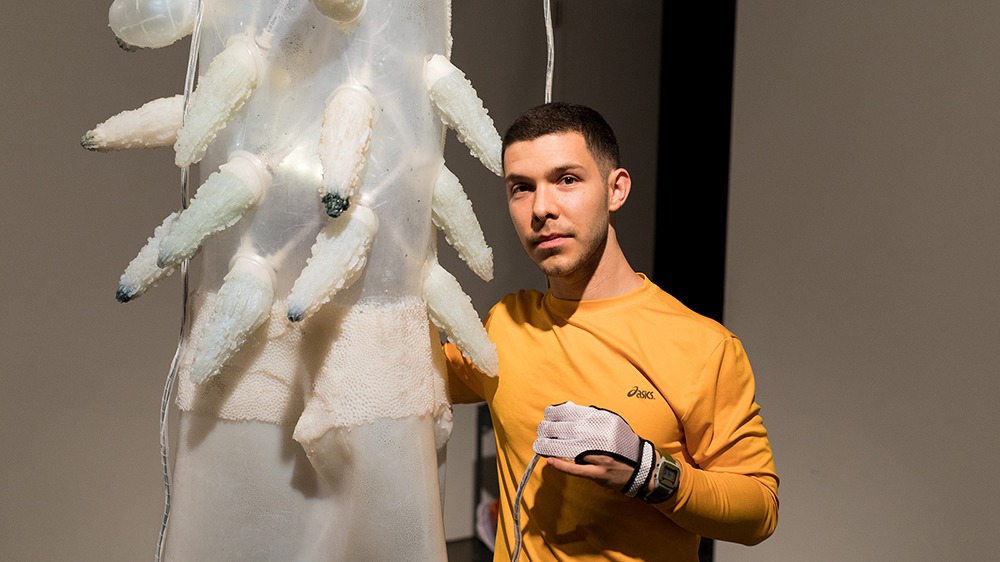
Paul Carlo Esposito is a graduate student in the Department of Design Media Arts. His work k explores the biological and ecological capabilities of new technologies. He uses video, sculpture, and interactive installation to investigate globalized networks of climate data, petroleum, nonhuman sexuality and other fluid things. His solo exhibition of work is on view in the Broad Art Center, February 27—March 1, 2018.
"A Life Alert commercial inspired the name of Paul Carlo Esposito’s latest exhibition.
Esposito said his exhibition alerts audience members of their connection to all living things. The design media arts graduate student will feature some of his most recent artworks, including sculptures and videos, in his “Life Alert” exhibition, which opened Tuesday and will run until Thursday in the Broad Art Center. Esposito aims to explore biological and ecological functions and their relationship to art and technology.
“I’m really interested in what we think of as alive,” Esposito said. “This idea of … the boundaries between what we consider human and nonhuman.”
“Life Alert” spans across two rooms: The front room features art videos, coral fossil concrete art, kinetic sculptures and a soft robotics fish tank, and the back room houses the exhibition’s centerpiece – a large silicone robot called “Symbiogen.”
The inspiration for “Symbiogen” came from the concept of symbiogenesis, the evolutionary theory of organisms benefiting from one another by feeding and living off each other. Esposito created the 4-foot-tall soft robot to resemble a pyrosome, a giant 60-foot-long bioluminescent jelly sea-creature colony made up of hundreds to thousands of free-floating organisms called zooids.
Esposito uses soft polymers like silicone to create robots, which appear often in his work. Silicone materials are suitable for creating life-like technology because they are comprised of polymer, oil and sand, he said. The combination of sand, the most abundant mineral on the planet, and oil, the most precious mineral on the planet, creates a texture that imitates human skin."— Polina Cherezova, Feb. 27, 2018

This post is an excerpt, read the full article at the Daily Bruin website.
Stay engaged. Use #UCLAarts to stay connected.


