MFA student exhibition merges STEM, art to explore consciousness through senses
The UCLA Design Media Arts fall preview show, Convolution, featured new works from the 2019 M.F.A. candidates. Participating artists included Hye Min Cho, Kit Kirby, Sara Drake, Isabelle Chen, Lena NW, Phazero, Maru Garcia, L05, Sam Congdon, Julian Stein, and Paul Carlo Esposito.
"Convolution explores consciousness through light, sound and the scent of a kombucha scoby.
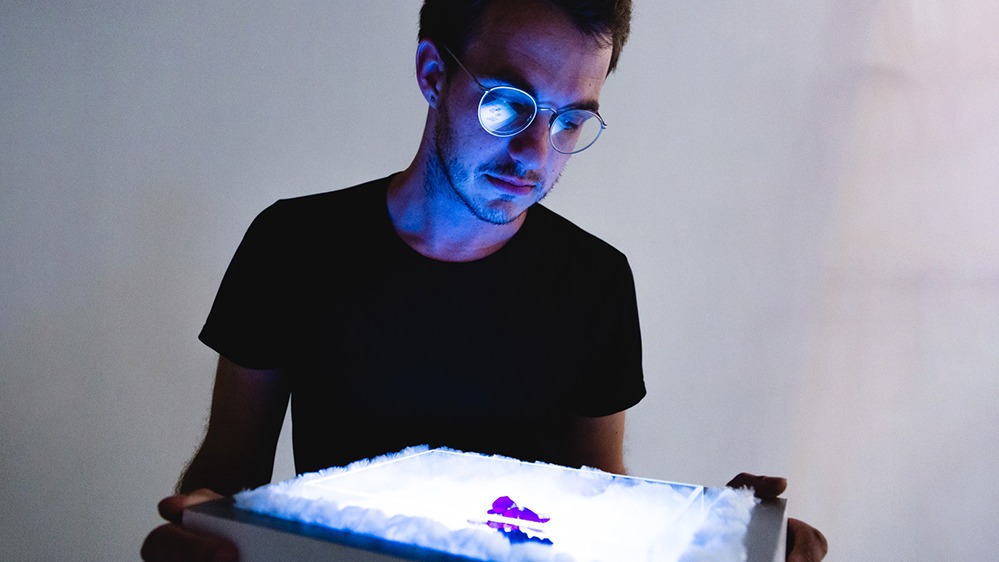
MFA student Samuel Congdon is one of the artists participating in Thursday's "Convolution" exhibition. The preview show aims to explore consciousness through senses like slight, smell and sound, integrating technology and performative art. Congdon's piece features glowing pedestals and a musical component, paying homage to past loves. (Amy Dixon/Photo editor) Hosted by UCLA Design Media Arts, the “Convolution” exhibition will feature the works of 11 2019 MFA candidates at the New Wight Gallery in UCLA’s Broad Art Center. The fall preview show, a precursor to the spring thesis show, bridges the gap between science, technology, engineering and math, and art by incorporating technical aspects into the artists’ broader messages about consciousness, said artist and MFA student Samuel Congdon. Taking place Thursday, “Convolution” will display immersive virtual reality pieces, as well as more traditional projections, onto screens or television sets. The artists explored concepts of consciousness through the senses with performative art and scent-based installations.
“I’m a performer who’s also interested in sculpture and installation and I’m trying to figure out how to merge those worlds and have a greater sense of precision in my sculptural work,” Congdon said. “I really tried to create an installation that could stand on its own and be a unique place to perform within.”
Computers are the basis of each art piece in “Convolution,” though the method by which they are incorporated varies from artist to artist, said Congdon. Although many of the artists will display just one piece, most of the installations have multiple working components. Congdon’s piece, titled “Lover’s Garden,” is a collaboration with his drag performance alter ego, Tulva, and consists of four intricately carved pedestals, an homage to past loves. Inlaid with resin and topped with acrylic to create a glowing effect, the pedestals also hold an impromptu music setup to engage the sense of hearing with jumbles of cables, a synthesizer and two microphones, re-enacting past loves.
“It’s a bit like how people play Beethoven for plants in that the performative aspect is meant to be nurturing or an upkeeping of these memories of past relationships,” Congdon said.
Other works combine technology with philosophy, posing questions about the fate of humankind as a whole, said artist and MFA student Paul Carlo Esposito. Incorporating ideas reminiscent of classic science fiction, Esposito’s piece plays upon the senses of sight and sound, featuring three nonhumanoid soft robotic organisms living on rocks in the far future. The organisms discuss human fossils and extinction with the same curious tone we use to discuss dinosaurs.
The organisms, depicted in a jellyfishlike form, also plays with ideas of aesthetics and the relations between artificial life and empathy. The animal-like sounds they make, as well as their unusual appearances, can further frustrate the feeling of empathy for a nonliving being that appears alive, Esposito said."— Kaia Sherry, Oct. 17, 2018


This post is an excerpt. Read the full article on the Daily Bruin website.
Stay engaged. Use #UCLAarts to stay connected.


