Meleko Mokgosi - Why I Paint
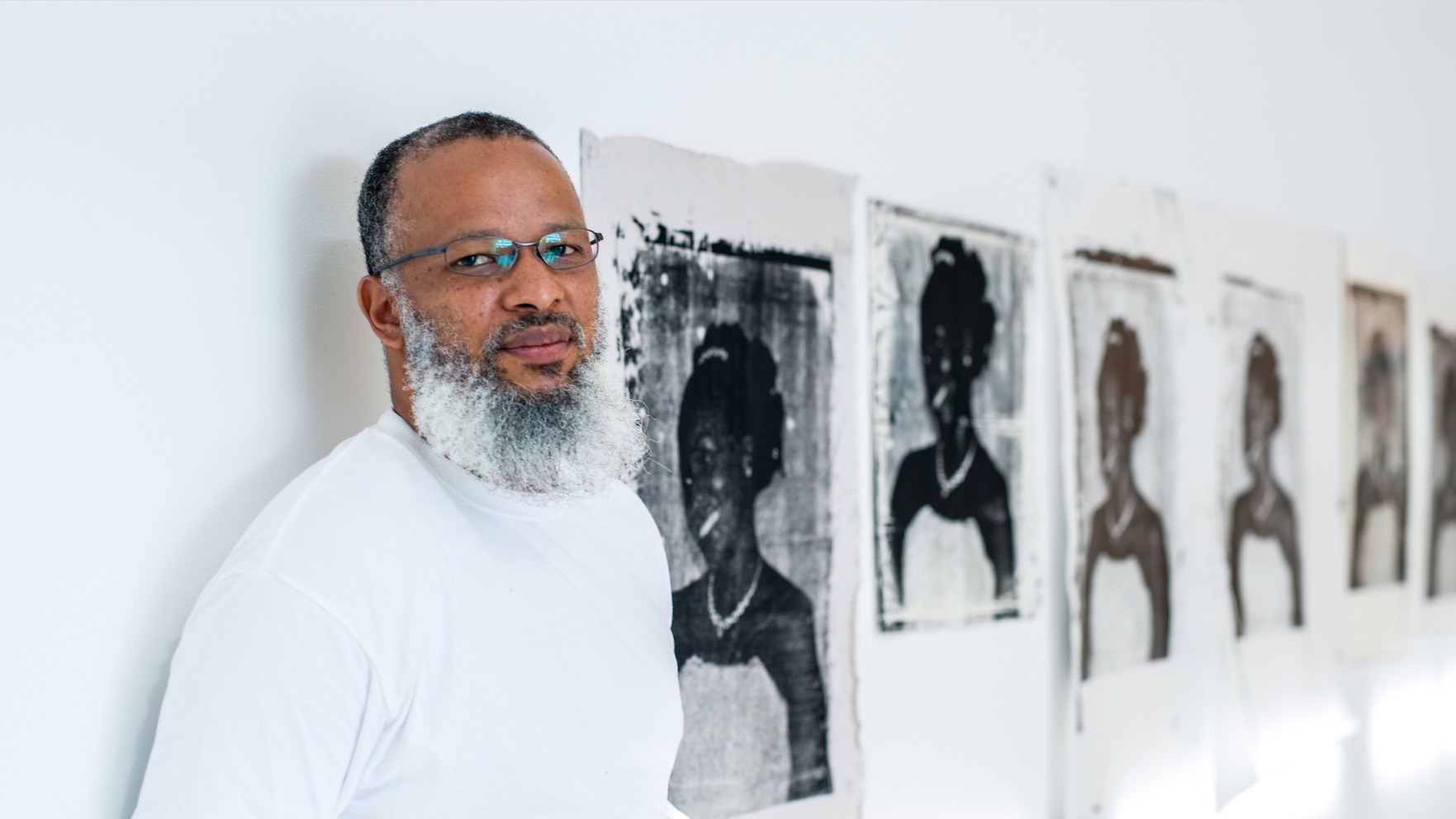
Alumnus Meleko Mokgosi (born in Francistown, Botswana), M.F.A. '11, is an artist who works within an interdisciplinary framework to create large-scale project-based installations. Mokgosi works across history painting, cinematic tropes, psychoanalysis, and post-colonial theory. His studio program interrogates narrative tropes and the fundamental models for the inscription and transmission of history along side established European notions of representation in order to address questions of nationhood, anti-colonial sentiments, and the perception of historicized events. His series, Democratic Intuition (2014-Present) aims to ask questions about how one can approach ideas of the democratic in relation to the daily-lived experiences of the subjects that occupy southern Africa.
"Meleko Mokgosi has stated that, ‘You have to know the history to painting, but you also have to know how to negate that history.’ For the Botswana-born artist, locating the limits of the medium is a generative process. Mokgosi’s paintings are large, and when hung side by side (as they often are) they become, as some critics have noted, cinematic. Indeed his subjects appear like film extras waiting for instruction, adrift in negative space, seemingly without context. By using the language of cinema (such as storyboarding and framing) together with his unusual form of social realism, Mokgosi’s depictions of figures from African society and politics – usually floating within passages of raw empty canvas – are open to the possibility of a story, albeit an alternative and incomplete one.
In dialogue with post-colonial discourse, Mokgosi’s work is primarily concerned with renegotiating issues of identity, nationhood, history, memory and perception. Importantly, Mokgosi’s documentary-like assemblages are often decontextualized images that have been sourced from photographs and news clippings from his homeland. The paintings emphasize a diversity of approaches to the notion of democracy, highlighting the dissonance between individual and collective thought, and showing those who are otherwise denied representation. Painting is here put in the service of those who are not usually seen or heard. Here, the Vitamin P3-featured painter tells us what interests, inspires and spurs him on.
Who are you? Meleko Mokgosi, artist and assistant professor of practice at Gallatin, New York University.
What’s on your mind right now? Trying not to get anxious about my first New York solo exhibition, and getting ready for the new academic year. The exhibition, at Jack Shainman Gallery, is broken up into two chapters, namely Lerato (Setswana for “love”) and Comrades. The chapters are two out of eight in my current project, Democratic Intuition (2014-present). I have been thinking a lot about democracy and trying to wrap my head around how this thing functions, and most importantly, how ordinary people understand and reciprocate it at the level of the daily-lived experience.
How do you get this stuff out? Out? It always stays in. My way of working is rather slow and boring, especially for a painter - so no late night epiphanies and musings with a whisky and cigarette. All my projects begin with the title and chapter titles; so no titles and research, no painting. The titles are strategic in their role as conceptual frameworks for the project. Following the conception of the titles, I conduct in-depth research involving the collection and analysis of data, which might include anything from reading to gathering media images, sand samples and music, as well as extensive travel to take photographs. After a period of research, I use line drawings to storyboard all the paintings that will be produced. During this phase, I make one “master” drawing or diagram for each painting, and in these drawings I map out the composition, line work, colour schemes, brushstrokes, and general layout of every panel, as well as how each panel relates to the one next to it and the installation as a whole. So it usually takes eight to twelve months before I get to make paintings. I find this method rather helpful because it allows me to follow the rules that guide my practice, as well as slow down the process of thinking - which is necessary."— Oct. 7, 2016

This post is an excerpt, read the full article on the PHAIDON website.