Meet Julia Koerner, the designer who helped bring Black Panther's 3D printed costumes to life
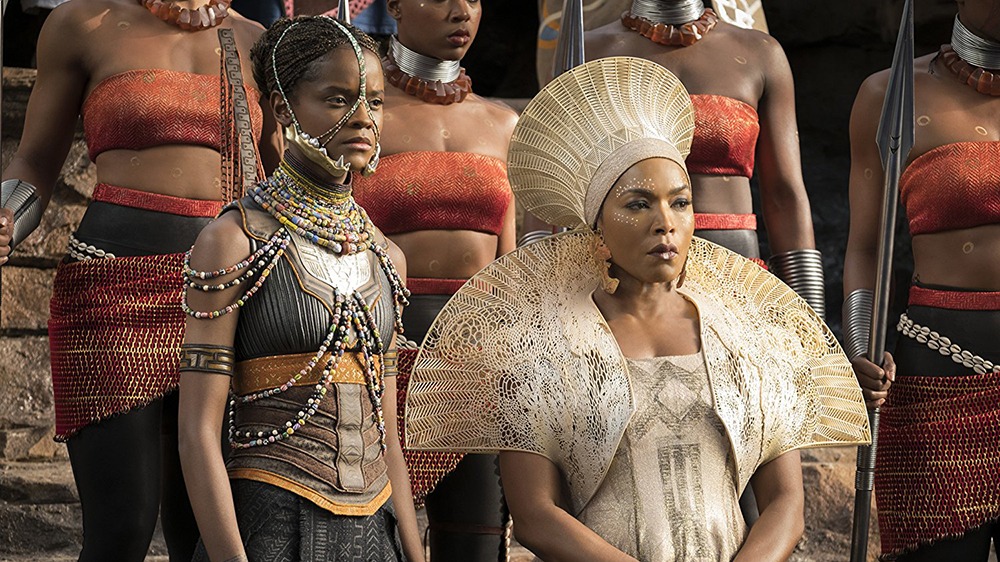
Faculty member Julia Körner is an award-winning designer working at the convergence of architecture, product and fashion design - specializing in additive manufacturing and robotic technology. Recognized today at the forefront of 3D printed innovative designs, Julia's work stands out at the top of these disciplines. Koerner collaborated with Ruth E. Carter, costume designer for the movie Black Panther, to create the 3D printed crown and shoulder piece worn by Queen Ramonda, a character played by Angela Bassett.
"Our readers will already know how excited we were about the release of Marvel’s Black Panther and how especially pleased we were that some of the film’s stunning costumes were made using 3D printing technologies.
To add to the excitement, we recently got the chance to speak to Julia Koerner, an architect and 3D printing fashion specialist who worked on the film and played an integral role in realizing the 3D printed crown and shoulder piece worn by Queen Ramonda, a character played by Angela Bassett.
Koerner, whose work we’ve written about before, is the founder of JK Design GmbH, a design practice specializing in the use of cutting-edge technology. Her 3D printed pieces, which blend nature-inspired and architectural structures, combine fashion and technology—something that drew the attention of Black Panther’s costume designer Ruth E. Carter.
“The kingdom of Wakanda in the film tells the story of a fictional place where advancements in technology and innovation are taking place,” Koerner tells us. “The costumes of the character Queen Ramonda were meant to exemplify the combination of traditional African culture and the most high-tech fashion. Fascinated by my recent work, costume designer Ruth E. Carter approached me to work together on 3D printed costumes for the film. Together we developed the most cutting-edge, digitally designed wearables that we could imagine.”
Ruth E. Carter, whose vision of Wakanda’s culture and aesthetic is being praised all over the globe, drew from various elements of traditional African cultures as well as technology to create an amazing visual tapestry in the film. Of course, she had a talented and dedicated team that helped bring her vision to the screen.
“It was great to work with Ruth Carter and her team,” Koerner elaborates. “Costume Concept Artist Philip Boutte created beautiful illustrations based on Ruth’s concepts, while I developed digital designs and parametrically generated patterns that were inspired by traditional African culture for the Zulu Hat and Shoulder Mantle.”
In our interview, Koerner explains what went into the design and manufacturing process for Queen Ramonda’s headpiece and shoulder mantle.
“Based on the initial costume design sketches by Ruth Carter, I developed a series of African-inspired 3D patterns and designed the Zulu Hat and the Shoulder Mantle so that it had corresponding elements in the pattern,” she told us. “It was important that the fashion pieces did not look hand-crafted and incorporated the technological look of something generated parametrically by algorithms by a computer. Therefore, we used visual programming software to develop the geometries for the pieces and experimented with the material intricacy and behavior."
“In actually fabricating the costume props, we worked with Belgian company Materialise, with whom I have frequently collaborated over the past 10 years. The technology we used was laser sintering, a powder-based 3D printing technology that enables the highest level of freedom of design as no supports are needed. The costume props were made from PA 12, a polyamide material that provided us with a high level of accuracy, flexibility, and strength. The material is also well suited for skin contact, making it ideal for fashion and costume designs.”
According to Koerner, the detail and structure of Queen Ramonda’s 3D printed costumes was realized in part thanks to her frequent collaborator Kais Al-Rawi.— Mar. 9, 2018

This post is an excerpt, read the full article on the 3ders website.
Stay engaged. Use #UCLAarts to stay connected.


