MATTHEW ROBB – On “Teotihuacán: City of Water, City of Fire”
The Fowler Museum at UCLA explores global arts with an emphasis on works from Africa, Asia, the Pacific, and the indigenous Americas—past and present. Matthew Robb, chief curator previously served as curator of the arts of the Americas at the de Young Museum in San Francisco.
"The new exhibit at San Francisco’s de Young Museum, Teotihuacan: City of Water, City of Fire, is a must-see experience. The galleries hold extraordinary treasures from the pyramids of the ancient city including items most recently unearthed along with major items on loan from Mexican and US cultural institutions. The companion catalogue – overseen and edited by Matthew H. Robb, chief curator of the Fowler Museum at UCLA and former curator, Arts of the Americas, Fine Arts Museums of San Francisco – is already a collector’s item. Coming in at seven pounds and 444 pages, this stunning volume illuminates the most up-to-date scholarship on Teotihuacán – a declared (thank the gods!) UNESCO World Heritage Site.
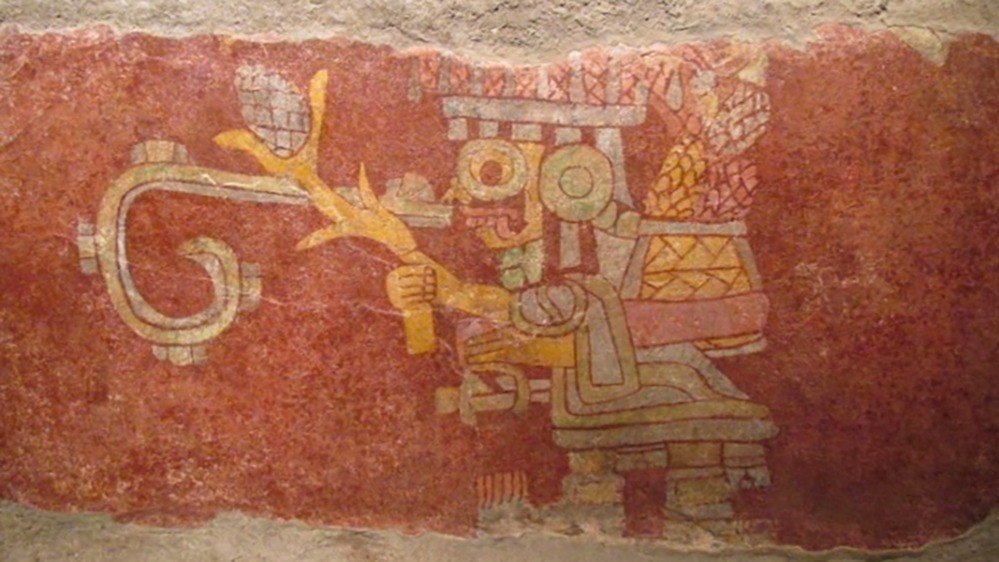
“The catalogue is a representation of an intense collaborative project,” said Matthew. “I was fortunate to be at the de Young for a few years to continue the relationship that had already been established with the Instituto Nacional de Antropología e Historia (INAH) in Mexico for practically thirty years. It goes back to a story about a set of murals from Teotihuacán that were looted in the 1960s and given to the museum in 1976 as a surprise bequest. The de Young worked very diligently over a period of many years to negotiate the legal status of those objects. At the time, that was very unusual and in many respects still is. But they ended up reaching this agreement with INAH where over half of the murals went back to Mexico. That generated this enormous foundation of good will on both sides – which led to the first exhibition in 1983 and many other collaborative projects in the decades that have followed.”
Being of an age, I have pondered the realm of human sacrifice for some time. It only looks-like I’ve come around. What have we learned about the people who were sacrificed? Were they regarded as disposable? Were they from Teotihuacán or somewhere else?
“We have a lot more data now. There is a group of sacrificial burials associated with the construction of the Pyramid of the Feathered Serpent – around the year 250 or so. We have other burials now from the Pyramid of the Moon as well. One of the really fascinating and challenging things – because of the ways that isotopes leave traces in your bones and teeth – you can now test for where the person grew up. Was it Central Mexico? Did they live all their life in Central Mexico or did they grow up somewhere else and come to Central Mexico? In the case of the burials at the Ciudadela [“the Citadel” a large square courtyard covering 38 acres] it’s a mix. Clearly there are some people who were not too far from Teotihuacán and others who are from farther away. This underscores our sense of Teotihuacán as a multi-ethnic city. We certainly talk about this in the book and demonstrate in the exhibition as well. There is a section of town over on the western edge of Teotihuacán where there are people from Oaxaca. We know that people living there have ties to their presumably Zapotec homeland in Oaxaca. There are people from Michoacán, Vera Cruz, and from the Maya region. We have the objects that show the images from those places are also circulating within the city as well. So, we know that from a pretty early date Teotihuacán is drawing people in from all over Mesoamerica – on some level.”— Sean Martinfield, Oct. 20, 2017

Read the full interview at the Huffington Post website.