Marisa Merz retrospective at the Hammer gives an overlooked female artist her due
This exhibition explores the prodigious talent and influence of Merz’s understudied body of work
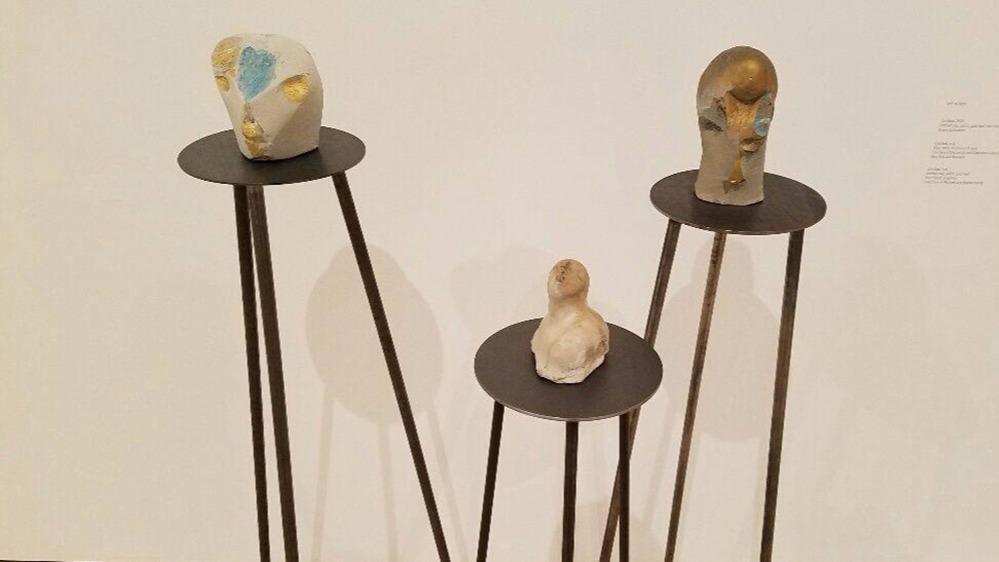
Marisa Merz: The Sky Is a Great Space at the Hammer Museum brings together five decades of works by the Italian painter, sculptor, and installation artist Marisa Merz. This survey will be the first retrospective exhibition of the artist’s work in the United States and will be accompanied by the first monograph to be published in English. Bringing together five decades of work–from her early, Arte Povera experiments with non-traditional art materials and processes; to the enigmatic heads and faces she created in the 1980s and 1990s; to mid- and late-career installations that balance intimacy with impressive scale–the exhibition will explore the prodigious talent and influence of Merz’s understudied body of work.

When you think of Italy and food, do canned peas immediately spring to mind?
Probably not. Which is one reason why a short film by Italian artist Marisa Merz at the start of her retrospective exhibition at the UCLA Hammer Museum is so beguiling.
Merz set up lights and a stationary camera in the kitchen of her apartment in Turin, the prosperous industrial and commercial center tucked into the country’s northwest corner. The 1967 film, given a slightly overexposed black-and-white palette and cheerfully amateur main performance, is a gentle sendup of classic Italian Neorealist films of the prior generation.
The artist is seated at a cluttered kitchen table, unartfully composed as a casual still life with bowls, vessels of olive oil and wine, a pitcher and other common paraphernalia. Merz, twisting a can opener to pop the top, pours off the liquid and begins removing the contents, one by one, placing each little pea onto a plate with focused care.
Her lips move with silent deliberation. Merz is “Counting,” as the film is titled, with each canned pea regarded as if a pearl to be soberly acknowledged and accounted for. (Canned peas, absurdist treasure!) The totting up scenario doesn’t so much end as simply unravel in a sudden burst of white film leader.
Neither is the artist just goofing on the glories of postwar Italian cinema with this brief if ponderous scene (it runs two minutes and 44 seconds), although it is certainly that. Merz is also lampooning Minimalism — ABC Art, as it was then sometimes called — the American import championed by Italy’s lone major collector of contemporary painting and sculpture, Giuseppe Panza di Biumo. Rigorous Minimalist order, with its geometric and industrial framework, is wittily characterized as culture in a can.
Transferred to video for the Hammer’s retrospective, the sometimes fluttery 16-millimeter film has apparently not been shown for 50 years — which is to say, not since it was made. That’s quite something, not least because the short film stands as the most concentrated exposition of Arte Povera aesthetics that I have ever seen.
On the other hand, its obscurity succinctly reflects the semi-oblivion to which the artist, the only woman among a dozen related Italian sculptors — including her prominent husband, Mario Merz — has generally been relegated. (Playing catch-up, the Venice Biennale awarded her the 2013 Golden Lion for Lifetime Achievement.) Merz is sort of like one of those canned peas, culturally hemmed in to a modern domestic routine; her distinctive importance as an artist is in how she embraced that seemingly confined context as integral to her work. Limitation became liberation. — Christopher Knight, Jul. 15, 2017

Read the full article at the Los Angeles Times website.
Read more news about Marisa Merz: The Sky Is a Great Space from Blouin Art Info, Artishock, White Hot Magazine,