Making art in the virtual classroom
Reflections on the arts and community engagement in a pandemic
Two months have passed since the start of “safer at home” and the transition to remote learning. We are still struggling to maintain a sense of normalcy as the novel coronavirus upends much of what seemed normal.
So, imagine being a teacher, in a Zoom class, helping your students try to address or process the anxiety and uncertainty while still teaching the subject of the class.
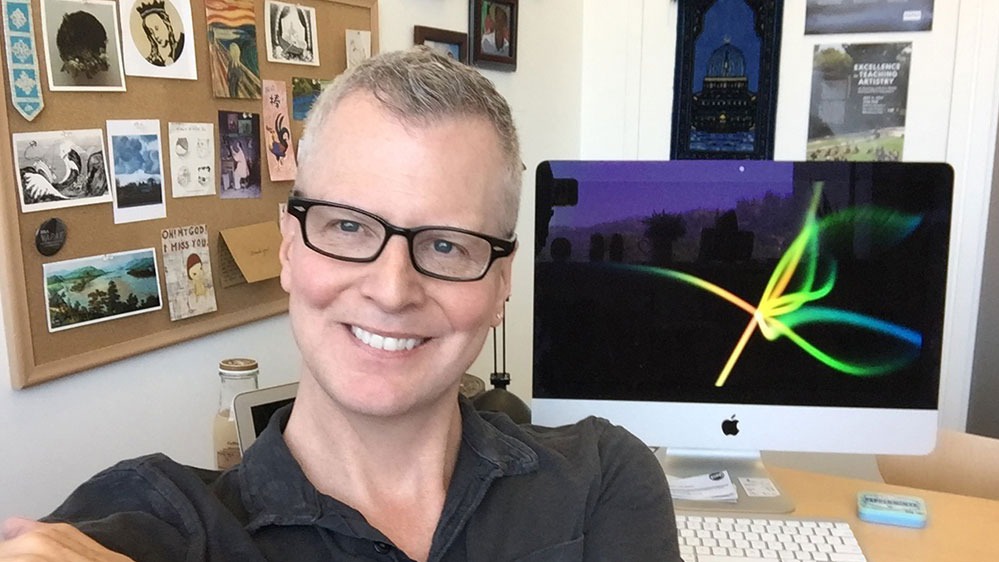
We’ve been exploring that dilemma on our podcast, Works In Progress. In this episode, we speak to Kevin Kane, director of the UCLA Visual and Performing Arts Education program, also known as VAPAE.
Kane reflects on teaching art to high school students during a pandemic, and the role arts education played in his own coming of age.
VAPAE offers courses for UCLA students interested in learning about the arts and community engagement. It also offers an arts education minor for undergraduates who themselves want to teach artmaking, with students preparing lesson plans and then teaching them in K-12 classrooms across Los Angeles. VAPAE also presents community arts programs throughout the city, during the school day and in afterschool and weekend sessions, that are multidisciplinary and multigenerational.
Kane grew up in Philadelphia at "a time when there was a lot of bullying, especially for young queer students." The arts classroom was a literal safe space, as well as a place to explore creativity and learn techniques and skills to express himself.
His participation in art, theater and dance, he said, gave him the confidence to become the first in his family to go to college and to be a professional artist. Arts education programs "helped me imagine a bright future for myself that I don't think would have been possible if I hadn't had access to the arts," he said.
Kane studied dance and theater arts at Hofstra University, then taught those subjects for eight years at John Marshall High School in Los Angeles, where he created original dance theatre productions with his students. He also worked in directing and choreography, and went on to receive his Ph.D. in cultural studies, with an emphasis in arts education, from Claremont Graduate University and his MFA in dance choreography from the UCLA Department of World Arts and Cultures/Dance (WACD).
The students in "Introduction to Community Engagement through the Arts" made a video montage of their feet to symbolize their various life experiences, called "Tracing Our Journeys: ethnography in movement."
At this point in the spring quarter, his undergraduate VAPAE students would be preparing lesson plans to present in LAUSD Title I schools "in a classroom setting with real live children."
According to Kane, these lessons would typically be delivered "in person, the materials would be right in front of us, the students would be right next to us, the engagement would be immediate, and the learning would be palpable."
Now he and his students are trying to figure out how to teach photography, dance, visual arts, and theater through Zoom rooms or other virtual platforms.
"Within the last five or so years, technology has started to become part of the way we're thinking about teaching the arts and making art with young people across the city. But this is the first time VAPAE has had to think about arts instruction entirely as a remote experience or a virtual experience," he said.
As part of a class called Introduction to Community Engagement through the Arts, Kane recently invited a former student to come speak: Gabriel Cortez, a poet, educator, and community organizer.
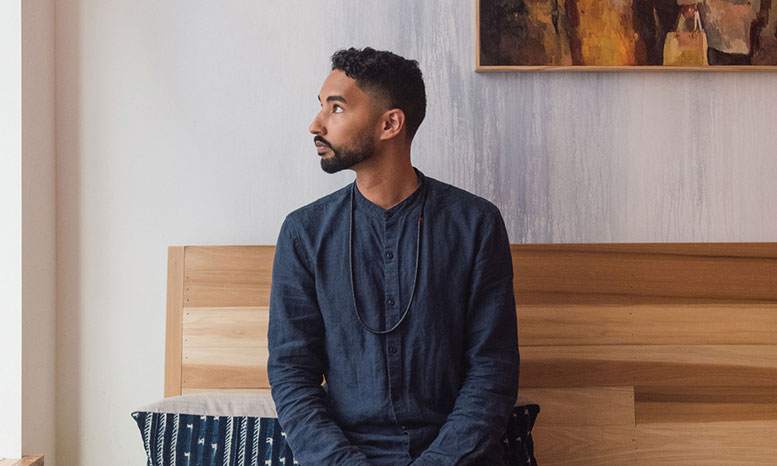
Gabriel Cortez, a poet, educator, and community organizer with Youth Speaks, joined Kevin Kane's class as a guest speaker.
Cortez spoke about his work in Oakland, California, with the literacy organization Youth Speaks. Then he gave the students writing prompts and a few minutes to write about how they are feeling. A few volunteers shared a bit of what they wrote. After the writing sessions, Cortez took some questions from the students, including a question about how Youth Speaks is offering educational and mentoring services remotely.
The pandemic, Cortez said, "hit in a really crucial time in our programming." He and other poet mentors are participating in a year-long residency, and were preparing their participants to perform on stage, some for the very first time.
"And of course we can't do that in a pandemic," he said. "So we had to pivot all of our in-person programs online."
On the plus side, the workshop attendees are not just their typical Oakland and San Francisco students. They are drawing students from Jamaica, Lebanon, Zambia and elsewhere around the world.
After a few more questions, Cortez left the students with this closing thought: "We gotta survive this moment. We've got to take care of ourselves and direct all energy towards that. If you have the privilege of getting to document this moment, write everything down. If you can, become a recorder, but if you don't, it's all good," he said. "We're going to be writing about this moment for the rest of our lives, just know that. There's no rush."
Following Cortez's presentation, students reflected on how the arts are helping us through this time, and what community engagement means right now.
"Even though it feels really stressful and overwhelming from time to time, I've been trying my best in finding the value and being able to learn new skills during this time and allow it to prepare me for when things are all better and when I am back at the studio and when I'm back in schools teaching," said Melina, a graduating senior with a degree in dance.
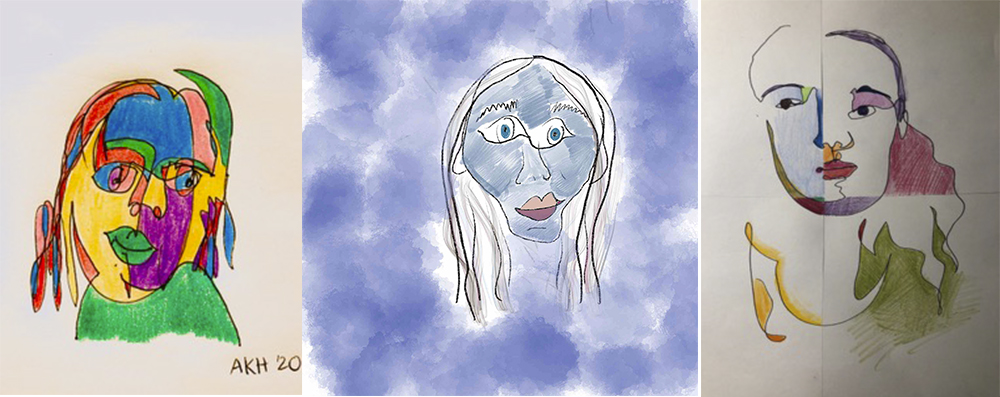
Abstract self-portraits created by students (from left) Annabelle Hendrickson, Emma McGee, and Fiona Hsu in the "Introduction to Community Engagement through the Arts" class.
Other students discussed finding strength or solace in creativity or the art they're making during this particular time.
Sophie, a psychology and dance double major, said the art she usually creates is choreography, movement and performance-based art. But in isolation, she said, "I've been having this need to just create visual art... and I've just found so much solace and peace in painting random things that I find in my house. I've just been finding jars and covers of books and random signs and everything, just to paint. And it's something that I just have never done before, but it is so relaxing and it brings me so much joy."
Other students shared stories of community engagement during this time. One student discussed the excitement of seeing her Lebanese community band together and raise money in an online auction for people in Lebanon. Another discussed building community through skillshares and zine exchanges. And another who participates in weekly family Zoom sessions hoped that the pandemic would help people communicate better in person.
Kane praised the creativity and innovation of his UCLA students.
"So I can't say that it's been a complete disaster. I've actually experienced bursts of hope," he said.
"My main goal in that class was to help our UCLA students not only just get through a difficult time that is unprecedented and unpredicted, but to really benefit from it in new and surprising ways, and I'm hoping that that's what's happening, for the majority of the students anyway."
Story by Avishay Artsy
Stay engaged. Use #UCLAarts to stay connected.


