'Made in L.A. 2018': Why the Hammer biennial is the right show for disturbing times
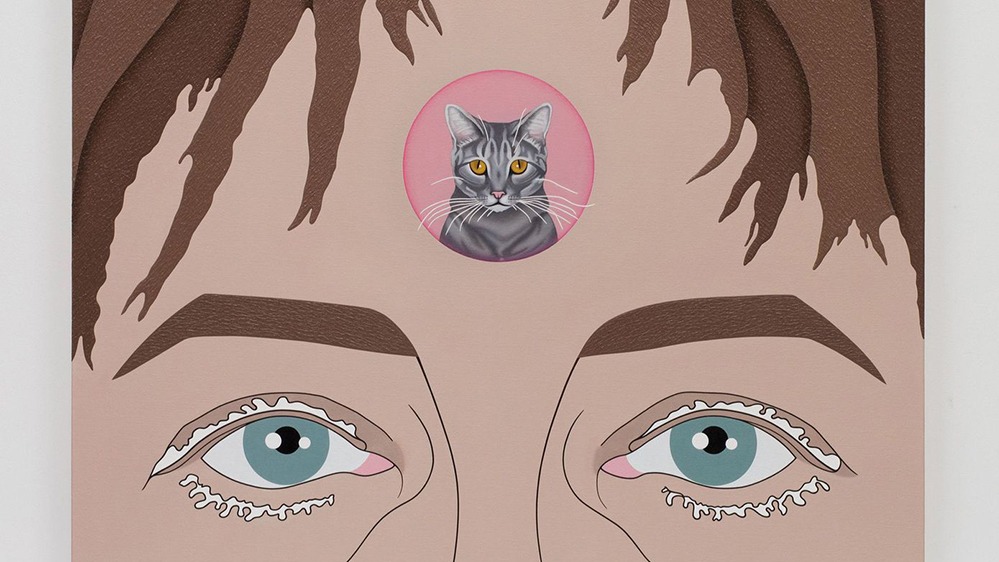
Made in L.A. 2018 is the fourth iteration of the Hammer’s biennial exhibition, continuing to highlight the practices of artists working throughout Los Angeles and the surrounding areas. This year's lineup includes ten alumni from the UCLA School of the Arts and Architecture, representing more than 25 percent of the artists selected. The exhibition is organized by Hammer curators Anne Ellegood and Erin Christovale. The exhibition will be accompanied by a comprehensive catalogue, as well as a full roster of free public programming. Refer to the UCLA Arts Calendar for the full listing of events and exhibitions at the Hammer Museum and across the School.
"The UCLA Hammer Museum’s much-anticipated biennial survey of new art produced in the city has just opened its fourth iteration. “Made in L.A. 2018” is the best one yet.
Eamon Ore-Giron, "Angelitos Negros," 2018, acrylic (Christopher Knight / Los Angeles Times) Part of the reason comes from simple, dramatic contrast. Since the show’s last outing in 2016, American society has been plunged into a period of destructive nastiness and malice. Art is inherently its opposite.
Artists have been responding. These 33 — up from 26 last time — were chosen with a keen attention to the resonance of their work within our socially disturbed time. Rather than art with partisan political agendas, Hammer curators Anne Ellegood and Erin Christovale have chosen smart work that, for the most part, feels acutely attuned to our beleaguered moment.
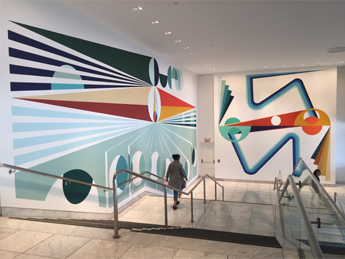
Emblematic is the big mural that wraps the stairwell at the museum’s front entry. At first look, you might not notice how.
In a palette of breezy pastels and tertiary hues, Eamon Ore-Giron painted hard-edge, geometric shapes that seem to fuse landscape elements represented as natural, industrial and schematic. In one lovely mural passage, a precision sequence of disks that evokes factory mass-production within a diagrammatic modern setting also conjures the phases of the moon.
Muralism has a long and venerable history in Los Angeles, home to landmark examples from the 1930s by David Alfaro Siqueiros and José Clemente Orozco. (The latter’s fiery “Prometheus” at Pomona College, an explosive burst of Expressionist fervor, is the first modern fresco in the United States.) Mexican muralism banished tasteful public decorum for blunt social agitation, essential to its Great Depression era.
Ore-Giron’s impressive mural interrupts that venerable tradition, responding to its public purpose and commitment in a novel way. The sleek formal rhythms of the Hammer mural are neither monolithic nor combative. Instead, they look to South America and Concrete art, with its cross-fertilization of imported European and indigenous modernisms. The forms draw on diverse pictorial legacies — say, a Uruguayan abstractionist like Joaquín Torres-Garcia and a Swiss one like Max Bill or a Russian like El Lissitzky."— Christopher Knight, Jun. 5, 2018


This post is an excerpt, read the full article on the Los Angeles Times website.
Stay engaged. Use #UCLAarts to stay connected.


