Lunch with Eamon Ore-Giron
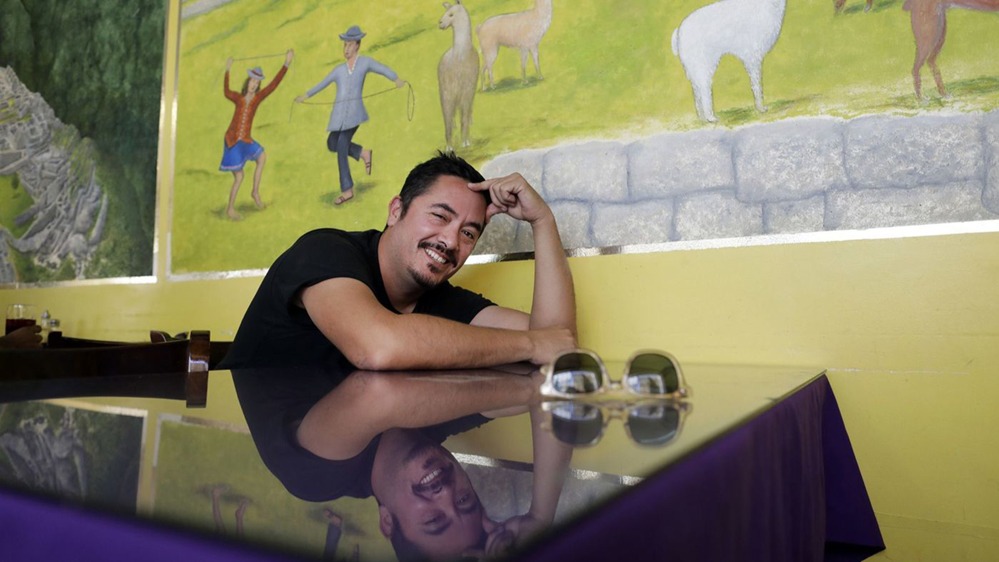
"In the great taxonomy of Los Angeles strip malls, the one that resides at the corner of Cesar Chavez Avenue and Spring Street in downtown sits somewhere on the continuum between utilitarian and grim. The structure is squat stucco. Parking is impossible. Shop facades are obscured by awnings that serve as faded shields against the afternoon sun. For a time, its most prominent business peddled bail bonds.For 19 years, Peruvian restaurant Intiraymi has occupied a corner spot on this mall, its principal marker a sign that bears a plastic chicken enveloped in plastic flame and an improvised wall of mesquite wood that stands before the front door. For 10 of those years, Peruvian American artist Eamon Ore-Giron has been a regular patron, materializing for the bountiful lunch specials ($9.95 — soup and bread included), and their well-rendered seco de cordero, lamb stew simmered in cilantro and corn beer.
“There is something very ’80s about this place,” says Ore-Giron as he dips into the plate of seco before him. “It reminds me of Lima — the light, when it’s super foggy, and you’ve been living under fluorescent lighting in a concrete room.”
Intiraymi is one of those spots that quietly powers Los Angeles — a local joint preoccupied with the day-to-day act of feeding a neighborhood. On a given afternoon, customers include construction workers, office clerks, Asian twenty-somethings in Dodgers gear, gaggles of Latin American immigrants in assorted national flavors, and government employees who drop in late in the day to pick up a spit-roasted chicken before heading home.
In recent years, as Peruvian cuisine has achieved a higher profile internationally — “it’s gotten really bougie really fast,” says Ore-Giron — Intiraymi represents, for the artist, a taste that is closer to home.
Born in Tucson to a Peruvian father and an Irish American mother (he is named Eamon, in honor of Eamon De Valera, the early 20th century Irish Republican leader ), Ore-Giron has called Los Angeles home base for the past 15 years, since he landed in the area to complete his master’s in fine art at UCLA.
His art draws from Peruvian rites (such as the 2011 video “Bite Work,” inspired by the Andean folk dance la chonguinada), but it also explores themes that resonate through the Americas, including issues tied to land and displacement, music and myth. This past spring, he created a two-story mural as part of the Hammer Museum’s 2018 “Made in L.A.” biennial that reflects an ongoing interest in pattern — pattern inspired by indigenous motif and 20th century geometric abstraction from Europe and Latin America." — Carolina Miranda, Nov. 21, 2018

This article originally appeared on the Los Angeles Times website.
Stay engaged. Use #UCLAarts to stay connected.


