Los Angeles Can’t Get Enough Sun & Sea
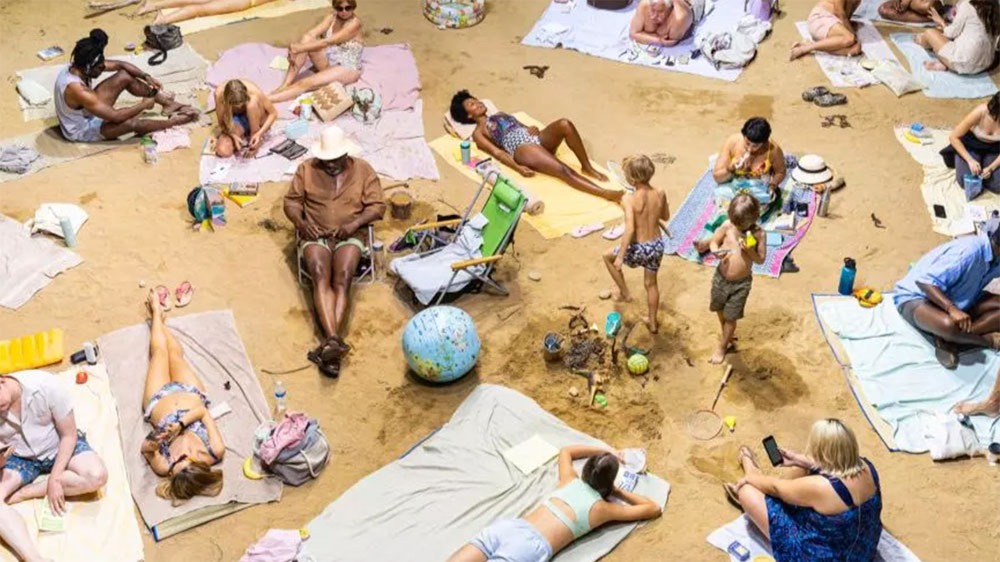
The audience for Sun & Sea | Credit: Elon Shoenholz A sweet-tempered German Shepherd lazily sniffs the sand around a worn gray rubber trashcan. Nearby, a man lounges on a towel, mindlessly surfing social media on his phone amid swells of deep, warm choral harmonies. A young woman with a badminton racket launches a neon yellow shuttlecock into the air where it mingles alongside an invisible, floating melody produced by a sunbathing soprano.
Welcome to the highly anticipated, much buzzed-about, and frequently Instagrammed Los Angeles rendition of Sun & Sea, a thoughtful, enveloping work of choral and operatic performance art from Lithuanian creators Rugilė Barzdžiukaitė, Vaiva Grainytė, and Lina Lapelytė.
Following its 2019 award-winning premiere at the Venice Biennale, the indoor manmade beach of Sun & Sea landed in Germany, Greece, New York, Pennsylvania, and Arkansas. The New York Times previewed it with a splashy feature on the logistics behind the installation of all that sand, and critics in city after city have raved about its subtle beauty and prescient themes (climate change and global warming, human behavior and ennui).
In Los Angeles, the piece ran for just three days (Oct. 14–16) at The Geffen Contemporary at MOCA, not nearly enough supply to meet demand. Presented jointly by the Center for the Art of Performance at UCLA (CAP UCLA), the Hammer Museum, and MOCA, tickets for all 15 hour-long viewings of the looping work sold out within minutes.
By logging on to CAP UCLA’s website right when they went on sale last month, I managed to snag two $25 tickets to the Saturday evening 7 p.m. time slot. As I arrived at MOCA’s large downtown warehouse space, I was curious about where exactly the beach would pop-up inside the space. On a recent visit to the museum, I’d gotten lost in the disorienting maze of trippy organic urbanism that makes up Pipilotti Rist’s large and immersive retrospective, “Big Heartedness, Be My Neighbor.” Currently on view at the museum, Rist’s show takes up the bulky center of the MOCA Geffen space. When you’re inside its color-saturated, acid-tinged world, there feels like little room for anything else.
By comparison, Sun & Sea seems small and somewhat pale and bleached out, relegated to a back corner of the museum where exposed scaffolding and bright white walls frame a neat little plot of pristine sand. Perhaps the staging of Sun & Sea is meant to feel sterile, presented under cool fluorescent lighting in a space that feels like a white box. In Los Angeles, the salty Pacific is so nearby with its fragrant ocean breeze, squawking gulls, and warm sun. In proximity to the real thing, this snippet of staged beach felt a tad cold and austere. I wonder how Sun & Sea would’ve communicated if it were allowed to sprawl across more of The Geffen’s ample square footage.
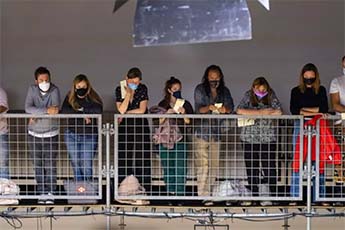
Whatever its size, Sun & Sea is effective, in large part thanks to the power of the human voice and the innate pleasure of voyeurism. Looking down from the scaffolding that surrounds the crowded little beach, one gets lost in the act of staring at strangers. Normally, it would be rude to gawk at people as they lounge in their swimsuits on a beach, but here sustained gawking is encouraged. Watch as a young man slowly peels and eats a banana. Get lost in the drama of children bickering over a plastic shovel. Stare at a couple as they lounge together, hands intertwined casually. A visual feast of the ordinary that mesmerizes in its mundanity, I was surprised by how engaging all this non-activity was to observe. — Catherine Womack, Oct. 19, 2021


This post is an excerpt. Read the full article on the San Francisco Classical Voice website.
HEADER IMAGE: Installation view of Sun & Sea | Credit: Elon Shoenholz
Stay engaged. Use #UCLAarts to stay connected.


