Learning from nature
Rebeca Méndez on changing behavior with art and design

In the midst of global crisis, how can art and design change our behavior and beliefs?
"I feel that that is a key aspect of my design and my art practice: what can I say that can make you a better human being?"
Rebeca Méndez is an artist, designer and a professor in the department of Design Media Arts at UCLA’s School of the Arts and Architecture.
Her work ranges from sculpture and installation, photography and film, to design projects for nonprofits and corporate clients. That work often draws connections between our actions and their impact on the environment and climate.
In this episode of Works In Progress, Méndez discusses how her formative life experiences shaped her artistic practice. From family vacations to explore jungle ruins in her home country of Mexico, to being a young gymnast on Mexico's Olympic team who couldn't compete after Mexico withdrew from the games in protest, to being raised by chemical engineers who instilled in her a scientific rigor and love of research that informs her approach to art and design.
"It seems more and more urgent that we learn how to respond to really be able to have the capacity to understand these changes that are happening so rapidly, and to have the tools and the mind to be able to respond with art and design," she said.
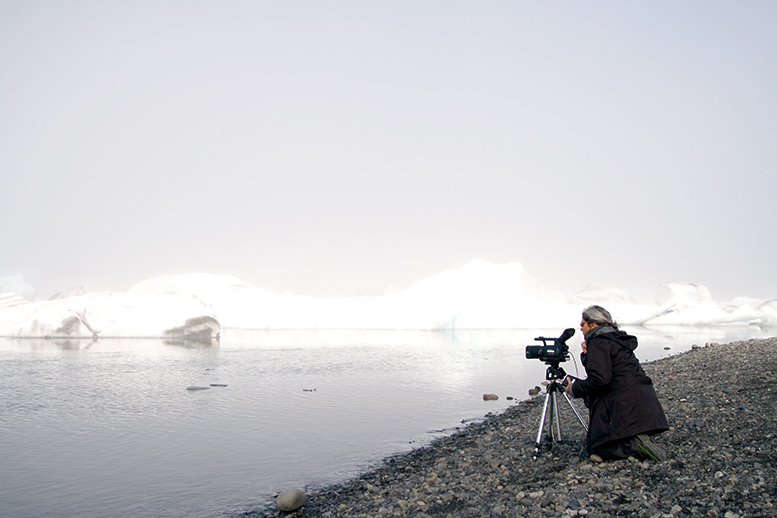
Rebeca filming in Jökulsárlón, a glacial lagoon, bordering Vatnajökull National Park in southeastern Iceland.
Méndez has done overtly political work, such as her bold typographic campaign for Refuse Fascism, and the pro-bono work she did for The Los Angeles Commission on Assaults Against Women. But she's also worked for corporate clients and advertising firms.
Méndez founded and directs the Counterforce Lab, a research and fieldwork studio at UCLA. Its latest project is a proposal to build largescale birdhouses across Los Angeles County.
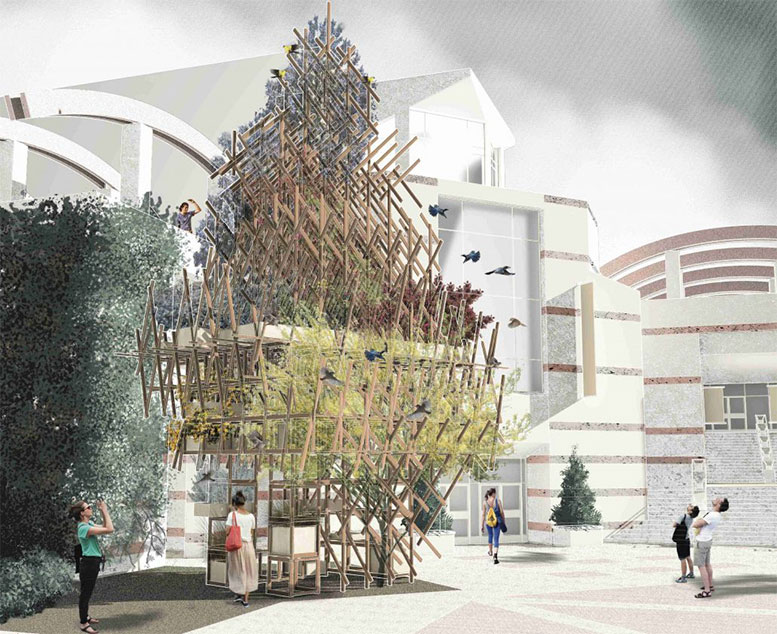
A rendering of the “biophilia treehouse.” Image courtesy of Counterforce Lab
"We're focusing on birds because they also are indicators of the overall health of an ecosystem," Méndez said.
The goal of these modular, lightweight "biophilia treehouses" is to create bird sanctuaries while bringing much-needed greenery to park-poor parts of the county, and to help connect people with nature. Communities will be invited to help build and maintain the treehouses, much like a community garden.
"After a few years of growth, they are really luscious and vibrant tree-like living sculptures," Méndez said.
The project is part of a competition called the PANDO DAYS Challenge, organized by the nonprofit envirionmental group Pando Populus. The group has invited art and design schools from across Los Angeles to develop creative projects that address the 12 goals of the Los Angeles County Sustainability Plan, which UCLA helped develop. The Counterforce Lab team was asked to respond to goal number five: Thriving ecosystems, habitats and biodiversity.
Design Media Arts student Hikaru Bakoshi, wearing a hat she made out of waste as an assignment to document the waste she produced for seven days for Rebeca Méndez's Word & Image course.


"This is not just about beautifying our landscape. This is about the health of birds, and of course the health of our human communities. Because as we know, every time that you have access to the natural world, you not only feel better... but how do we expect people to care for the environment when they have no contact with it?"
Méndez is also co-teaching her "Word and Image" class this quarter, which invites students to consider how much waste they produce by cataloging, photogaphing, and making sculptures and books out of the objects they'd otherwise throw away.
The project, also organized by Pando Populus, has in the past culminated in a citywide Junk Battle which challenged design and architecture students to propose creative projects addressing institutional waste.
"I've been teaching classes around art, design and environment for over 10 years. But I would say that this was the first time that I really saw a change in their behavior, in their minds," Méndez said.
"At the core of design, as story tellers and object makers, we have the power to affect behavior. And this, to me, it was perfect, because I saw it in front of my eyes that we were able to change their minds and change behavior."
Story by Avishay Artsy
Stay engaged. Use #UCLAarts to stay connected.


