Lauren: the performance art taking on Amazon’s Alexa
Lauren McCarthy’s work prompts us to rethink the value of domestic digital assistants
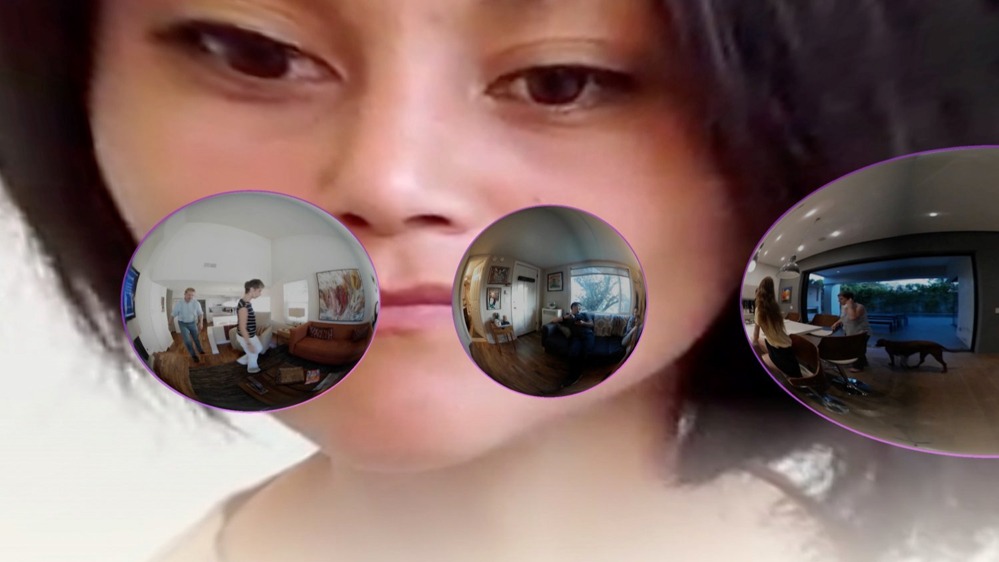
Design Media Arts Assistant Professor Lauren McCarthy, who also earned her M.F.A. from the department, is an artist based in Los Angeles whose work examines how surveillance, automation, and network culture affect our social relationships. She is the creator of p5.js, an open source programming language with over 1.5 million users, for learning creative expression through code online. She is co-director of the Processing Foundation, a non-profit whose mission is to promote software literacy within the visual arts, and visual literacy within technology-related fields—and to make these fields accessible to diverse communities.
"It is early evening and the sun is fading. “Lauren,” says the woman sitting on the sofa, “turn the lights on in the living room.” She says this to no one in particular, but suddenly the lights are on. “Too much,” she says, and the lights fade slightly. “You have a call with your mother in 10 minutes,” says a disembodied voice. “Thanks, Lauren,” says the woman. “Remind me again in five.” The woman on the sofa is a member of the audience taking part in performance art by Lauren McCarthy. Lauren — the voice and the artist — is elsewhere, connected to every element of the woman’s home via the internet, and video, audio and other sensors installed for a week of 24-hour surveillance. Lauren the artist has trouble making connections with other people. And “LAUREN”, the piece of performance art, is her way of trying to fix that. “I want access to someone in a really personal intimate way,” says McCarthy in her sunny studio on the UCLA campus, where she is an assistant professor at the Design Media Arts school. “But I have such a hard time with the first interactions.” “LAUREN” is a human-controlled version of Amazon Echo’s voice-activated speaker Alexa. McCarthy controls everything in the house and is on call throughout. “When I do these performances, it’s also an endurance test for me,” she says. “Or a test of my own ethical limits.”
Lauren McCarthy’s ‘LAUREN’ performance
The piece examines the unsteady partnership between human social connection and technology. It is a way into someone else’s world, mediated by machines. More than any of the installations in AI: More Than Human a major exhibition at the Barbican in London, McCarthy’s work represents our vision of a domestic future. But it also hints at what we are most afraid of now that future is here, and what we never think about when we invite technology into our homes.
“It’s one thing to have your phone on you all the time, but it’s still something you [can] leave in the other room,” says McCarthy. “To have your entire home space taken over by these devices . . . The implications seemed so much bigger.” Our relationship with technology begins to break down when we think we are in control. We choose to believe that these devices operate at our behest. We are still surprised when we realise a domestic machine may be recording our lives. We know we buy these objects from companies who provide convenience in exchange for our data, but we choose to forget. They get through our front doors because they are rolled out with a limited set of features, says McCarthy. They respond to our lighting requests and tell us the news. “But the potential is much more interesting and much more terrifying,” she says. “Because it’s a machine, we may ask for things we might not ask a human to do.” And because it has a learning algorithm, “it can keep feeding us more and more extreme versions of whatever we want . . . in our homes.”
This echoes the concept of The Familiar, described in the Barbican exhibition catalogue by co-curator Suzanne Livingston. “The Familiar” is what we imagine our domestic artificial intelligence will be, and what the companies who are creating it are working towards. It is an extension of brands, advertising and commodities, but remains invisible. It interprets our daily habits and integrates itself into family life. “It genuinely exceeds the butler function,” says Livingston. “It has a mind and a personality of its own, which it uses to learn about your desires and preferences and to anticipate the ways in which they might be met.” While those of us who have bought an Amazon Echo or a Google Home might believe we have already welcomed a Familiar over the threshold, McCarthy’s “LAUREN” suggests that the reality is different. To curate her performances, she interviewed participating households beforehand. She also spoke to the people close to them, to try to understand how she could help her volunteers in ways that they did not ask for directly. Voice-activated assistants cannot yet perform this kind of personal curation. They can only make assumptions based on their owners’ previous behaviour — a narrow window into the complexity of the human mind. To get into your head, domestic devices of the future will still need a human behind them, to interpret the data we are not even aware we are generating. Computers do not know what to do with nuance.
For example, one of McCarthy’s audience members spent most of her time at home on the phone, talking to friends and family. While one of “LAUREN” ’s functions was to provide companionship, “I felt like the best thing I could do as a system was nothing, because she had such a full, rich life already,” McCarthy says. Choosing to go against a prime directive is not something Amazon’s Alexa would do. It would never have been able to interpret what it thought the device’s owner really needed — to be left alone — because it can only make decisions based on the information put into it. Other cues pass it by. But we do not want to know that. When AlphaGo, Google’s game-playing robot that beat Ke Jie, the greatest logician in the world at Go, in 2017 — the world’s greatest logic game — we chose to believe that the machine had interpreted the rules with logical elegance and grace on a scale previously unimaginable. We believe that technology can see into our minds. Machines convince us that they can predict what we will do, and know the things we want to know before we have even imagined the questions. We are both delighted and horrified, because it forces us to examine what it means to be human."— Aleks Krotoski, Jul. 19, 2019


This article originally appeared on the Financial Times website.
‘AI: More than Human’ is at the Barbican in London until August 26
Stay engaged. Use #UCLAarts to stay connected.


