L.A. HABITAT: CATHERINE OPIE
A talk with Opie in her backyard studio about the state of photography and the city of Los Angeles
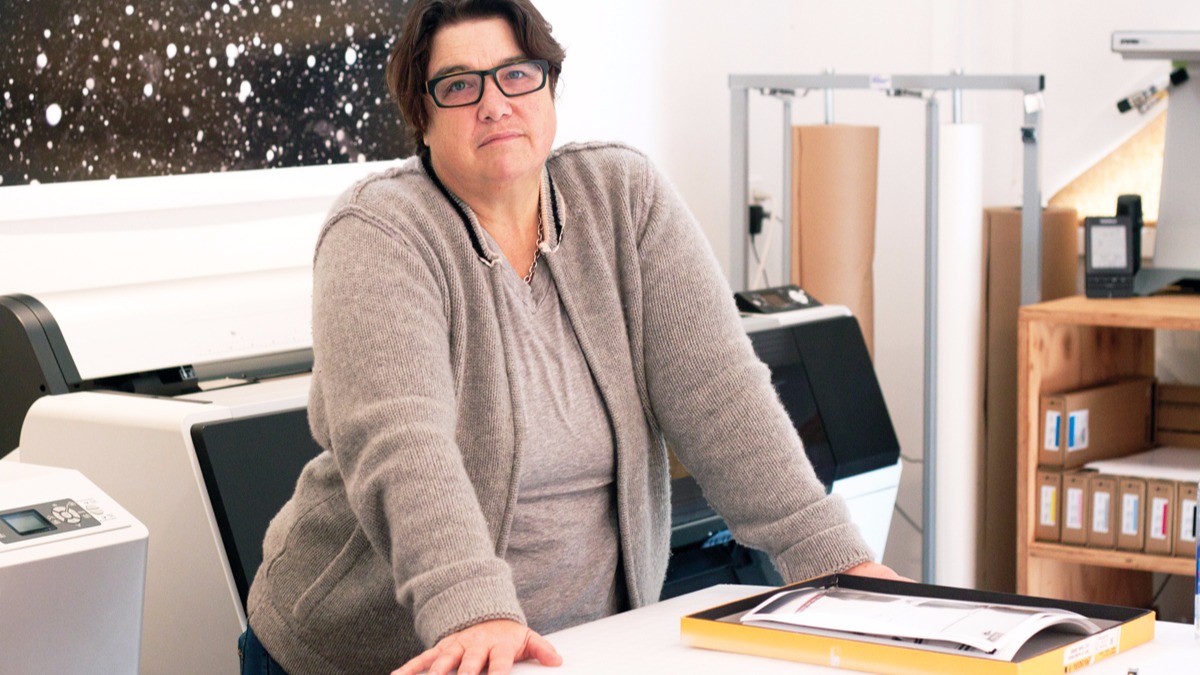
Catherine Opie is a professor of photography in the UCLA Arts Department of Art. Opie’s work has been exhibited extensively throughout the United States, Europe, and Japan. Currently, Opie has two exhibitions open in Los Angeles, Catherine Opie: 700 Nimes Road will be on view at MOCA Pacific Design Center, through May 8; Catherine Opie: Portraits will be featured at the UCLA Hammer Museum, through May 22.
L.A. Habitat is a weekly series that visits with 16 artists in their workspaces around the city.
This week’s studio: Catherine Opie; West Adams, Los Angeles.
“I never thought I would leave the Bay Area,” Catherine Opie said one afternoon last December over a cappuccino at her studio. Opie, who was born in 1961, had moved from Ohio to San Diego with her family when she was 13. Later she moved north to attend the San Francisco Art Institute, and she liked it there. “I was very happy about being queer and coming out and being a part of the leather community,” she continued. “It seemed like L.A. couldn’t compare to what San Francisco offered me in the ’80s.”
The photographer was talking in her backyard, an idyllic area framed by avocado trees. She has lived in Southern California now for more than three decades, having ventured south in 1985, after getting her BFA at the San Francisco Art Institute to attend CalArts, in Valencia, which was a formative educational experience.
Under the tutelage of pioneering faculty like artists John Baldessari and Judy Fiskin and critic Douglas Crimp, she honed her work. “I had a hardcore photo background at the [San Francisco] Art Institute that was utterly technical,” Opie told me. “CalArts was the opposite conversation, in terms of being a conceptual school. It allowed me to suddenly realize I needed to have ideas behind my work.
Opie has since become famous for her incisive portraits, which deal with how people relate to various communities, societal roles, and subcultures (whether imposed or chosen), and she has most memorably turned the camera on her own body, depicting herself with cuts on her back in 1993 and as a nursing mother in 2004. But she also earned acclaim for her still lifes and landscapes, and L.A. has ended up being a vital source of inspiration for her. She has captured the city’s mini-malls and freeways, the surfers of Malibu and the houses of Beverly Hills and Bel Air.
“It’s very hard to depict L.A.,” Opie said. “You can be a street photographer for the rest of your life in San Francisco, whereas in L.A. there is no sense of ‘street’ here, to a certain extent. It challenged me to think, how do you make work about place which isn’t necessarily about people?”
Over the course of her three decades in the area, she has become a local fixture—a board member at the Museum of Contemporary Art and a professor at UCLA, where she pushes her students to go off campus and engage with city. “L.A.’s a large place and neighborhoods are so specific,” she said. “How do we begin to think about the diversity of the specific neighborhoods? How can you never go to South Central, and why would you be scared to go to South Central? A lot of my questions for my students are, where is fear blocking us up, and what does that fear really mean?”— Katherine McMahon, Mar. 4

Read the full article at the ArtNews website.