L.A. artist Rodney McMillian peels back the facade on the ultimate symbol of power: the White House
Department of Art Associate Professor Rodney McMillian's artistic practice embodies a wide range of media and techniques. An overarching concern in his work is the relationship between language, aesthetics and content. His upcoming exhibition at the Contemporary Austin will be his first solo exhibition at the museum. Opening on Feb. 1, the show is the result of McMillian winning the museum’s inaugural Suzanne Deal Booth Art Prize, a new biannual award that includes a $100,000 prize, a solo show and a catalog.
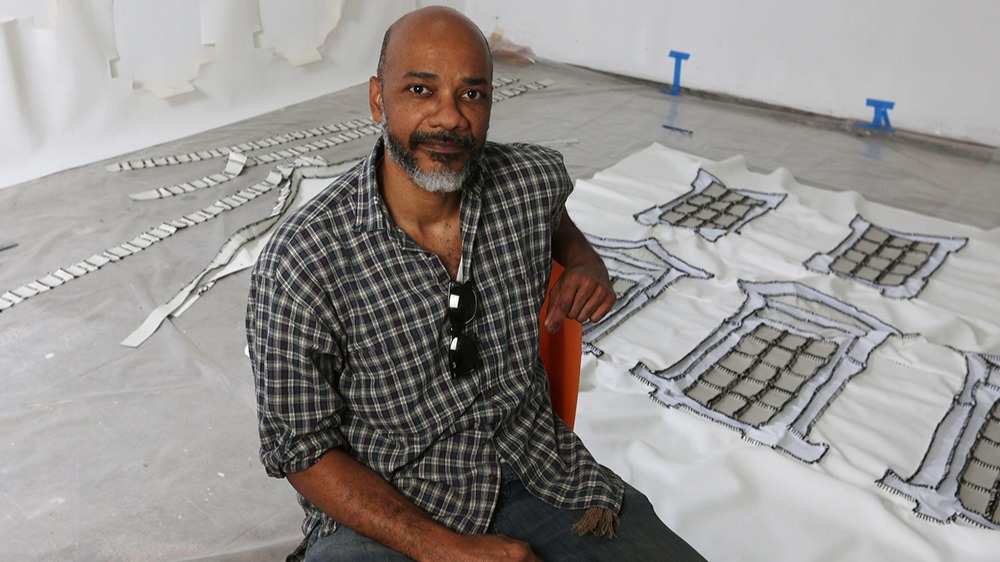
"Spread out on the floor of Rodney McMillian’s Los Angeles studio is a piece of the White House. To be certain, it’s not part of the actual White House, but , McMillian’s handcrafted approximation — its tidy rows of symmetrical windows and neoclassical pediment rendered in a patchwork of floppy white vinyl bound with black thread.
“It’s handmade, it’s hand-stitched,” he says, gesturing at the floor. “It’s movable and malleable.”
And it will hang like a curtain in the artist’s exhibition at the Contemporary Austin next month in the Texas capital. Visitors will peel back the vinyl to reveal an installation that ruminates on the nature of our nation’s most idealized symbols of power in ways that are spectral and surreal — not to mention a little bit humorous.
The installation is part of McMillian’s first solo exhibition at the museum. “Against a Civic Death,” which opens at the Contemporary Austin on Feb. 1, is the result of McMillian winning the museum’s inaugural Suzanne Deal Booth Art Prize, a new biannual award that includes a $100,000 prize, a solo show and a catalog (currently in production).
The Contemporary’s chief curator Heather Pesanti, who sat on the prize jury and organized the show, says the honorific is “really about providing artists with unfettered space for their ideas.”
In the case of McMillian, those ideas touch on long-running questions of history whose tentacles reach right into the present. His work achieves this in ways both stark and elegiac.
“It’s not reactionary — it’s not an artist picking up on what’s happening now,” Pesanti says. “The way that he hovers between abstraction and representation. There is a poetry to his work. It’s not didactic, but it has very specific references: the Klan or the White House or Shirley Chisholm” — the first black woman elected to Congress and first black politician to run for president.
“But he leaves everything very open-ended,” she adds. “His work is so interesting because it operates on so many levels.”"— Carolina A. Miranda, Jan. 10, 2018

This post is an excerpt, read the full article at the Los Angeles Times website.
Read more about Rodney McMillian.
Read about the Suzanne Deal Booth Art Prize.