Kyle Abraham's Political Choreography
UCLA World Arts and Cultures/Dance Faculty Member, Kyle Abraham
According to the New Yorker, UCLA Dance faculty member Kyle Abraham's "best work combines truth and beauty by making a message about race metamorphose, again and again, into symbol."
"The Brooklyn Academy of Music’s annual Next Wave Festival, as its name indicates, usually brings us work that is new, or new to New York. But in this year’s festival you could see Kyle Abraham’s “Pavement” looking very much as it did when it premièred, at Harlem Stage Gatehouse, four years ago. Nowadays, you don’t retire a dance that is both concerned with race and very good. In any case, this 2012 piece shows us, with no need of updating, that the circumstances underlying the Black Lives Matter movement preceded its actual founding, in 2013, in response to the acquittal of Trayvon Martin’s killer. Indeed, as Abraham has said, the dance was inspired by John Singleton’s movie “Boyz n the Hood,” now twenty-five years old. Singleton’s boys, all African-American, lived in South Central Los Angeles. Abraham’s are in Pittsburgh, his home town, and, interestingly, two of the six dancers are white. (One is a woman.) But the subject is the same: fear, and vigilance. If you’re a young person in one of this city’s black neighborhoods, you don’t have to do or be anything special in order to get killed. The score of “Pavement,” a montage of J. C. Bach, Jacques Brel, Sam Cooke, and many others, is punctuated by snippets of dialogue from “Boyz n the Hood.” Here’s one: “My mama say, ‘A bullet don’t have no name on it.’"
Political art is always, in some measure, a problem for audiences living in the time of its creation. They don’t know what they’re clapping for, the art or the cause. Some people just go ahead and clap for the cause, and feel proud or sheepish about it. Others, annoyed at being preached to, turn their backs on work that has real artistic value. (I would say that at least half the Western world’s great art started out political.) The whole thing is a mess. The ideal, of course, is a piece in which the artistic qualities—in dance, those would be shape, tempo, rhythm, attack, etc.—are such as to elicit a feeling that you recognize as being on the side of justice. But you never know whether that’s really justice or just your wish for a piece you admire to share your politics.
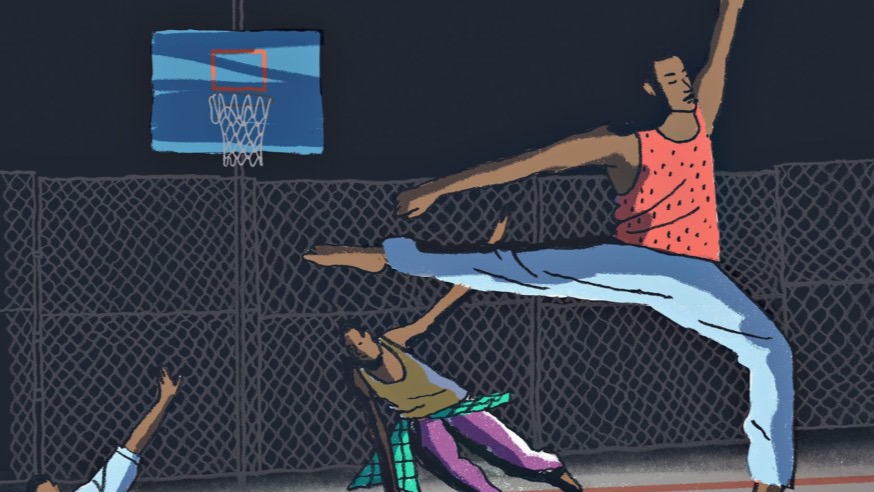
“Pavement,” I think, comes close to combining truth and beauty, by making its realism metamorphose, again and again, into symbol. The boys who constitute its cast are constantly running, and at first you think, Why shouldn’t they be? They’re boys, and they’re on a basketball court. But after a while you start to feel that they’re running a bit too much. The running becomes a dance, a dance about running—a symbol. Now realism intrudes again. One boy starts to fall, another catches him and lowers him to the ground. He’s been killed. But has he? Soon he’s up again, and catching somebody else’s fall. This happens repeatedly. And, incidentally, the fall is beautiful: a spiral. It’s a design as much as a homicide." — , January 2, 2017

Read the full article at the New Yorker website.
Header Image: Detail of illustration by Josh Cochran