Kronos Quartet, Rinde Eckert & Van-Ánh Vo In 'My Lai,' Come to Royce Hall
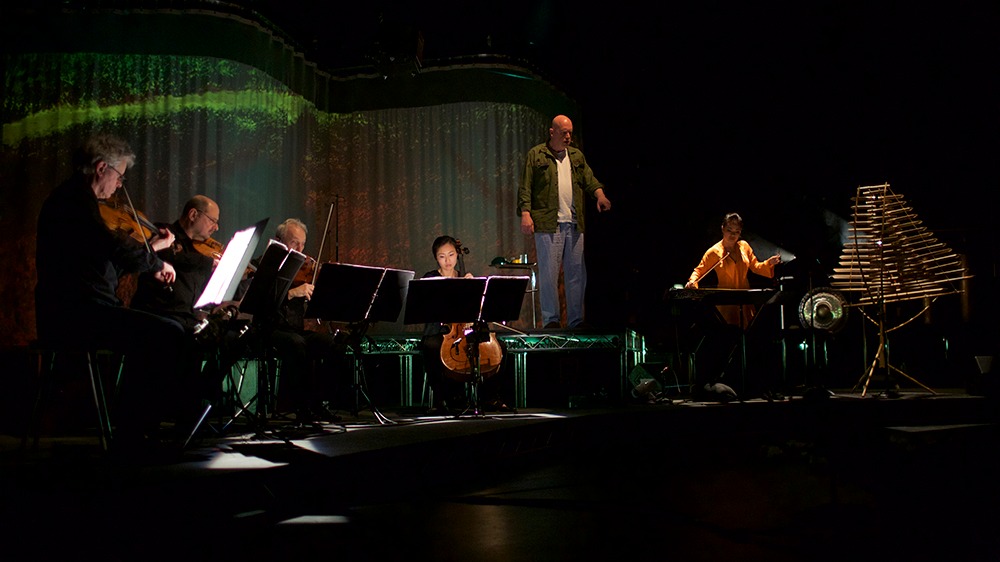
For more than 40 years, the Kronos Quartet has pursued a singular artistic vision, combining a spirit of fearless exploration with a commitment to continually reimagining the string quartet experience. Kronos’ adventurous approach dates back to the ensemble’s origins. In 1973, David Harrington was inspired to form Kronos after hearing George Crumb’s Black Angels, a highly unorthodox, Vietnam War-inspired work featuring bowed water glasses, spoken word passages and electronic effects. Kronos revisits the inspiration for the founding of the group with My Lai. The infamous 1968 massacre of unarmed Vietnamese villagers by American soldiers provides the context for this gripping new work written by composer Jonathan Berger and librettist Harriet Scott Chessman for the Kronos Quartet, tenor Rinde Eckert and Vietnamese multi-instrumentalist Vân-Ánh Võ. My Lai, which features traditional Vietnamese instruments and digitally processed sounds, is told from the perspective of the heroic helicopter pilot Hugh C. Thompson, Jr. who tried to stop the slaughter and was vilified for reporting it.
"UCLA's Center for the Art of Performance (CAP UCLA) presents the Kronos Quartet, tenor Rinde Eckert and Vietnamese instrumental virtuoso Vân-Ánh Võ inMy Lai, composed by Jonathan Berger with libretto by Harriet Scott Chessman, at8 p.m. on Friday, March 9 at Royce Hall.
Ahead of the 50th anniversary of the My Lai massacre on March 16, 2018, My Laiapproaches the infamous massacre through the memory of Hugh C. Thompson Jr., the American Army helicopter pilot who courageously intervened in the atrocities, in which American G.I.'s killed over 500 innocent Vietnamese villagers, including many women and children. Now facing cancer in the last month of his life, Thompson is haunted by this massacre, and by his own inability to save more lives. In Berger and Chessman's fevered character study of Thompson, it is not his heroism that day that takes center stage, but the tragedy of how those implicated in war are haunted by the trauma of its violence - regardless of how they acted.
"Feeling neither heroic, nor particularly proud of what he did, the consequences of Hugh Thompson's naïve, idealistic attempt to stop the carnage are pieced together in an effort to seek closure and resolution," said Jonathan Berger, whose previous chamber operas include Theotokia and The War Reporter, with librettos by Dan O'Brien. "The My Lai massacre is but one of many painful and ugly scars for which our country bears responsibility. The government's attempt to hide and distort the story of the My Lai massacre should serve a stark reminder of the moral and ethical dangers of governmental abuse of power."
"Hugh Thompson increasingly emerged for me as a compelling, extraordinary figure. I sought first to listen for his voice, and somehow this voice - open, plainspoken, humble, yearning and furious, forthright, baffled, pained and sorrowful - came to me powerfully," said Harriet Scott Chessman. "Once Jonathan started to compose the music, the libretto changed, gradually gaining the shape it has now, and yet the voice I imagined for Hugh Thompson has held and deepened."
Warrant Officer Thompson was a member of the 123rd AviationBattalion of the 23rd Infantry Division. Flying his observation helicopter on the morning of March 16, 1968 on a reconnaissance mission, the 24-year-old officer, together with his young crew Lawrence Colburn and Glenn Andreotta, could find no Viet Congactivity in Son My Village. As Thompson and his crew started to realize that American soldiers were engaged in a large-scale massacre, he made three heroic and unauthorized landings, in addition to sending anguished radio reports. Upon his return to base, Thompson reported the massacre in person, which led to the order to cease fire that effectively stopped the My Lai atrocities. My Lai, however, was the site of only one of many massacres of South Vietnamese civilians to occur during the course of the war.
For more than 40 years, the Kronos Quartet has pursued a singular artistic vision, combining a spirit of fearless exploration with a commitment to continually reimagining the string quartet experience. Kronos' adventurous approach dates back to the ensemble's origins. In 1973, David Harrington was inspired to form Kronos after hearing George Crumb's Black Angels, a highly unorthodox, Vietnam War-inspired work featuring bowed water glasses, spoken word passages and electronic effects. The antiwar spirit that helped spark the quartet's founding continues to burn bright, with the Kronos organization commissioning such recent works as My Lai and Alexandra Vrebalov and Bill Morrison's Beyond Zero: 1914-1918, which CAP UCLA presented last season.
"My Lai allows the listener to reflect upon the horror of that day through the eyes and memories of someone whose bravery, presence of mind, and moral courage compelled action in the face of evil," says David Harrington, artistic director, founder, and violinist of Kronos Quartet. "I think My Lai distills some of the most positive aspects of humanity, at the same time as it recognizes a senselessly destructive event that caused immense suffering. The music alternates between being at times internal and reflective and at other times evoking the harsh confusion and disorientation of modern warfare. It alternates between some very violent sounds we can make on our instruments with moments of incredible beauty."
The program opens with the sardonically titled My Lai Lullaby for string quartet, ?àn b?u and ?àn tranh, composed by Jonathan Berger for Kronos in collaboration with David Harrington and Vân-Ánh Võ.
This project is funded in part by Susan & Leonard Nimoy and the Good Works Foundation in support of the CAP UCLA Artists' Fellowship program.
My Lai (music by Jonathan Berger, libretto by Harriet Scott Chessman) was commissioned for the Kronos Quartet, Rinde Eckert, and Vân-Ánh Võ by the Harris Theater for Music and Dance with support from the Laura and Ricardo Rosenkranz Artistic Innovation Fund and The Andrew W. Mellon Foundation, the Gerbode-Hewlett Foundations 2013 Music Commissioning Awards initiative, and the National Endowment for the Arts."— BWW News Desk, Mar. 1, 2018

This post is an excerpt, read the full article at the Broadway World website.
Get tickets to Kronos Quartet, Rinde Eckert and Vân-Ánh Võ at Royce Hall.
Stay engaged. Use #UCLAarts to stay connected.


