Just Say When: The Transmutation of Trauma in Lari Pittman’s Nuevos Caprichos
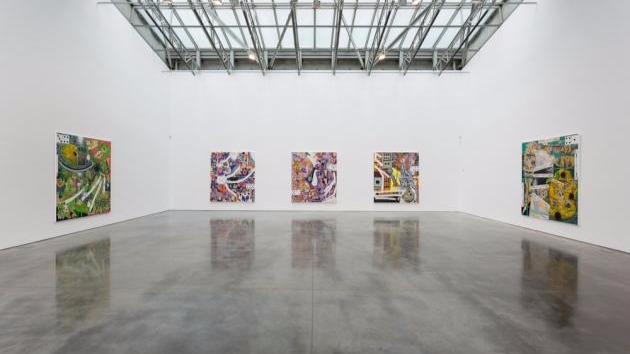
Professor Lari Pittman’s meticulously layered paintings and works on paper have been exhibited nationally and internationally. His series of paintings Nuevos Caprichos is exhibited at Gladstone Gallery in New York through February 13.
Through exposure to violence and tragedy maximally capitalized upon by the media, the human psyche is inundated daily without reprieve. How can we escape such an overwhelming barrage of events that cannot be ignored? How do we synthesize them with our lives that must go on in their daily routine, without crumbling to the ground before the enormity of their meaning? For some it is political action, lobbying, and creating movements of peaceful demonstration; others fight violence with violence, attacking those who oppress.
Lari Pittman’s response to what he terms “empathy overload” has been to create eight large-scale paintings, whose size and plethora of visual information act as a vehicle to exorcise these experiences. Pittman himself was a victim of violent crime in July of 1985 when he was shot in his abdomen by an intruder and nearly lost his life. Since then, several of his paintings have dealt with violence as a theme, such as inFlying Carpet with a Waning Moon Over a Violent Nation; Flying Carpet with Magic Mirrors for a Distorted Nation; and Flying Carpet with Petri Dishes for a Disturbed Nation. Not a religious man, Pittman nonetheless states, “What I have learned from religious painting is the aestheticization of violence and then the possibility of aestheticizing this internalized violence that I think, as American’s, we’ve all been subjected to and fully internalized.” (Hammer Lectures, UCLA Department of Art Lectures: Lari Pittman, Nov. 6, 2013) Pittman uses this knowledge to take what is typically seen as the abject and transform or transcend it through ornamentation and overabundance.
Painted with cel vinyl (originally used for animation art) and lacquer spray on canvas over wood panel, the images appear as elaborately printed and roughly cut out shapes of collage within a collage as if scanned, then layered, then scanned again, while being shaken up like the colored glass in a kaleidoscope of non rational space. Pittman’s figures appear to be in the midst of a danse macabre that echoes the tumultuous ferocity of Picasso’sGuernica (1937). In contrast to Picasso’s neutral palette, Pittman manipulates a dualistic tension created by the use of multiple palettes, one of brighter primaries and another of muted tertiary colors.— Kim Power, Feb. 1

Read the full article and view the other paintings at the Arte Fuse website.