Judy Chicago, the Godmother
For decades, the feminist artist was pushed to the sidelines. She can no longer be ignored.
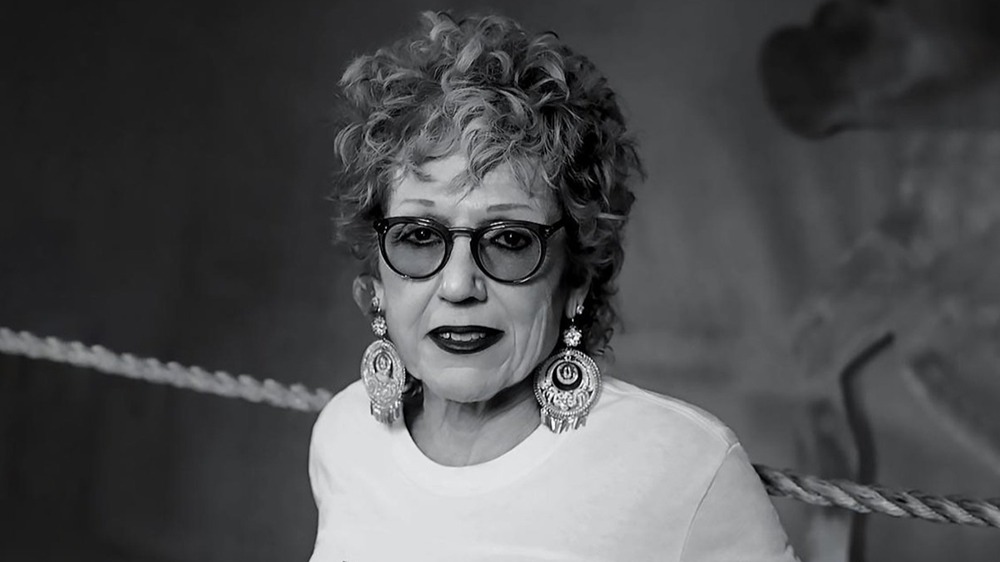
Alumna Judy Chicago (B.A. ’62, M.A. ’64) is an American feminist artist, art educator, and writer known for her large collaborative art installation pieces, which examine the role of women in history and culture. By the 1970s, Chicago had coined the term "feminist art" and had founded the first feminist art program in the United States. Chicago's work often incorporates skills such as needlework, china painting, welding, and pyrotechnics. For over five decades, Chicago has remained steadfast in her commitment to the power of art as a vehicle for intellectual transformation and social change and to women’s right to engage in the highest level of art production.
"IN A LARGE, low-lit room is a triangle-shaped table arranged with 39 place settings, the site of a distinguished gathering. It is laid with plates that rise a few inches off the table, as if levitating, each one sumptuously painted with wings or petals or licks of flame emanating from a glowing center: variations on the vulva. As you move along the table, which is 48 feet long on each side, the plates become small sculptures, bulbous and gleaming. Beneath them are runners embroidered with elaborate designs and names in gold thread — women of accomplishment who are familiar and unfamiliar, mythical and rarely spoken of: Sappho, the ancient poet; Anna Maria van Schurman, the 17th-century artist, thinker and theologian; Elizabeth Blackwell, the first female physician in the United States. The whole assemblage stands on a floor of luminescent triangular tiles covered in more gold — 999 names of other heroic women written in curling letters. The room is like a temple — a holy place, distinct from the everyday.
When Judy Chicago’s “The Dinner Party” opened on March 14, 1979, at the San Francisco Museum of Modern Art, no one had ever seen anything like it. It was theatrical, audacious and definitively feminist: a work of stark symbolism and detailed scholarship, of elaborate ceramics and needlework that also nodded to the traditional amateurism of those forms, a communal project that was the realization of one woman’s uncompromisingly grand vision, inviting both awe and identification. It caused an immediate sensation. But that was only the beginning of its tumultuous life.
One cold day in December, I met Judy Chicago, who is 78, at the Brooklyn Museum, where “The Dinner Party” is now permanently installed. Her style, like “The Dinner Party,” is flamboyant and groovy and uncategorizable. She wore jeans, a leopard-print silk shirt under a black vest embroidered with sequins and a double strand of gold beads. Her lipstick was purple, her curly hair dyed a reddish-pink, with tinted glasses to match, giving her a dreamy, psychedelic look. But the eyes peering out from behind those glasses were sharp and commanding.
We walked into “The Dinner Party” accompanied by Chicago’s husband and constant companion, the photographer Donald Woodman, who that day played the part of a benign bodyguard. Chicago regarded her creation with the fierce and slightly bemused love of a parent for a grown child. The work is so thoroughly assimilated into art history that its authority feels like a given, but Chicago remains protective of it. She vividly remembers its difficult birth — the years of painstaking labor, the organizing, over five years, of a volunteer force of 400 to help her, the doubt about whether it would ever be finished and the eventual triumph of its debut. Chicago’s intention, she told me — with a mixture of self-deprecation and utter seriousness — had been to rededicate the history of Western civilization to the women who are often left out of it. She wanted to make a work so large that it could never be erased. When I asked her what it was like to be in the presence of the piece now, sadness crept into her voice. She said she felt relief. “From the beginning, you know, I was determined — it needed to be permanently housed, because if it hadn’t been, it would have simply reiterated the story of erasure it recounts. It just — I had no idea it was going to take this long.” "— Sasha Weiss, Feb. 7, 2018

This post is an excerpt, read the full article at the New York Times T Magazine website.
Read about the making of Chicago's The Dinner Party.
Hear about how Judy Chicago pioneered the first feminist art program.
Stay engaged. Use #UCLAarts to stay connected.


