Jennifer Bolande: The Composition of Decomposition
Professor Jennifer Bolande joined the UCLA Department of Art faculty in 2004. Working in photography, film, sculpture, site-specific, and constructed environments, Bolande explores the quiet affinities between particular sets of objects and images, and the meanings they manufacture. Using one medium to examine the properties and potential of another, Bolande is interested in the ways in which meaning shifts and transforms in the passage from one medium or context to another. Her work often centers on changing, overlooked or disappearing aspects of the cultural landscape. At UCLA, Bolande teaches undergraduate students in new genres and graduates in all areas of the department.
"James Baldwin often talked about the traps of history, writing in his 1962 New Yorker essay “Letter from a Region in My Mind,” “To accept one’s past—one’s history—is not the same thing as drowning in it; it is learning how to use it. An invented past can never be used; it cracks and crumbles under the pressures of life like clay in a season of drought.” These sentiments illustrate the malleable nature of history, the fact that not all stories are written, and that, as a result, we must be vigilantly conscious of the history we are inscribed with, and in being so inscribed, rewrite. This idea is evident in Jennifer Bolande’s The Composition of Decomposition, currently on view at Magenta Plains. The work assumes the position that, in order to accept one’s history, one has to learn how to use it. Here, “news becomes history,” as the press release describes: “Beneath the surface things assume a different kind of order.” Now more than ever, we are faced with news that rapidly turns into history, having to instantly make sense of and adapt to the current state with which we are presented. Bolande’s decades-long practice probes this process as we experience the proliferation of online news outlets. Her work is extremely timely: the artist considers present and past, stacking, archiving, and excavating through sculpture, photographs, and photo-reliefs—a practice that takes time and requires being static during turbulent moments.
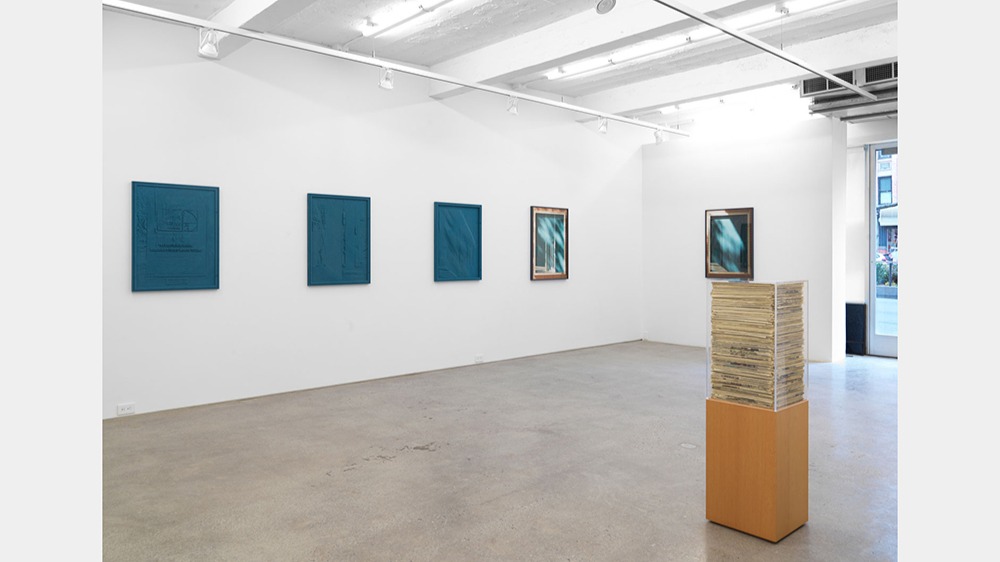
Installation view: Jennifer Bolande: The Composition of Decomposition, Magenta Plains, New York, 2020. Courtesy Magenta Plains. Newspapers are the physical materials that make up the bulk of Bolande’s show. Upon entering the gallery, we confront Image Tomb (with skeletons) (2014), for which she cut through a two-year stack of New York Times periodicals, “excavating” both physically and metaphorically the printed page, and revealing along the way, much like excavation does, images and words hidden within the stack. This tomb buries a historical photograph of skeletal remains found in London. Bolande came across this photograph of a group of 14th-century plague victims whose remains had been unearthed from a cemetery in London. The image of decomposing bones gradually yellowed in the artist’s archive until one day, when it was discovered again, it launched her on a six-year inquiry into newspapers as so-called “shapers of meaning.” The use of dimensional space is perennial across the works in the exhibition: The body of work created for The Composition of Decomposition began with the Image Tomb, an actual physical tomb carved out for the image, the dimensionality of the stack put into effect immediately. But the artist doesn’t stop there. In Ghost Column (2017 and 2019), two white polychrome resin sculptures embody towering stacks of stark white paper. These sculptures sit facing Excavation Core (2017), which is the emptied-out stack from Image Tomb. Both works take up space and seem to be in conversation. An emptied-out core is perhaps nothing more than a ghost column.
mage Tomb lays near Smoke and Snow (2010), an archival pigment print displaying three sections of photographs, two of which document an avalanche sweeping through Switzerland. The two cut sections of the paper are displayed side by side, lending themselves to the excavation that keeps unfolding throughout the gallery. Bolande not only cut through the stack of newspapers to create a final resting place for the image of the skeletons, but she utilized the cut-out sections to continue exploring the transitory nature of images and of news. The lower level of the exhibition space showcases six of these pairings, framed side by side. Composition of Decomposition No.39 (2016–2017) shows a cropping of ballet dancers from a performance at Lincoln Center, juxtaposed with a cropped image of a basketball player from the Brooklyn Nets team extending his hand towards another player; while Composition of Decomposition No. 257 (2016–2017) displays a photo of a man on a motorcycle photographing a faraway cloud of smoke next to an unintelligible composition of black and orange. These image pairings came from the disinterment made for Image Tomb and were produced by chance: the artist retained the order of the original stack, and the removed section became the raw material for these pairs as well as for the 428 page hardcover artist’s book The Times (2016). Bolande treated the extracted core like a book, opening its pages and photographing them together. The results were these accidental spreads, printed at actual size and on view here.
It is up to us to make sense of the pairings and the work. Bolande presents us with works so pregnant with meaning yet so open to interpretation: delineating between the flatness and transitory nature of images and the realness of dimensional spaces that we create."— Sahar Khraibani, Apr. 2020



This post is an excerpt. Read the full article on the Brooklyn Rail website.
Read more about Jennifer Bolande.
Stay engaged. Use #UCLAarts to stay connected.


