Janet O'Shea: Managing conflict through competitive play
Martial arts training, conflict resolution, and the physicality of protest
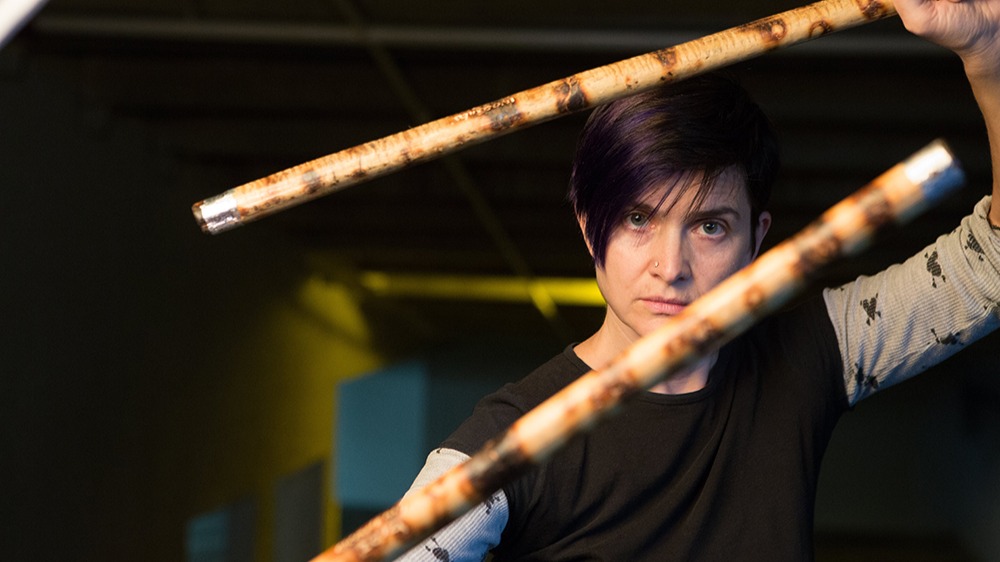
These are polarized times. Fights over masks and vaccines, the debate over policing, immigration reform and the border situation – even in this new political era, partisan divides feel as wide as ever.
For Janet O’Shea, fighting may be the solution.
She’s a professor in the UCLA Department of World Arts and Cultures/Dance, and focuses on critical dance studies, performance, and the social and political contexts of martial arts.
Her 2018 book “Risk, Failure, Play: What Dance Reveals about Martial Arts Training” looked at how physical play and martial arts can help people learn to cooperate and manage conflict.
"We have this idea that play is for children, and it's for the elderly, and it's not for adults in their working life. And that if adults are playing a sport, it really should be for a reason, like, either it needs to be professional, or it needs to be a workout that is geared towards specific outcomes, or maybe it's part of some various structured amateur activity,” O’Shea said. "But generally, there's not a lot of space given for play, and there's not a lot of value given to play, for adults within their higher education and working lives.”
O’Shea was awarded the Gold Shield Faculty Prize in 2020. In this episode of the UCLA Arts podcast Works In Progress, O'Shea talks about the value of competitive play, veganism and food politics, and her forthcoming book, "Bodies on the Line: Physical Risk and Social Justice."
O’Shea says she became interested in martial arts training and in writing about martial arts through the experience of sparring. She had dabbled in martial arts before, but a Jeet Kune Do class at UCLA introduced her to a fairly high level of sparring.
"I was really fascinated by how this practice can engage elements of violence and yet feel so profoundly different,” she said.
That experience led her to think more deeply about play as a mechanism and an approach for managing disagreement. Unlike violence, sparring has parameters for conduct, such as touching gloves at the beginning and hugging at the end, “and they frame it up as a game space, also as a space of teaching and learning.”
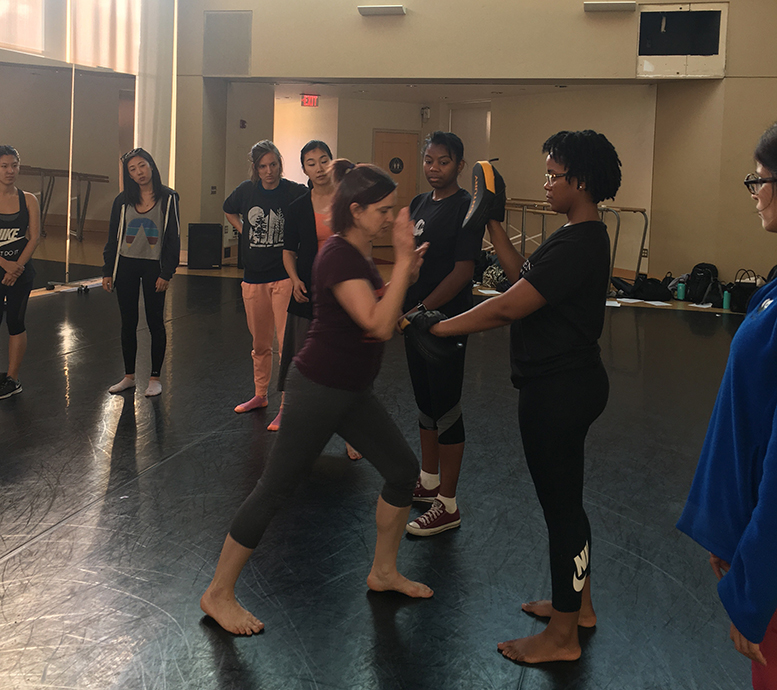
Janet O'Shea leads a workshop in martial arts for dance students. Image courtesy of Janet O'Shea.
O’Shea says martial arts training taught her to manage aggression, and to manage her responses under pressure, a lesson that’s carried into other parts of her life when disagreements arise.
"So much of the functioning of healthy relationships, healthy institutions, and even a healthy society depend upon the ability to disagree with respect," she said.
And while virtual play is beneficial, O’Shea said, "we lose something when our physical bodies are not present. I think we lose a kind of accountability. I think we lose a kind of vulnerability.”
O’Shea has never fought at a competition level. And while she’s not ruling out the possibility, what interests her most is the training, which is not goal-oriented.
While sparring, O’Shea says, "the world just melts away. It's a state of such heightened focus because it's a state in which there could be almost anything going on around us, myself and my sparring partner, and none of it matters... so it's a state of very engaged thought and non-thought at the same time.”
O’Shea joined UCLA’s faculty in 2008 as a professor of dance. Her interest in martial arts training led her to teach a class on phenomenology, martial arts and personal empowerment. She also became interested in empowerment self-defense, “which is a self-defense system that treats violence as a tool of social control, and self-defense as a social justice intervention.”
That led her to become interested not just in individual responses to injustice, but how to confront systemic issues. She began teaching about food politics, an issue connected to critical dance studies because it’s about “what bodies commit to in space, and also what is done to bodies in space.” Her class connects industrial agriculture to the climate crisis, water resource depletion, and species extinction, among other issues.
Going vegan was one step towards resolving her feelings about how food is produced, but for her, it doesn’t stop there.
"The corporate control of the food system is such a major problem, and individual choices certainly matter, but we also need a systemic overhaul of that system,” she said.
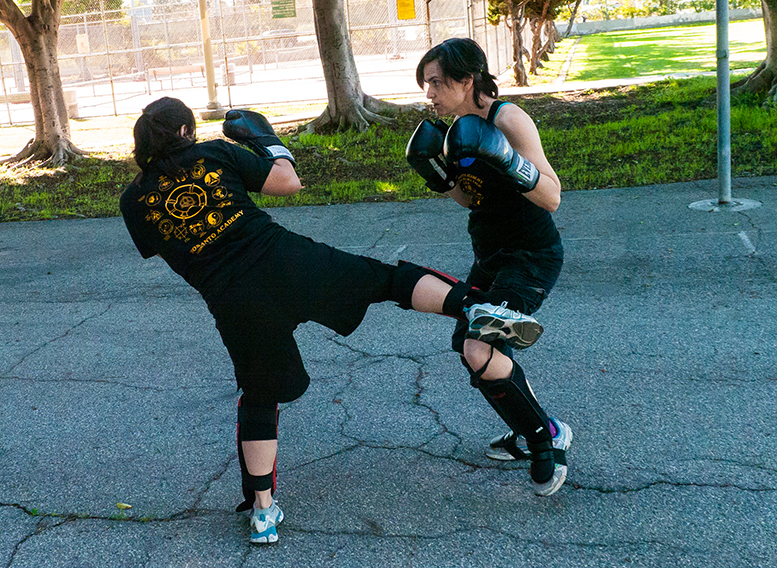
Janet O'Shea practices muay Thai's basic drills with a partner. Photograph courtesy of Tim Becherer.
O’Shea is now working on her third book, "Bodies on the Line: Physical Risk and Social Justice." The project looks at “how social justice interventions might intentionally cultivate and mobilize emotion,” she said, with a focus on four emotions: grief, survival, care, and imagination.
She’ll examine those emotions through three examples of political activism: urban cycling, border humanitarian aid, and farm animal rescue.
"In each of these, advocates are representing their own interests, but also they're representing the interests of somebody else who cannot, or who struggles to represent themselves,” she said.
"And the more distant the relationship between those two things, the more radical the intervention appears to be.”
Story by Avishay Artsy
Stay engaged. Use #UCLAarts to stay connected.


