It's a cat's world in new kitty-filled exhibition at Walker Art Center
Kitty-filled exhibit by Candice Lin investigates legacies of colonialism
Candice Lin, assistant professor in the UCLA Department of Art, investigates the legacies of colonialism, racism, and sexism by mapping the trade routes and histories of a range of colonial goods. Co-organized by the Walker Art Center and the Carpenter Center for the Visual Arts at Harvard University, "Candice Lin: Seeping, Rotting, Resting, Weeping" is composed of a site-specific installation that responds to the space of the gallery at each institution, allowing the shape of the work to evolve over the course of its presentation.
Artist Candice Lin at her new solo exhibition, “Seeping, Rotting, Resting, Weeping,” at Walker Art Center. Photo by Alicia Eler/Star Tribune The feral kitty that artist Candice Lin called White and Gray disappeared one day from the porch and alleys where he roamed near her Los Angeles home.
"He was a really mean cat, and anytime you tried to pet him he'd hit you, for some reason," said the soft-spoken Lin on a recent afternoon at Walker Art Center in Minneapolis. "He had a lot of stomach problems, which I talk about in the animation."
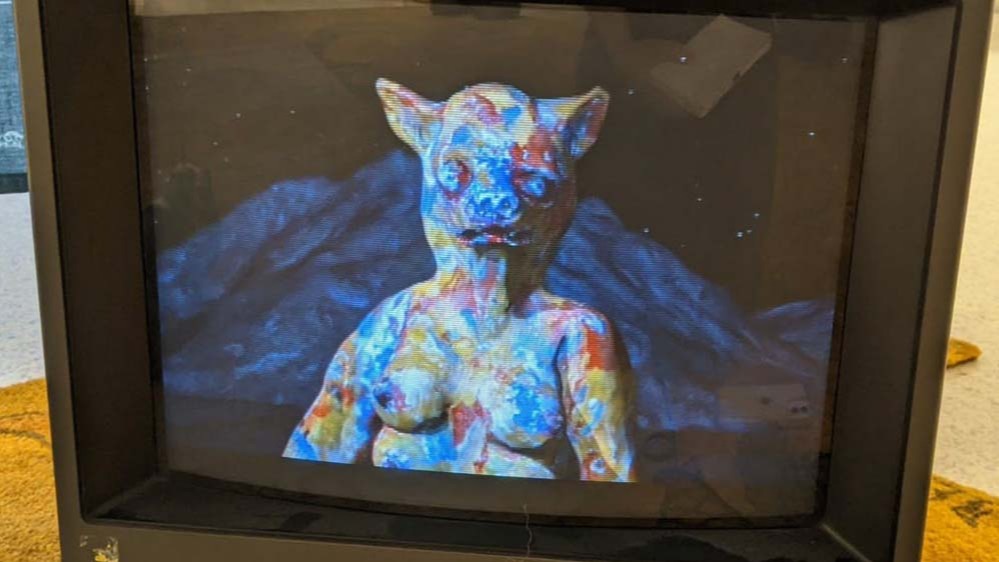
A four-minute animation imagines White and Gray's mysterious ending, replete with a group of poker-playing cats, wild poops and a fatal encounter with a slithery reptile. It's located in the corner of an intricately designed tent, made from hand-dyed and hand-printed fabric panels using traditional Japanese techniques.
This is the centerpiece of Lin's solo exhibition "Seeping, Rotting, Resting, Weeping," which can be experienced at the Walker through Jan. 3, when it will travel to Harvard University's Carpenter Center for the Visual Arts.
White and Gray isn't the only kitty in sight. Cats appear everywhere in the gallery — a vehicle for creating an animist approach to the world, which dovetails with Lin's research-based practice focusing histories of materials in relation to colonialism, slavery and migration.
The centerpiece is a nomadic, and possibly sacred, tent structure filled with ceramic cat "pillows" referencing ancient Chinese headrests. The tent is guarded by sculptures that recall the ferocious-looking Zhenmushou tomb guardians from China's Tang Dynasty (618-906 A.D.) and a devil statue invented by George Psalmanazar, an 18th-century European who pretended he was a native of Formosa (present day Taiwan), persuading English intellectuals that Jesuit priests kidnapped him from the "savage" island.
"My main interest is in a lot of these moments of mistranslation, where there is maybe an idea of exotic otherness," said Lin.
That same concept is visible in the indigo designs she produced for the tent structure, which reference Nigerian adire cloth from the early 20th century, when the British ruled parts of western Africa. During Nigeria's colonial period, the ways this cloth was made changed from hand-drawn to stamped and stenciled, and geometric flora and fauna gave way to crowns and other European iconography.
Lin said she thinks about these "moments in history where there is a reckoning of difference, and what happens to the imagery in that moment … the projection of otherness, co-optation of another culture's symbols of power." — Alicia Eler, Aug. 11, 2021



This post is an excerpt. Read the full article on the Star Tribune website.
HEADER IMAGE: Video still from Lin’s installation “Seeping, Rotting, Resting, Weeping” at Walker Art Center.
Stay engaged. Use #UCLAarts to stay connected.


