Interview: Devin Kenny & Coleman Collins
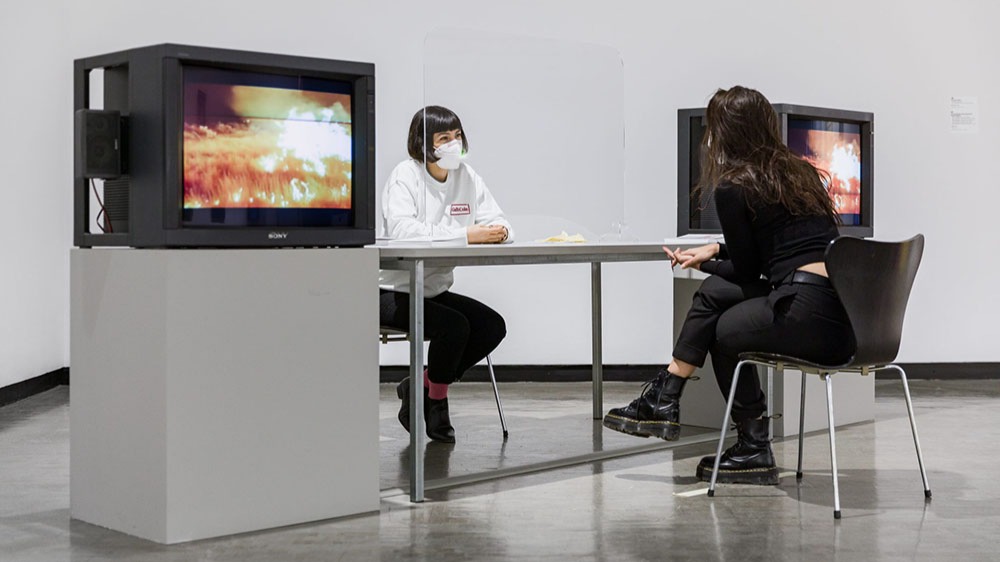
This interview from Outland brings together two School of the Arts and Architecture alumni: Devin Kenny '13 (M.F.A., art) and Coleman Collins '18 (M.F.A., art).
Devin Kenny: What Would Upski Think?, 2018 How has the possibility of independence from fiat currency and financial institutions changed the way we conceptualize investments, debt, and markets? How can new modes of exchange inform artmaking and activism? Devin Kenny’s What Would Upski Think? (2018) is a computing rig installed in art spaces that runs Bail Bloc–a program that mines the cryptocurrency Monero, converts it to dollars, and donates the proceeds to bail funds; the software was developed by the collective Dark Inquiry, of which Kenny is a member. Coleman Collins’s GuiltCoin (2021) proposes using an ERC-20 token as “streamlined mechanism for efficient guilt reduction.” The two artists met to discuss feedback loops between technology and culture, the role that debt and guilt play on individual and collective scales, and how institutional contexts inform the experience of their work.
DEVIN KENNY When I learned about your work from Andrea Fraser, who was my mentor at UCLA, I was very excited about it, specifically GuiltCoin––it seemed to have similarities to my work What Would Upski Think?, a project I had shown at Artists Space and MoMA PS1. Anyone can download the Bail Bloc application and contribute their excess computing power to the cause. The wall text advertised this, and I also requested the curatorial staff install it on their computers for the run of the show, which they did.
COLEMAN COLLINS I didn’t know about Bail Bloc when I created GuiltCoin, but I think there’s a lot of overlap. I like how you’re thinking about technology as a social process. Technology always incorporates these feedback loops, right? Even something as simple as a social media algorithm takes what you put in and feeds things back to you. There’s always an interplay between the user’s agency and the technology. I appreciate how you think about technology as a process with points where people can either intervene or try to evade it, as with the anti-surveillance work you’ve done in the past. I’m also interested in identifying places where there’s space for agency and decisions that can have larger effects.
KENNY Technology changes culture, but it’s also a product of culture. I’m interested in exploring that feedback loop. That’s one lens through which I could look at GuiltCoin.
COLLINS GuiltCoin is a crypto token that relies on a conceptual leap. It’s a thought experiment: What if one could reduce guilt by purchasing this currency? I wanted to point to the relationship between guilt and debt, both historically and linguistically. The first iteration was at the Kunsthalle in Vienna, and––as pointed out by David Graeber––the German word Schuld means both “debt” and “guilt.” So money is always entangled with these relationships of obligation.
I wanted to crystallize that idea and think about the ways in which guilt and debt are embedded into so many parts of society. Sometimes when you purchase something you also want to make a donation to mitigate the effects of the thing you’ve bought, like carbon offsets. Or buying a cup of coffee means that Ethiopian schoolchildren get shoes, or whatever. There’s this underlying layer of guilt that many people experience when interacting with the larger economic system – in addition to the everyday guilt people feel because of their social circumstances.
So what would it look like if that guilt could be alleviated? Would it be a good thing? How are people dealing with guilt and how do they identify the role that guilt plays in their life? At the museum, visitors were invited into the gallery for a consultation about their guilt. It’s different from Bail Bloc because it’s more theoretical, more tongue-in-cheek. Bail Bloc has real material effects for people. So both projects have very different strategies, but I think they both address the extent to which one can take control over one’s circumstances and deal with this sense of powerlessness that many people feel given the overwhelming odds...
— Moderated by Lauren Studebaker, Nov. 30, 2021



This post is an excerpt. Read the full article on the Outland website.
Stay engaged. Use #UCLAarts to stay connected.


