Indigenous artist Mercedes Dorame shines at the Fowler Museum
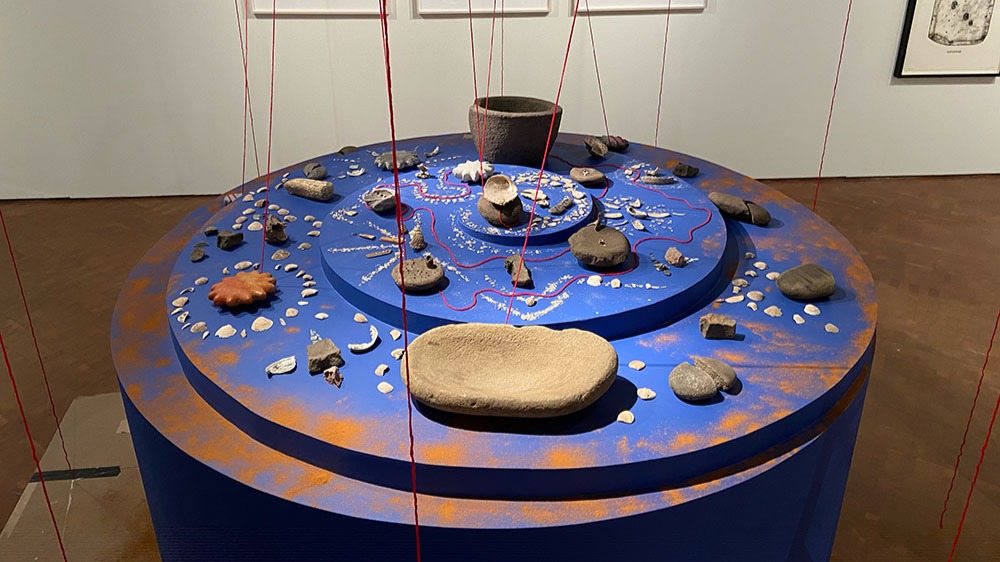
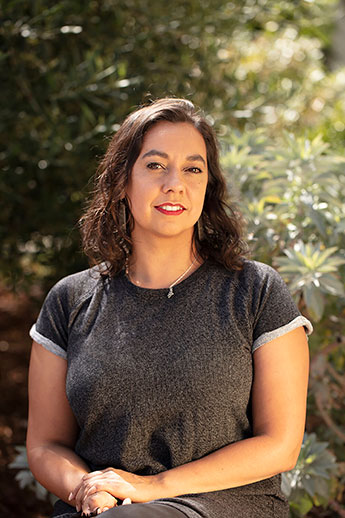
Mercedes Dorame. Photo by Josef Jacques Intertwined almost like cat’s cradle, the red yarn extends to the ceiling from the giant blue spiral plinth it rests on. Broken abalone shells, stone bowls, rocks and other objects rest on the sky blue surface of the plinth in constellation-like arrangements. Rust-colored cinnamon dusts the outer edges of the display.
This striking installation has been greeting visitors to the Fowler Museum at UCLA who have come to take in “The Map and the Territory: 100 Years of Collecting at UCLA.” The final (and delayed by the pandemic) of four initiatives celebrating UCLA’s centennial, “The Map and the Territory” is a collaborative exhibition organized in partnership with the Hammer Museum and the UCLA Library that features works gathered from 13 different campus collections, which are home to more than 21 million objects.
In putting it together, curators and custodians of UCLA’s diverse collections worked together to identify common themes for the exhibitions, which represents various geographic regions, eras and modes of reckoning with human experiences.
With that unifying principle it makes sense that UCLA alumna and contemporary artist Mercedes Dorame’s piece, “Our Land and Sky Waking Up — ‘Eyoo’ooxon koy Tokuupar Chorii’aa,” is among the exhibition’s highlights. The shells, bowls and rocks used in her piece are parts of an archaeological site in Southern California.
“That area is so important because it was a meeting place and a trading spot, and it was rich in resources. It’s an estuary space, so there’s freshwater and saltwater, and all the things that that support life. It has a personal history for me, it has a family connection,” said Dorame, a member of the Gabrielino-Tongva tribe, who is known for works that map the history of the original inhabitants of Tovaangar — what is now called Los Angeles County — and that reaffirms Tongva presence today.
“Even just the title of the ‘Map and the Territory’ has so much overlap and overlay of time and experience, and sometimes the parts that get left out of those timelines, or maps, is the original people,” said Dorame, whose work as an artist and as a teacher is driven by her activism for Indigenous people, more specifically her efforts to establish her own tribe’s continued presence in Southern California today and their connection to the land.
For Dorame, exhibiting this work at the Fowler Museum meant challenging what’s traditionally referred to as an “artifact.” The artist says that she’s interested in the gray area of what institutional archives think of as “valuable” (usually what has a human imprint, if made of stone that would be called a “worked lithic”), and what objects remain at a site that has been excavated. While carved bowls and other worked lithics abound in her piece, so do stones and broken abalone shells. — Madeline Adamo, Oct. 22, 2021


This post is an excerpt. Read the full article on the UCLA Newsroom website.
HEADER IMAGE: “Our Land and Sky Waking Up - ‘Eyoo’ooxon koy Tokuupar Chorii’aa,” 2021. Mercedes Dorame/Fowler Museum.
Stay engaged. Use #UCLAarts to stay connected.


