In the Studio: Cauleen Smith
The UCLA art professor reimagines the past and the future
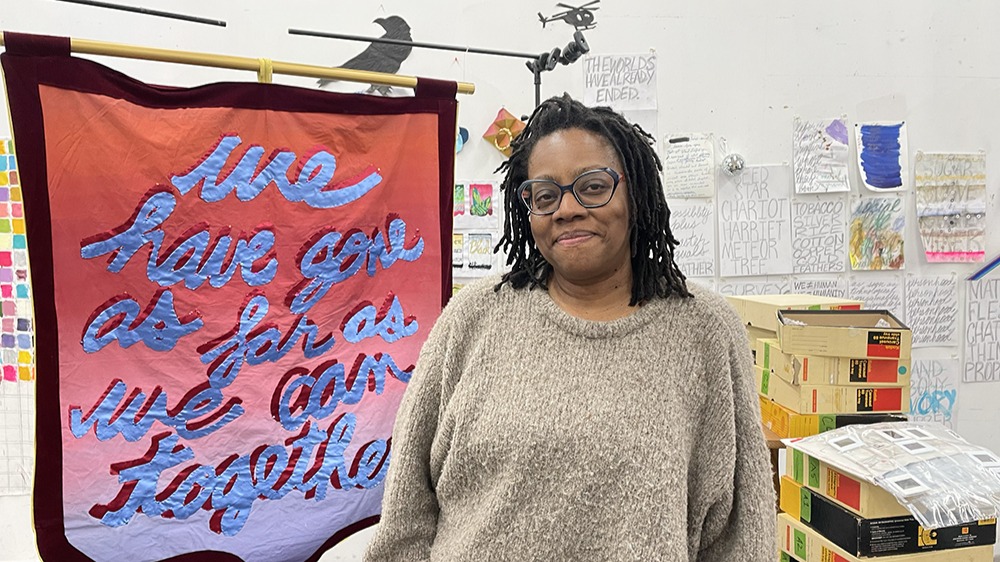
Cauleen Smith’s studio in Lincoln Heights is what you might expect a multi-hyphenate artist and director’s space to look like: towers of bins filled with colorful cloth, handmade wax candles, filmstrips of volcanic lava flows, colorful paint swatches pinned to the wall, and a glittering disco ball.
Smith’s output defies easy categorization. Her shows can include video and sound, textiles, sculptures, works on paper, and site-specific installations that interweave themes of history, identity, music, outer space, Afrofuturism, and our changing climate.
Smith recently joined the faculty of the UCLA School of the Arts and Architecture’s Department of Art. She’s currently instructing graduate students and will begin working with undergraduates on video and audio installations in the spring.
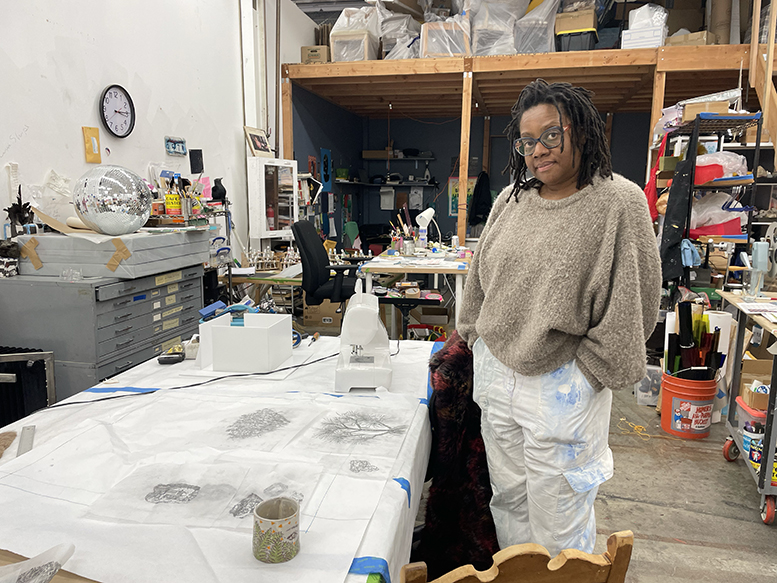
Image courtesy UCLA Arts
Smith relocated to Los Angeles after years spent working and teaching in Chicago, Austin, and Oakland. She was born in Riverside, grew up in Sacramento, and received a bachelor’s degree in creative arts from San Francisco State University. In joining the UCLA faculty, she’s also returning to her alma mater – she received an M.F.A. from the UCLA School of Theater, Film and Television.
“I really love the idea of teaching at a public school. And I really enjoy working at research institutions because of the libraries, for one, and then the possibility – though it's difficult because everyone's so busy – of having dialogues with people in different disciplines,” she said.
Smith is enjoying a renewal of interest in her earliest work. Her debut feature Drylongso, which she wrote while studying at UCLA and which premiered at the 1999 Sundance Film Festival, is being re-released with a new 4K restoration by Janus Films. Filmed in Oakland in 16mm, Drylongso is a genre-bending story of friendship, romance, and a serial killer on the loose, and has been hailed as a “lost treasure of 1990s DIY filmmaking.” Smith has since made over 40 experimental short films, and she is regularly cited as an important influence on contemporary Black experimental filmmakers.
Smith’s current work explores two seemingly disparate topics: geology, and worker cooperatives.
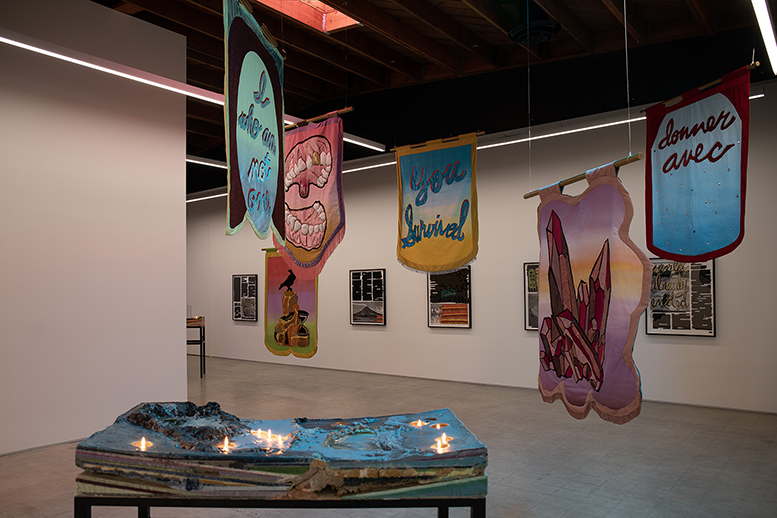
The fabric banners that hang in her studio were recently on display in a show titled My Caldera at Morán Morán gallery in Los Angeles. A caldera is the deep hollow created after a volcano erupts and collapses. The banners bear phrases such as “I who am not one,” hinting at the myth of individuality and the benefit of cooperative effort; and a seemingly contradictory phrase, “we have gone as far as we can together.”
“I was specifically thinking about the American project, and how it doesn’t seem to be working out, and we need to do something different,” she said.
On the wall are images of geologic formations taken from a book she found at a thrift store called “The Great Wonders of the World,” paired with mostly blacked out text from the book, creating redacted poetry that connotes a cyclical process of extraction and extinction.
“If you’re a practicing geologist, if you're not doing research, then you're probably extracting cobalt or gold or oil or lithium. And a lot of the way that they describe the land has to do with its uses or what's there, as opposed to cultural or relational ways you could engage with the planet,” she said.
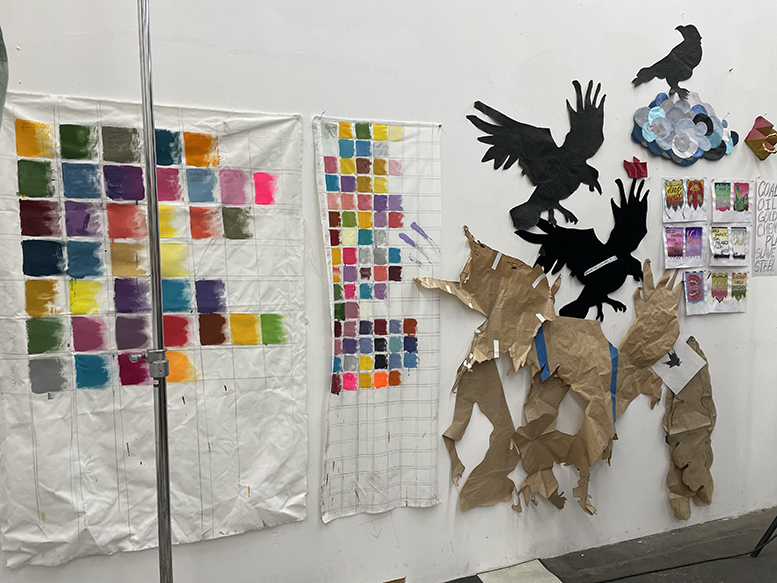
On one table, old film reels are stacked next to film strips of erupting volcanoes. Smith took screenshots from TikTok videos of volcanoes and printed the frames onto film, spliced them together, and re-digitized them, in a volcano-like process of destruction and creation.
“What I love about volcanoes is that they really cannot be owned or contained. And they're always making new land that could be the site of generating something new on a planet that has all been chopped up and staked and claimed,” she said.
On another table are hand-drawn sketches of plants. Pandanus candelabrum, also known as the chandelier tree, is a spiny shrub that grows in Liberia above rocks in which diamonds are found.
“It's an endangered plant because when people see it, they burn it off and then start digging,” she said. “It’s a very beautiful plant. I wish I could get a hold of it so I could grow it myself.”
Another plant grows above cobalt, and is also used as an indicator plant. Smith plans to turn the images into wallpaper for an upcoming installation.
Next to the table sits a 35mm slide projector loaded with slides from a live performance by avant-garde jazz musician Sun Ra, along with images she took in Los Angeles. The slides are part of Smith’s performance at the Hammer Museum on March 9 of Black Utopia LP, an homage to Sun Ra that combines sound and image to reflect on “contemporary African diaspora culture.”
Music is a central theme in her work, as well as an important part of her creative process, she said.
“Most of my films are structured like music compositions, like different kinds of song structures from symphony to a blue song,” she said. “I really depend on music to figure out how to make films.”
For another area of interest, cooperative living, Smith is currently planning a research trip to Mississippi for a film project about the history of Black intentional cooperatives. One particular collective of Black farmers in Leflore County was so successful that white farmers reached by carrying out a massacre in 1889 and stealing their land. The white farmers marched to protest the Black farmers’ alliance, so Smith is hoping to make a film that responds to that event, complete with a marching band.
That project continues an ongoing focus on how people, particularly Black people, form mutual aid networks outside traditional capitalist structures, she said.
Her 2018 short film Sojourner reimagined communal settings across California – including Alice Coltrane’s ashram in the Santa Monica Mountains and Noah Purifoy’s Outdoor Desert Art Museum in Joshua Tree – as radical feminist utopias.
Most of Smith’s projects begin with voluminous amounts of research.
“The best part of being an artist is that I don't have to do research the way academic systems and disciplines insist on it. I can make connections and I can even use what I've learned to speculate, which is why I like science fiction so much,” she said.
Smith is also drawn to science fiction’s ability to present visions of other, perhaps more cooperative, societies.
“Even while we know that the climate is changing, we can't imagine doing things differently. So we're just going to basically obliterate ourselves off of this planet because of a failure of imagination,” she said.
As Smith works on her many creative pursuits, she’s also looking forward to more time in the classroom. She says working with students is integral to her artistic practice.
“The process of figuring out what's interesting to them, and trying to help them along with that, is really rewarding,” she said. “The few moments in my life where I haven't been teaching, I've really missed the conversations with students and missed being helpful in that regard.”
Stay engaged. Use #UCLAarts to stay connected.


