In the Classroom
A look at the UCLA Arts' New Interdisciplinary School-Wide Course Series
Every quarter, UCLA Arts students dedicate themselves to spending hours in classrooms and their studios, gaining a deeper knowledge within their field and honing their craft, be it fine art, design, architecture, theory, or dance. But what happens when their curriculum breaks down these form-specific barriers? What type of dialogue emerges when young artists of every discipline are in conversation with each other?
Last spring, the UCLA School of the Arts and Architecture launched an exciting new initiative: a series of school-wide courses designed for students from across the school’s four departments (Architecture & Urban Design, Art, Design Media Arts, and World Arts and Cultures/Dance) to create, think, and percolate ideas together. The series continues this academic year with one of these unique courses offered each quarter. The Winter quarter offering, White Rooms/Disseminating Spaces, is an exploration of the paradigm shift from ‘visuality’ to more discursive/research-based practices in art, both within the white cube of the gallery, and beyond the gallery into other realms. As the series continues in the Spring, Find by Image will look at the artistic applications of machine learning and unpack advances in technology that are fundamentally shifting how we derive meaning from the world.
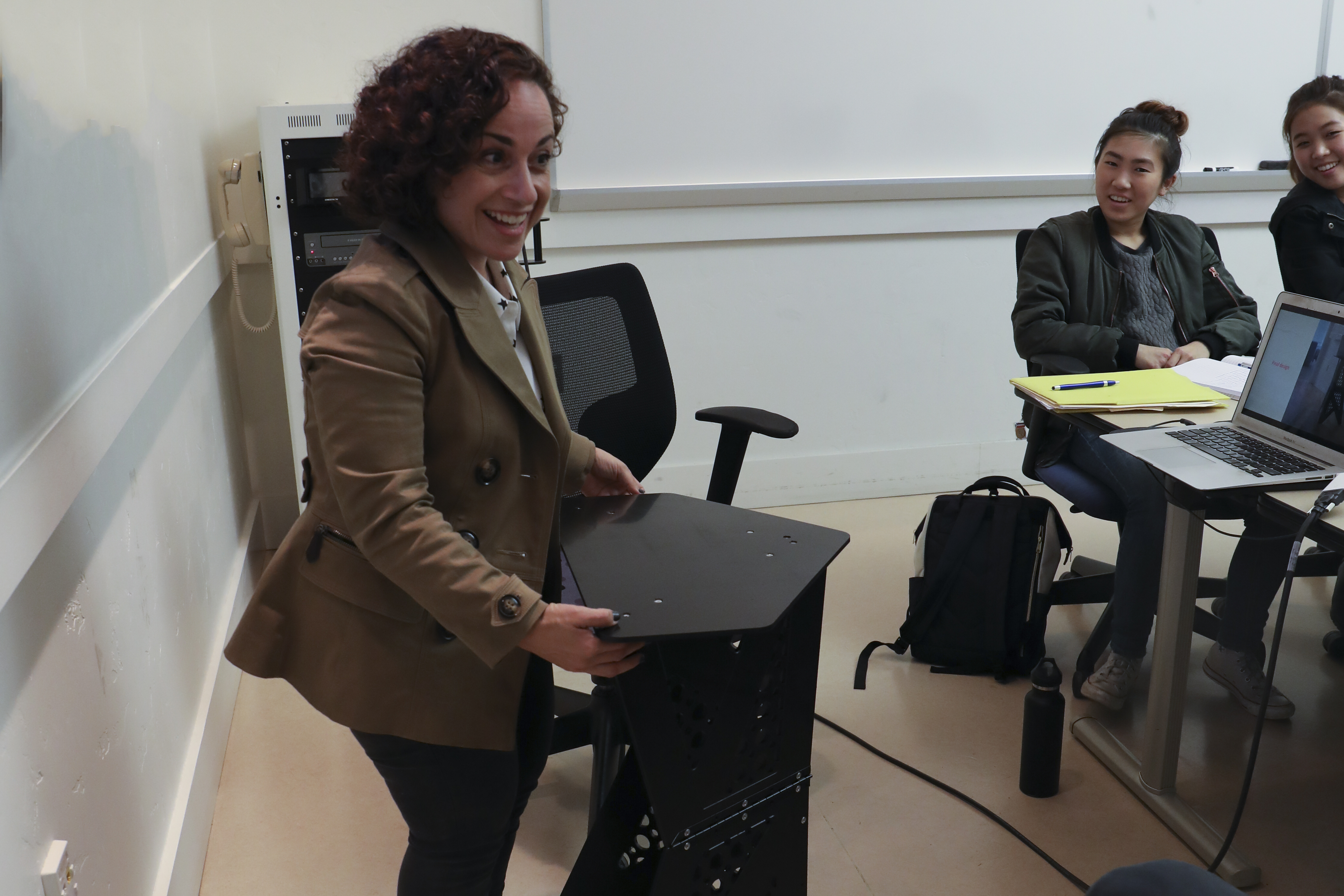
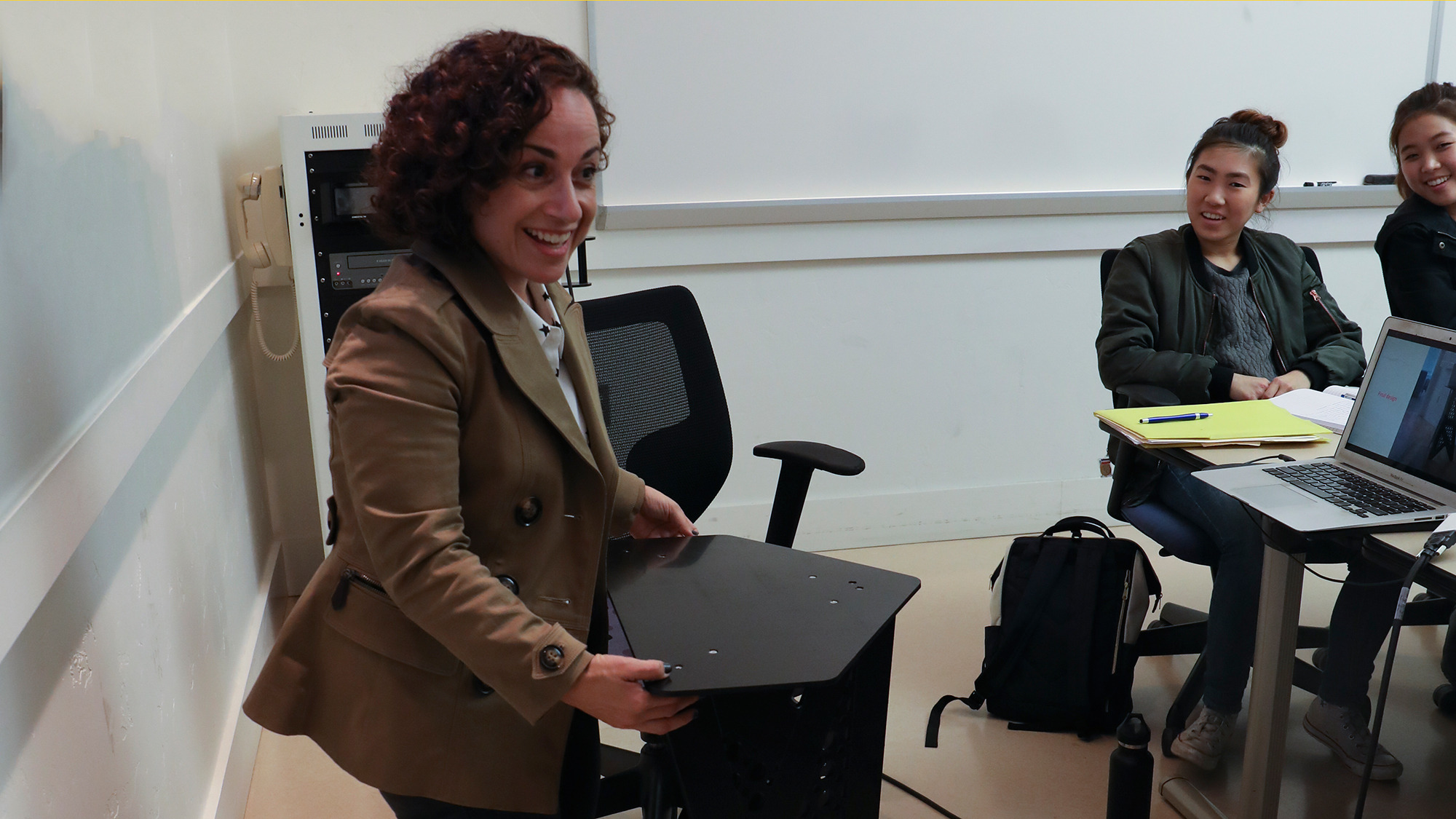
Amanda Cachia, instructor of Re-Visualizing Embodiment: Choreopolitics, Design, Access & Space tests out the latest iteration of the alterpodium which visiting designer Hugo Pilate presented to her for the first time during a class session. “It was important to me to have these guests who kind of represent the different art forms that by the students being represented in the class. We had the designer, we had the artist, we had the choreographer. I was trying to cover all of those backgrounds.” – Amanda Cachia
As they wrapped up their final presentations in December, we checked in with students from the fall iteration of the series, a course titled Re-Visualizing Embodiment: Choreopolitics, Design, Access & Space taught by art historian, curator and PhD candidate at UCSD Amanda Cachia. The goal of the course was to engage these young artists in a dialogue that centers on the creative potential of disabled bodies to generate social transformation within visual culture. What began as an opportunity for artists to think outside their disciplines grew into a valuable experience in which students shared their diverse perspectives, exchanged ideas, and approached new solutions through their given medium.
The class brought together students from all across the school: from fine art and architecture to art history and dance. Students soon began to tackle the challenges that go along with a multi-disciplinary course such as this. Discussing a complex issue such as disability from multiple perspectives and varied backgrounds raises the stakes of communication. “You can be told something over and over and over again, but it's not until you really start looking at something through a different lens or a different perspective that you really start to understand it,” third-year transfer Architecture student Christian Cononico explained. “I think that's what this class was able to offer. I wasn't just learning about disability, I wasn't just learning about architecture, I was actually being forced to look and understand more deeply and that was the most beneficial part.”
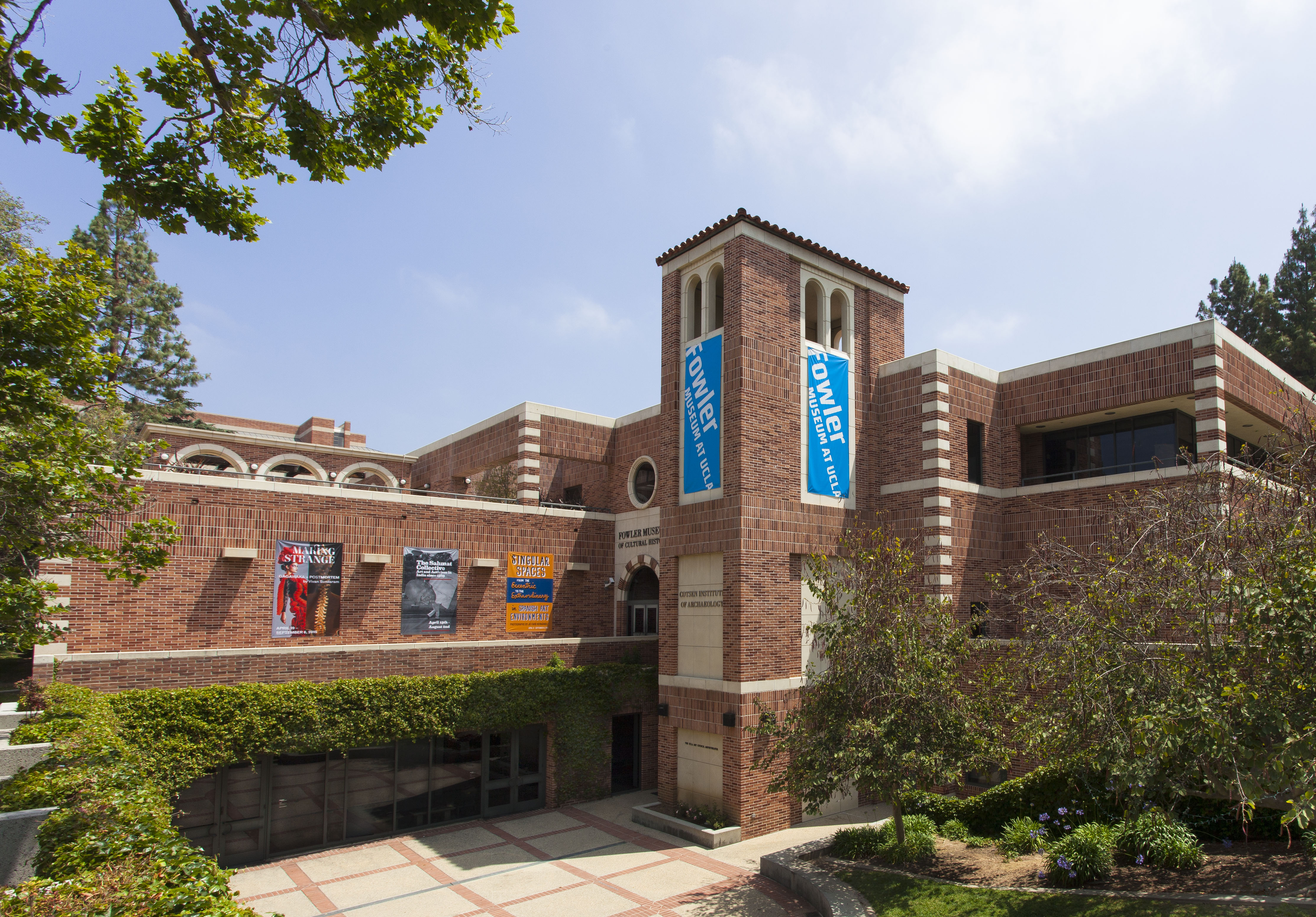
The course included presentations by guest artists including Susan Lee Foster, Allison O’Daniel, and Hugo Pilate and a trip to the Fowler Museum on UCLA’s campus. “The class was so interactive,” says first-year dance student Rachel Horiuchi. “We were actually going to a museum, and seeing the art, not just sitting down and listening to a lecture. I've never done anything quite like that before, and reconvening to discuss what we all found was fascinating.”
At a time when we are hyper-conscious of political correctness and when honest conversation between people with differing viewpoints is more important than ever, the students were compelled to outline a working vocabulary in their discussions. The class would often go through the difficult yet valuable process of breaking down the root of certain descriptors to create terminology they found to be useful as a group. For Christian, this interrogation of language “was challenging, but these are areas in which I otherwise would have lacked knowledge, and I am grateful for having Amanda as a professor because she created an environment where we could all feel comfortable to speak regardless of our different backgrounds or knowledge on the topic...it was the best class that I took this quarter for that reason.”
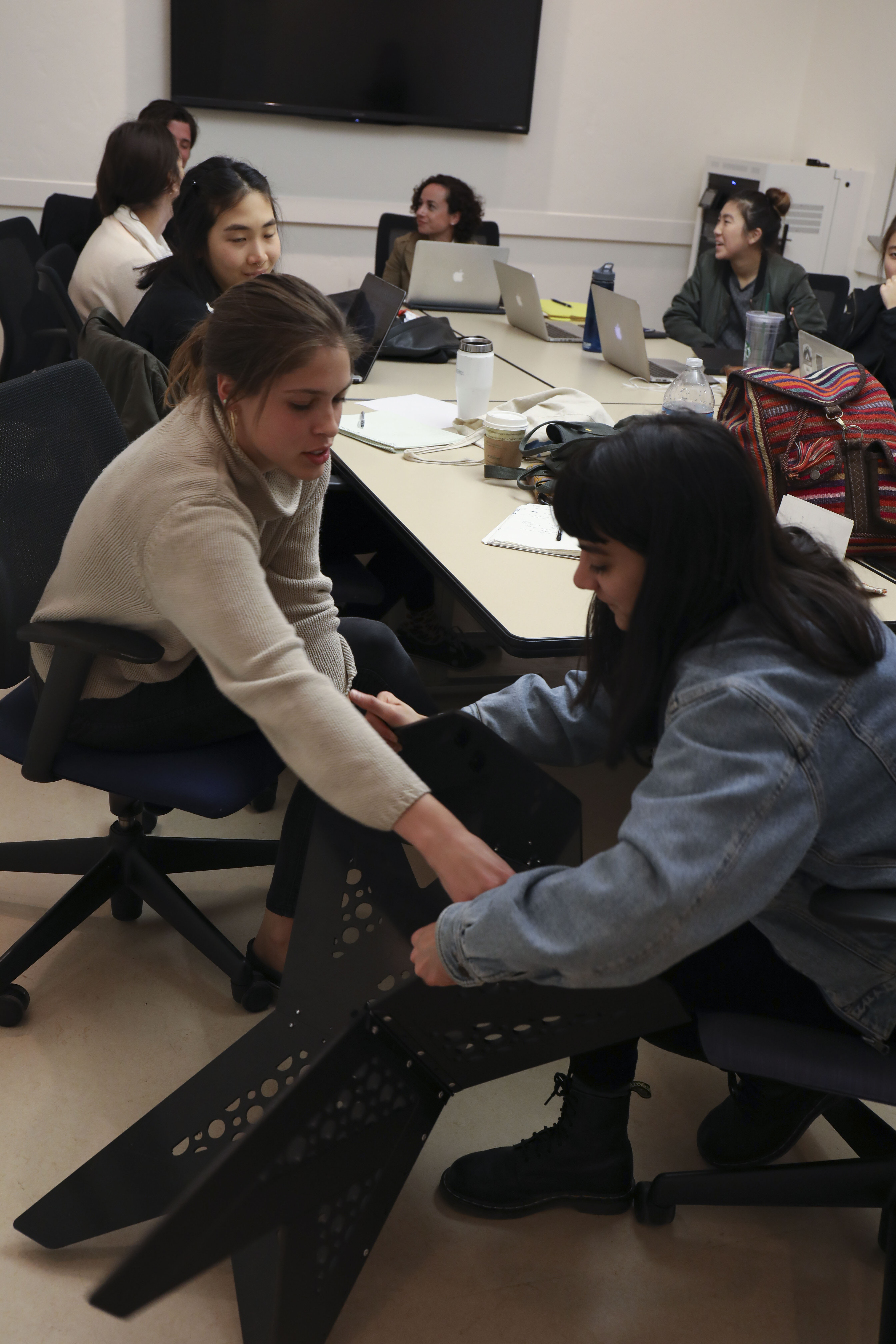
Students test out the ease of assembly of the new alterpodium in class. In his new design, Pilate made the podium more light-weight and aesthetically pleasing by incorporating a perforated pattern. “What I like about UCLA and this class is that you're not just learning how to do something. Instead they teach you how to think. Instead of just doing whatever is standard, say, creating a wheelchair out of tubular steel, you're taught to experiment: ‘instead of metal let's try and use wood,’ or, ‘Instead of two wheels let's use three or four and let's use mechanics. Let's create a wheelchair that can climb up stairs,’ in order to make spaces more accessible and enhance the experience of using it.” – Christian Cononico
When asked why students thought the arts are uniquely positioned to facilitate this type of challenging of dialogue, they expressed that within the arts there is a kind of curious open-mindedness that allows for experimentation, one that is not confined to black and white answers. Cachia echoed this idea saying, “the arts have traditionally provided a forum for transformation and change and celebration, and creative space. It's nice to think that the arts also provides a very rich platform, a generative platform for disability as well.” Both Christian and others saw a transformative shift between the beginning of the quarter and the end. “It was so interesting to see how one piece of work could be interpreted in so many different ways, but at the same time a piece of work we could find so many connections that we shared with each other,” first-year World Arts and Cultures/Dance student Rachel Horiuchi noted. “A classmate would mention one idea and I'd say, ‘That's everything that I'm learning about right now through dance, how to embody that idea in movement, so I totally get what you're saying.’” Students like Christian and Rachel were thinking differently about their own medium and finding connections with others. It’s not every day that students in different fields have the opportunity interact in the same classroom, and the outcome was both challenging and insightful.
Story by Anna LaPlaca '17, Communications Student Assistant for UCLA Arts
JOIN THE CONVERSATION
Stay engaged. Follow us on Facebook, Twitter and Instagram. Use #UCLAarts to stay connected.
Subscribe to our mailing list to receive this quarterly newsletter directly to your inbox!