In 'Doggie Hamlet,' a cast of canines, sheep and, yes, humans — ay, there's the rub
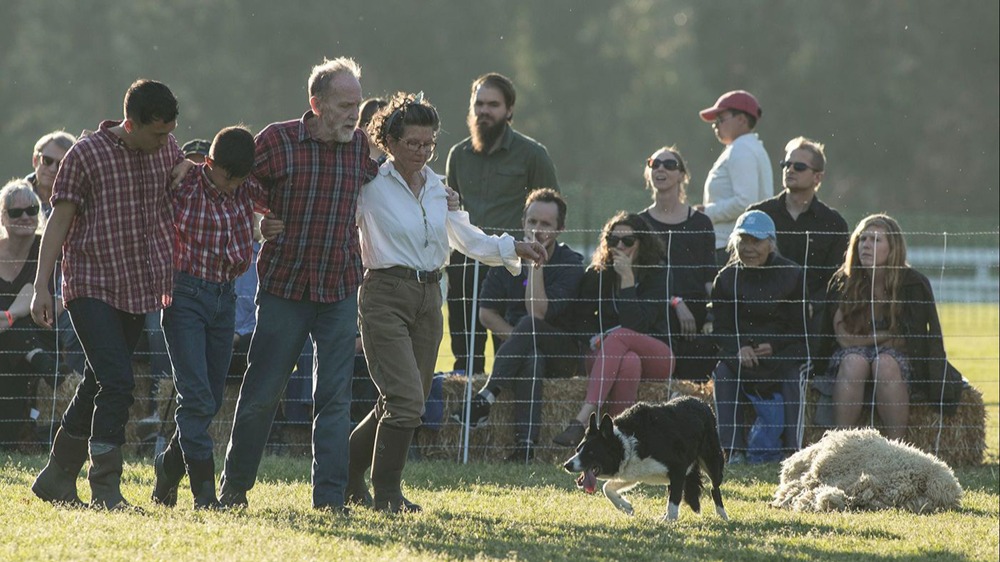
Ann Carlson's Doggie Hamlet is a full-length outdoor performance that weaves theatrical elements with competitive sheep herding trials. The work is performed by two women, two men, one boy, three herding dogs and a flock of sheep in a fenced field. Doggie Hamlet recalls the bucolic impression of a landscape painting or a 3D pastoral poem. The sheep, the dogs, the human performers and the natural landscape are at once themselves and stand as living symbols in this work. Through story, motion, site and stillness, Doggie Hamlet explores instinct, sentience, attachment and loss. Doggie Hamlet was presented by the Center for the Art of Performance at UCLA Feb. 3 & 4, 2018.
"To bah or not to bah — that is not the question of "Doggie Hamlet," a site-specific performance work by choreographer and director Ann Carlson that involves a flock of sheep, three herding dogs, six human performers, a few scattered pelts, plenty of green grass and very little (if any) Shakespeare.
On Saturday at 4 p.m., an arty audience, abandoning its traditional black garb for sportier looks in more durable fabrics, gathered at Will Rogers State Historic Park to sit on bales of hay for the first of two weekend performances of a stylized 70-minute animal act that defies categorization.
The theatrical composition, presented by the Center for the Art of Performance at UCLA, is characterized by Carlson as "a dance, a living landscape painting, and a 3-D pastoral poem." Such a description, while still somewhat fuzzy, at least puts you in the ballpark for an event that takes place on a polo field but whose real setting is the bridge between inner and outer landscapes.
Carlson is an interdisciplinary artist whose work explores the boundaries between forms. Worlds that might seem far apart are brought into conversation, as they were in "The Symphonic Body," in which members of the UCLA community were orchestrated in a symphony of their workday gestures.
The division between art and nature is of special interest to Carlson, whose pieces often bring human beings into choreographic intimacy with other sentient creatures. Hierarchies are challenged in works that make unexpected analogies among species that wouldn't on the surface seem to have all that much in common.
"Doggie Hamlet" was inspired by "The Story of Edgar Sawtelle," a novel by David Wroblewski that draws on "Hamlet" and Rudyard Kipling's "The Jungle Book." In a program note, Carlson shares that the novel's 1950s Midwestern setting resonated with her own life. But rather than retell the story in a different form, she responds here to thematic elements rallying around "dogs and death, muteness and devotion."
Narrative threatened to emerge at points in the production but never really took hold. When language was used, it wasn't always easy to discern what was being said. Speech ultimately seemed no more consequential than bleating or barking."— Charles McNulty, Feb. 4, 2018

This post is an excerpt, read the full article on the Los Angeles Times website.
Stay engaged. Use #UCLAarts to stay connected.


