How Will the Future Remember COVID-19?
Three visions for a hypothetical pandemic memorial
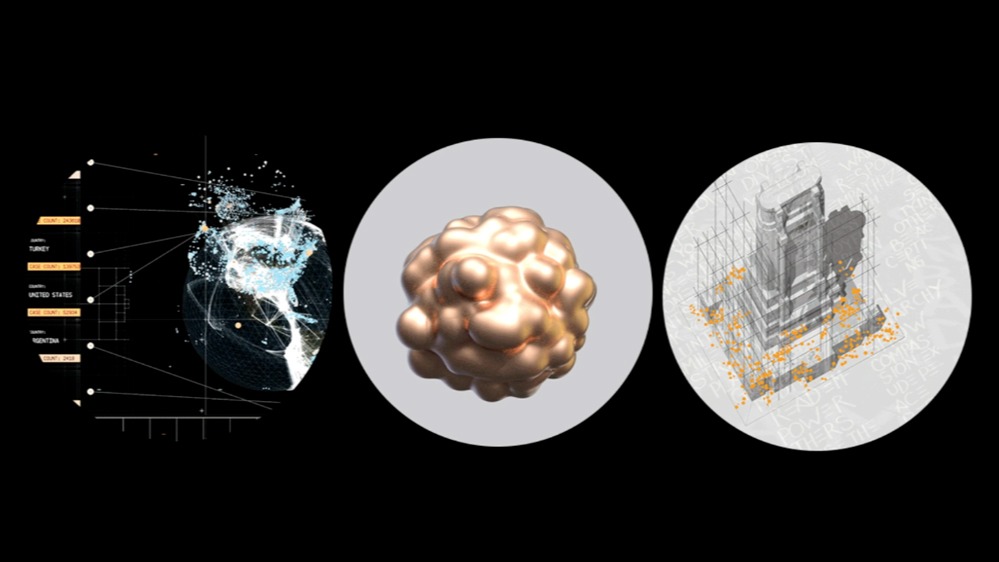
Alum and Visiting Assistant Researcher Refik Anadol (Design Media Arts, MFA '14), works in the fields of site-specific public art and live audio/visual performance with an immersive installation approach, particularly his works explore the space among digital and physical entities by creating a hybrid relationship between architecture and media arts.
"Unlike a war, a pandemic is invisible and diffuse. It’s everywhere and nowhere. Its death toll is ultimately unknowable. That makes a virus difficult to mark with physical tributes. Few memorials mark the 1918 Spanish flu; one is a modest granite bench built in Vermont two years ago, underwritten by a local restaurant also marking its own centennial.
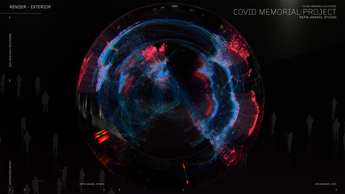
Refik Anadol Studio – Memory Globe The coronavirus pandemic is not over, either. Not even close. A third wave of infections, hospitalizations, and deaths is lashing the nation from coast to coast. More than 12 million Americans have contracted COVID-19, and more than 250,000 of them have died. Early vaccine tests are promising, but a broad rollout is months away at minimum. Even after it wanes, the long-term effects of the virus could continue to debilitate people who have “recovered.”
So this might seem like a strange time to imagine memorializing the pandemic in a formal way. A premature time. Maya Lin’s Vietnam Veterans Memorial was conceived in 1981, six years after the United States had withdrawn from the conflict. Michael Arad and Peter Walker’s 9/11 memorial broke ground at the site of the World Trade Center in 2006, almost five years after the attacks.
But there are downsides to waiting. A traumatic event is an author of its own memorial; as a famous anecdote attests, when a Nazi soldier asked Pablo Picasso if he had made Guernica, the famous painting the artist created during the month following the Luftwaffe’s bombing of its Basque namesake in 1937, Picasso replied, “No, you did.” The feelings, facts, and ideas available during a calamity dissipate as it ebbs. The temptation arises to contain tragedy in a tidy box, closing the book on its history.
Rather than await a design competition for a real memorial, we wanted to see, in the brutal heaviness of the moment, how some of the nation’s most exciting designers might memorialize this time. We commissioned three pieces from artists who straddle the lines between art and architecture, design and social justice, technology and manufacturing to speculate on the question What might a COVID-19 memorial be? These are the results."— Ian Bogost, Nov. 24, 2020

This post is an excerpt. Read the full article on the The Atlantic website.
Read more about Refik Anadol.
Stay engaged. Use #UCLAarts to stay connected.


