How we are teaching now
UCLA Arts faculty and adjuncts share their experiences teaching during the time of COVID-19
In mid-March, as the novel coronavirus continued to spread throughout the world, UCLA—along with universities and institutions worldwide—transitioned to remote operations. Arts faculty and adjunct instructors had to quickly rethink their courses to be taught remotely. Faculty members from the four departments that make up the UCLA School of the Arts and Architecture spoke about how they're overcoming that challenge.
We covered topics that seemed especially challenging: How you do you teach a class about building construction that requires site visits? How do you teach students ceramics when they cannot access the studio with the raw materials and kilns normally used to teach? How do you teach and learn dance remotely from spaces with little room to move, on a computer? Even classes that seemed to lend themselves well to digital learning, like a software design class, feel the absence of the all-important one-on-one or peer-to-peer interaction that one usually gets in the classroom. And yet, faculty and students are adapting—as we heard from these four professors.
Candice Lin, artist and Assistant Professor in the Department of Art, instructing ceramics students on how to make and sculpt adobe. Image courtesy Candice Lin.
To teach her advanced ceramics course without access to the on-campus ceramics lab, Candice Lin, an interdisciplinary artist and an assistant professor in the Department of Art, had to rethink her entire approach.
"I had had a plan that the class was going to be about surface design and glazing, which obviously wasn't going to be possible with the class being online and no access to the kilns," said Lin. "So I made it about ceramics and performance, and focused on performative qualities of clay and what you can do with unfired clay. As well as, I have some demos around making paper clay, which is a lot stronger in its unfired state, and adobe. And we've been doing some pit firing."
Usually, pit firing involves digging a hole and filling it with unfired clay and objects for burning, and letting the fire bake the clay over several hours. Some students used barbecue grills and pizza ovens. The class is also exploring paper clay, adobe and claymation.
"I feel like the love of teaching ceramics is so much about being, you know, with people, getting to put our hands in the medium. And I have been surprised at how great it's been going online, but still, I miss being able to actually be together making clay things."
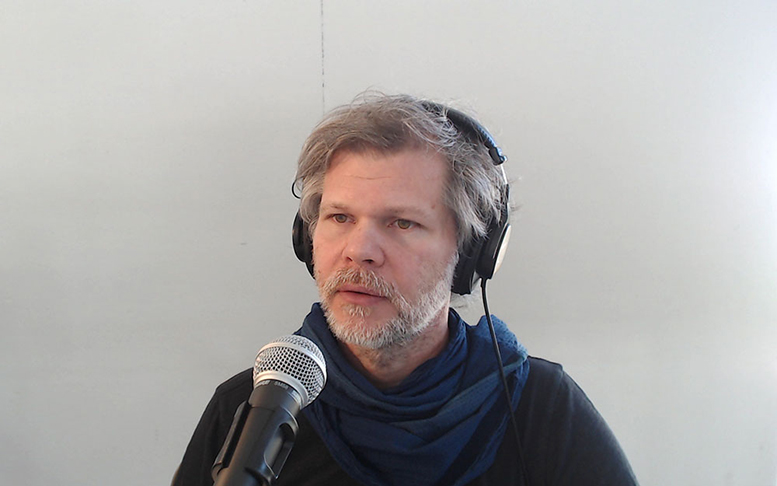
Casey Reas at his home studio/classroom. Image courtesy Casey Reas.
"For me, being in the classroom and having direct conversations with people about the work is where the learning really happens," said Casey Reas, an artist and a professor in the Design Media Arts department. His class this quarter, Interactivity, involves writing code to create software for visual media, such as "their own miniature version of a digital painting program."
Reas broke up a long three-hour review class into smaller groups for 45-minute reviews, after realizing that smaller groups worked better for online reviews.
"I think in a lot of classes in DMA, there is an amount of technical learning that happens and that kind of learning is very well suited to remote instruction," Reas said. "But that's not what being a student at UCLA is really about... It's community and critical thinking and learning through looking at other people's work and analyzing other people's work. I mean, that can happen to an extent in the remote instruction, and it does, but it's greatly diminished."
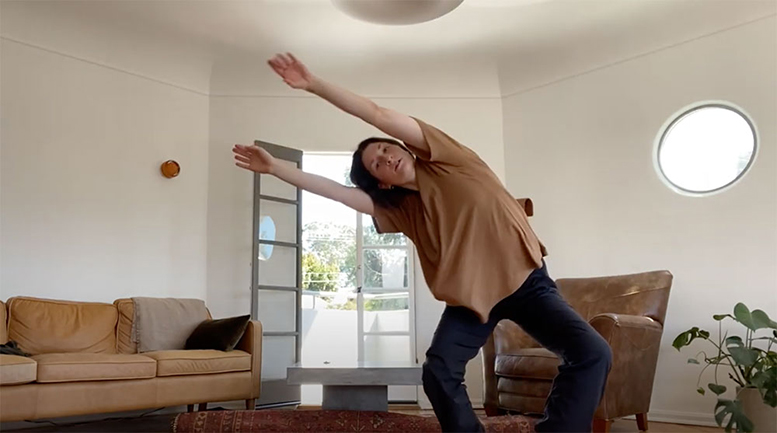
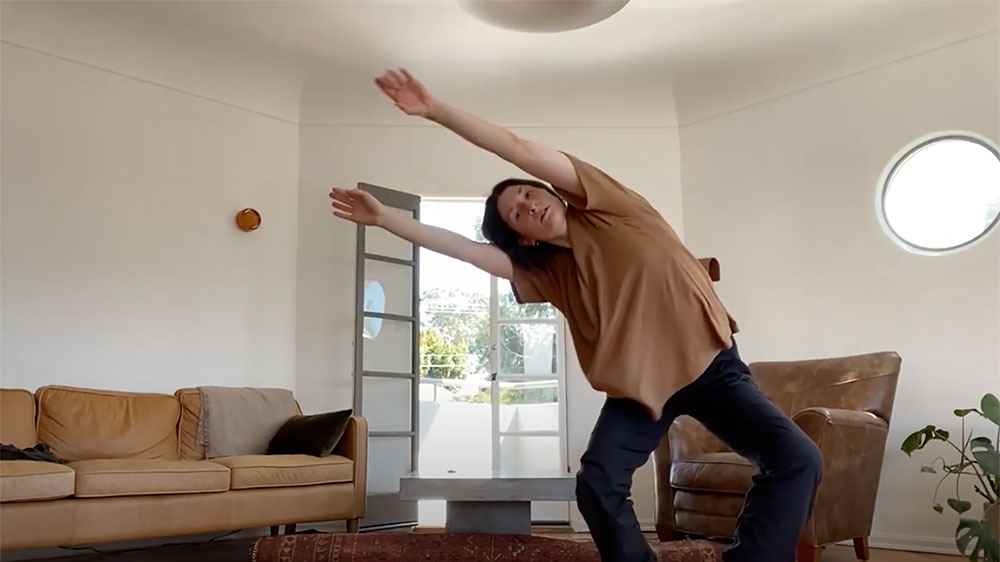
A screenshot of the dance videos that Gracie Whyte is making for her dance students. Image courtesy Gracie Whyte.
"We're so used to being physical all the time and finding that motivation," said Gracie Whyte, a dancer, choreographer and adjunct faculty member in the department of World Arts and Cultures/Dance. "It's really easy when you have to show up in class and then you start moving and you're like, 'yay, okay, everything's fine.' But for the students who don't have reliable Wi-Fi, it's just a lot harder to find that motivation."
Whyte is teaching dance, and making instructional dance videos, in her living room. But her students' lack of space to move around has also forced her to rethink her choreography.
"There's no traveling through space, which is a large part, obviously, of the dancing," she said. "Some people are dancing in their kitchens and they don't have space to, like, fly a limb."
Whyte has found inspiration in how her friends and fellow dance instructors are adapting to these new restrictions.
"What's really interesting to me is how everyone is doing it really differently... whether it's the prerecorded [videos]... or people are using TikTok, there's just lots of different approaches. And I think it says a lot about dancers and our sense of creativity."
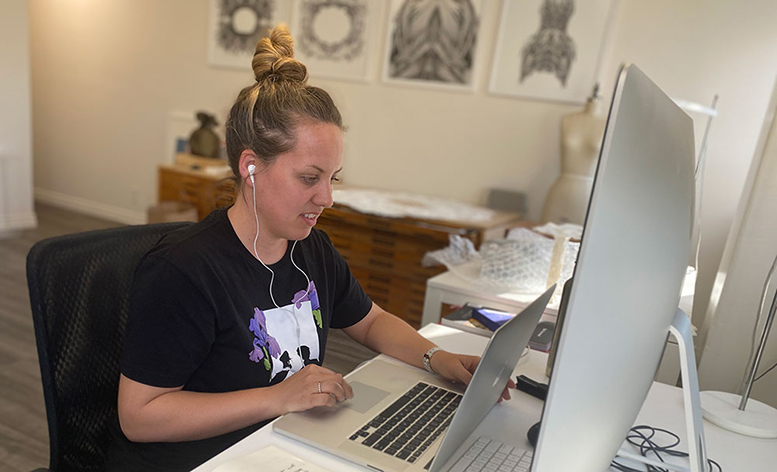
Julia Koerner, an assistant adjunct professor in the Architecture and Urban Design department, is bringing guest speakers to her Zoom classes to share the latest innovations in construction materials and techniques. Image courtesy Julia Koerner.
For architects-in-training, getting to tour a building construction site is an exciting opportunity to see theory carried into the real world. Julia Koerner, an assistant adjunct professor in the Architecture and Urban Design department, had to rethink her Advanced Building Construction class because site visits were no longer possible. Instead she's emphasizing novel fabrication techniques and the use of advanced construction methods and materials. She's invited top builders and industry leaders from around the world to speak to students directly in her Zoom lessons.
"It allows everyone to be closer because they have the ability to all sit in the front row, essentially," said Koerner.
Story by Avishay Artsy
Stay engaged. Use #UCLAarts to stay connected.


