How Judy Baca’s murals help recover history through ‘public memory’
Judy Baca, professor in the Departments of World Arts and Cultures/Dance as well as Chicano/a Studies at UCLA has served as the Founder/Artistic Director of the Social and Public Art Resource Center (SPARC) in Venice, California since 1976. As a visual artist and one of the nation's leading muralists, Baca is best known for her large-scale public art works.
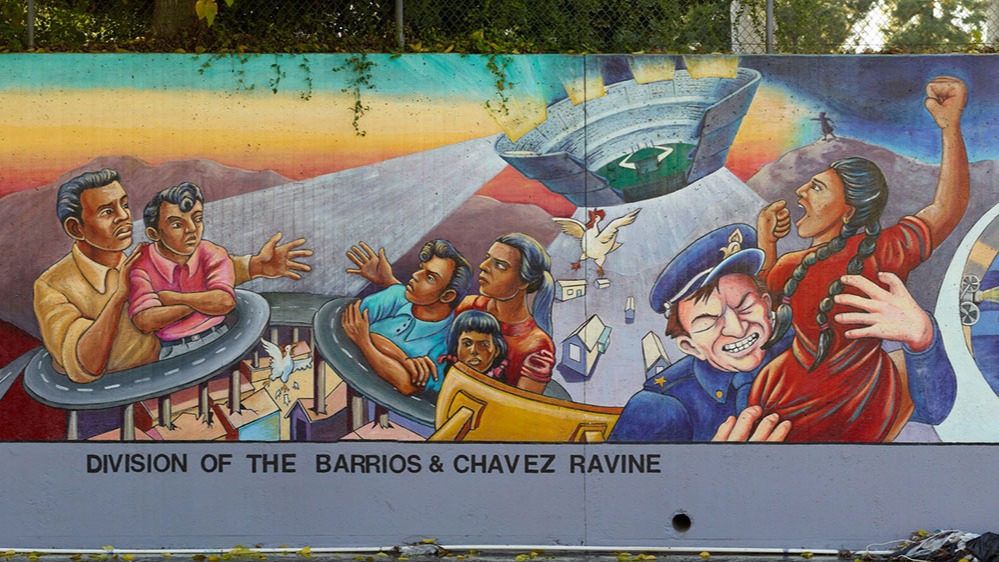
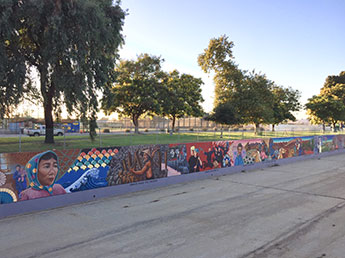
Judy Baca’s mural covers lesser known histories of LA’s communities of color. Photo courtesy of SPARC Archives. A new exhibit at the Museum of Latin American Art in Long Beach, California, looks at the monumental scale and achievement of an artist capturing the untold stories of Los Angeles. Jeffrey Brown took a look at the work of Judy Baca for our arts and culture series, CANVAS.
Jeffrey Brown:
It runs a half-mile along the concrete banks of a river in the San Fernando Valley, 13-foot-high panels that tell a history of a city.
It's called The Great Wall of Los Angeles, one of the largest murals in the world, designed and painted, with a little help from her friends, by Judy Baca.
Judy Baca, Visual Artist:
The story I wanted to tell was the story of the history that wasn't recorded in the history books, the history of people of color, the history of women, of indigenous people, to look at what was missing from the story of America, and to reconstruct that and teach it to the young people, who'd begin to learn about each other.
Jeffrey Brown:
Many of the ideas and stories came from local community members. And so did the actual painting, the work of some 400 people working hand in hand with Baca.
It was the 1970s and early '80s, the beginnings of a commitment to a public art that would reach and benefit those around her. Fast-forward to today, a celebration of that commitment in her first major retrospective exhibition of more than 120 works at the Museum of Latin American Art in Long Beach.
Judy Baca:
All of them are based in the notion that the land has memory, and that, if I put my ear to the ground, I can hear it, and that I can then articulate it visually.
Jeffrey Brown:
Now 75, Baca grew up in the L.A. neighborhoods of Watts and Pacoima, raised by a single mother who worked at the Goodyear tire factory and a grandmother deeply attuned to the land.
Judy Baca:
So, I came out of tradition that was both indigenous and also the tradition of a contemporary woman in the United States, a Chicana born here in the United States.
— Jeffrey Brown and Lena I. Jackson, Nov. 30, 2021


This post is an excerpt. Read the full article on the PBS website.
Stay engaged. Use #UCLAarts to stay connected.


