How Judy Baca Redefined the Intersection of Art and Activism
Judy Baca, professor in the Departments of World Arts and Cultures/Dance as well as Chicano/a Studies at UCLA has served as the Founder/Artistic Director of the Social and Public Art Resource Center (SPARC) in Venice, California since 1976. As a visual artist and one of the nation's leading muralists, Baca is best known for her large-scale public art works.
Judy Baca, “Josefina: Ofrenda to the Domestic Worker (Homenaje a la Trabaiadora Doméstica)” (1993), digital print on canvas, 14 x 6 feet (collection of the artist) LONG BEACH, Calif. — For 50 years Los Angeles-based artist Judy Baca has been creating sites of public memory. Through her collaborative murals, multimedia art, and teaching she has redefined what it means to work at the intersection of art and activism. Now, for the first time, you can visit a retrospective exhibition that celebrates her impressive career.
Judy Baca: Memorias de Nuestra Tierra, a Retrospective, on view at the Museum of Latin American Art (MOLAA) in Long Beach through January 2022, is co-curated by MOLAA chief curator Gabriela Urtiaga and guest curator Alessandra Moctezuma, the gallery director at San Diego Mesa College, who came to know Baca as her painting assistant in the 1990s. While Baca is best known for her large-scale public murals, this exhibition highlights the expansiveness of her practice, bringing together more than 120 works in a range of media including painting, sculpture, installation, and a series of intimate works on paper that have never been publicly shown.
Eschewing the white box, as Baca has done throughout her career, the curators painted the galleries various shades of red, blue, and yellow, and the convictions that once kept Baca out of the mainstream art world — her entrenchment in community activism, collaborative practice, and commitment to amplifying marginalized voices — are what give this presentation its undeniable power. Despite the importance of Baca’s work, and her influence on a generation of students as a professor in the Cal State and University of California systems, decades of entrenched art-world racism, gender bias, and resistance to overtly political displays in art have delayed a comprehensive treatment of her career until now.
Coming of age in the late 1960s, Baca was active in Los Angeles’s anti-war, feminist, and Chicano civil rights movements. She knew she wanted to be a different kind of artist. “I somehow wanted my work to matter. I didn’t want to create work that went to white boxes,” she explained to me when we spoke. “I wanted to make work to go to where my family was and where my community was.” Baca began her studies at California State University Northridge in the wake of the 1965 Watts Rebellion, a six-day uprising precipitated by police violence against residents of the predominantly African American neighborhood (where Baca spent her early childhood). In 1970, a year after completing her BFA, she joined the Chicano Moratorium, which brought out massive numbers of Chicano protesters in opposition to the war in Vietnam and its disproportionate toll on the Chicano community. — Jordan Karney Chaim, Aug. 24, 2021



This post is an excerpt. Read the full article on the Hyperallergic website.
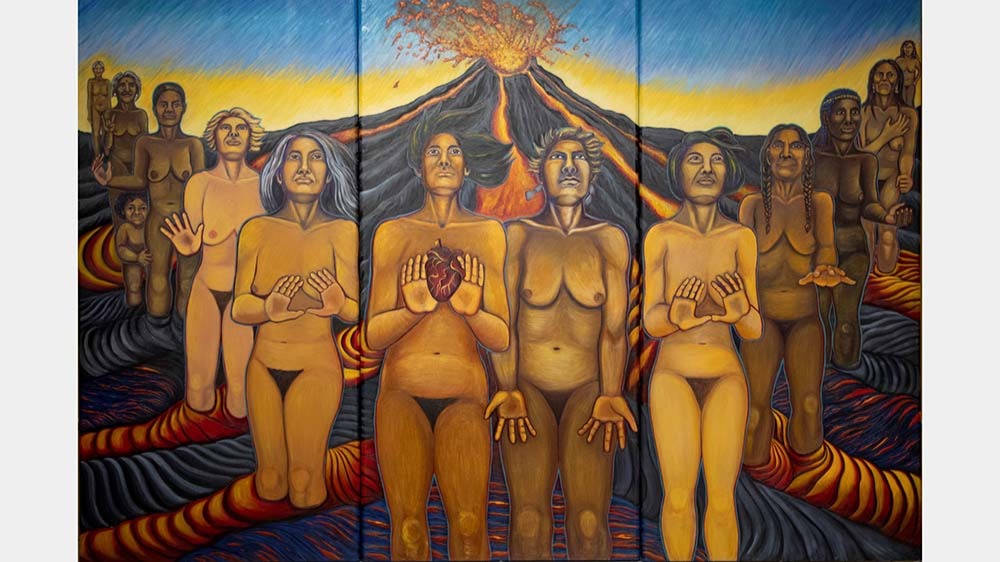
HEADER IMAGE: Judith F. Baca, "Matriarchal Mural: When God Was A Woman" (1980–2021), double-sided triptych: “Thirteen Women in the Volcanic Eruption” (side one), acrylic on wood panels, 8 x 12 feet; collaborators: 2021 Painting Assistants: Martha Ramírez-Oropeza, Gina León, 1980s: Julie Ruelas and Yreina Cervantez, plus 10 additional women (MOLAA Permanent Collection)
Stay engaged. Use #UCLAarts to stay connected.


