How does a human critique art made by AI?
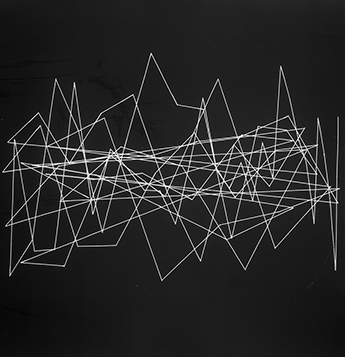
"In 1962 something unusual happened at Bell Labs in Murray Hill, New Jersey. After a long day tending the room-size IBM 7090, an engineer named A. Michael Noll rushed down the hall with a printout in hand. The machine’s plotter had spit out an arrangement of lines. The abstract design on the sheet could have passed for a work in the print section at a museum of modern art. Noll had decided to explore the machine’s creative potential by having it make randomized patterns. Noll’s breakthrough would eventually be called “computer art” by both fellow programmers and cultural historians. His memo announcing the creation to the Bell Labs staff, however, was more measured: “Rather than risk an unintentional debate at this time on whether the computer-produced designs are truly art or not,” he wrote, “the results of the machine’s endeavors will simply be called ‘Patterns.’”
A. Michael Noll: Gaussian-Quadratic, 1963, gelatin silver print, 30 inches square.

The idea that machines can mimic certain aspects of human reasoning—thus becoming “artificially intelligent”—stretches back to the birth of information theory in the 1940s. But for decades after the first experiments in digital “thinking,” little to no progress was made. Prognostications about a cybernetic future stalled and funding dried up, in what researchers referred to as an “AI winter.” But recently, optimism has returned to the field. In the past several years, machine learning algorithms—powered by a deluge of images from social media—have advanced enough that artificial neural networks produce images that some say exhibit creativity in their own right.
AI was already capable of automating rote, mechanical tasks. But its newfound ability to generate images has inspired a resurgence in the debate about machine creativity. It also prompts the question of what art critics can say about work made by computers. Criticism plays a key function in the humanist tradition as a mediator between institutions and the public. Not only do critics tie cultural production to its historical and socioeconomic context, but they also highlights art’s role in cultivating the democratic values of empathy and egalitarianism. Three recent books offer possible paths for criticism that addresses creative AI. But all of them have serious shortcomings.
Noll’s “patterns” are the earliest examples cited by Arthur I. Miller in his book The Artist in the Machine: The World of AI-Powered Creativity (MIT Press, 2019). A historian of science, Miller grounds his writing on AI in his longtime interest in creativity and genius. “The world of intellect is not a level playing field,” he writes. “No matter how diligently we paint, practice music, ponder science, or write literature, we will never be Picasso, Bach, Einstein, or Shakespeare.” Miller begins from the premise that the brain is, like the computer, an information processor. Computers and artists alike ingest data, apply rules, and adapt them to create something novel. The genius brain makes connections better and faster than the average one, like a computer with more processing power. If creativity is, as Miller defines it, the production of new knowledge from already existing knowledge, then the computer may someday have the capacity to match and exceed the human brain.
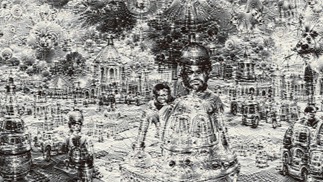
Miller’s book pays special attention to Alexander Mordvintsev’s DeepDream, a 2015 breakthrough for machine creativity. While working for Google as a computer vision engineer, Mordvintsev interrupted a deep neural network trained on images of dogs and cats. His intervention rendered a momentary visual trace of the network’s attempt to spot patterns in data. The result was an image of a technicolored chimera, half-dog and half-cat, that spliced together parts of the reference image (a kitten and a beagle perched on adjacent tree stumps) with thousands of other images of similar subjects. It was dubbed “Nightmare Beast” after it went viral on the internet.
Miller discusses a host of other engineer-artists who have helped advance the growing phenomenon of art made with neural networks. In Portraits of Imaginary People (2017), Michael Tyka drew upon thousands of portrait photos from Flickr to create images of people who never existed. Leon Gatys’s style-transfer work employs a neural network to make found images resemble paintings by Rembrandt, Cézanne, and Van Gogh. Miller doesn’t fully explain how these images exhibit creativity. The computer makes decisions about colors and brushstrokes, but its transformations are more of a novelty act than the creation of original work.
Almost all of Miller’s triumphant examples employ unsupervised learning, in which a neural network generates images by itself. A more specific subset of this process used by artists is known as a generative adversarial network (GAN), which involves two dueling neural networks: the discriminator, which is trained on real images, and the generator, which scrambles pixels to make completely new images. The generator sends each image it makes to the discriminator, which judges whether or not the image is made by the generator.
GAN art engages only in combinatorial creativity, meaning it synthesizes existing image data to make something slightly new, based on its imperfect ability to correlate an image to assigned metadata. Mordvintsev fed a neural network images of cats and dogs, then interrupted it midstream to watch it try to build a cat or a dog itself from scraps. The GAN is cognitively inferior to a newborn child. It needs to be fed source material specifically and carefully. One of AI-art criticism’s first tasks will be to show the public that supposedly “smart” technologies are, in practice, quite dumb. Just because GANs employ unsupervised learning—meaning there is no predefined output—does not make them creative.
Artist Casey Reas details the many steps involved in the production of GAN art in Making Pictures with Generative Adversarial Networks (Anteism Books, 2020). One of the developers of the generative art software Processing, Reas provides a text that is part “how to,” part reflection on the aesthetic capacities of the method. It is the best account so far of how a critic might engage with the end product of something on the order of DeepDream.
To start, Reas is adamant that with each step in the highly complex process of working with GANs, the artist makes critical interventions. First, one must select and upload a large set of images. Reas compares this process to a photographer’s choosing subjects, staging, and equipment. Second, one makes adjustments to interrupt or influence the neural network’s output. These choices are often speculative, and the end result is always a matter of testing and learning. Reas describes it as coaxing images from the “latent space.” No one is sure exactly how the networks’ layers learn, and thus, no one is quite sure why the networks modify images the way they do.
Reas gives a sober assessment of the role of the artist vis-à-vis these nascent tools. He is neither utopian about superhuman powers nor dismissive of AI-based creative output, as limited and contrived as it may be. Instead, he lays out the points of entry for criticism. Anywhere the artist directly intervenes, the critic may follow. A critic writing about DeepDream could, for example, point to the narrowness of Mordvintsev’s selection of images of cats and dogs, and how the end product suffered as a result. Or the critic could comb through the various versions produced by the neural network and judge the relative merits of each composition. Both of these approaches treat the artist-engineer as a curator, as someone whose primary work is the selection of images. This is because the true moment of machine creativity is illegible to humans. If it weren’t, then there would be nothing artificial about its intelligence."— Mike Pepi, May 6, 2020

This post is an excerpt. Read the full article on the Art In America website.
Read more about Casey Reas.
Stay engaged. Use #UCLAarts to stay connected.


