How Brenton Zola Transformed Tradition Into Innovation
Meet Brenton Zola, Graduate Student Speaker for UCLA Arts 2024 Commencement
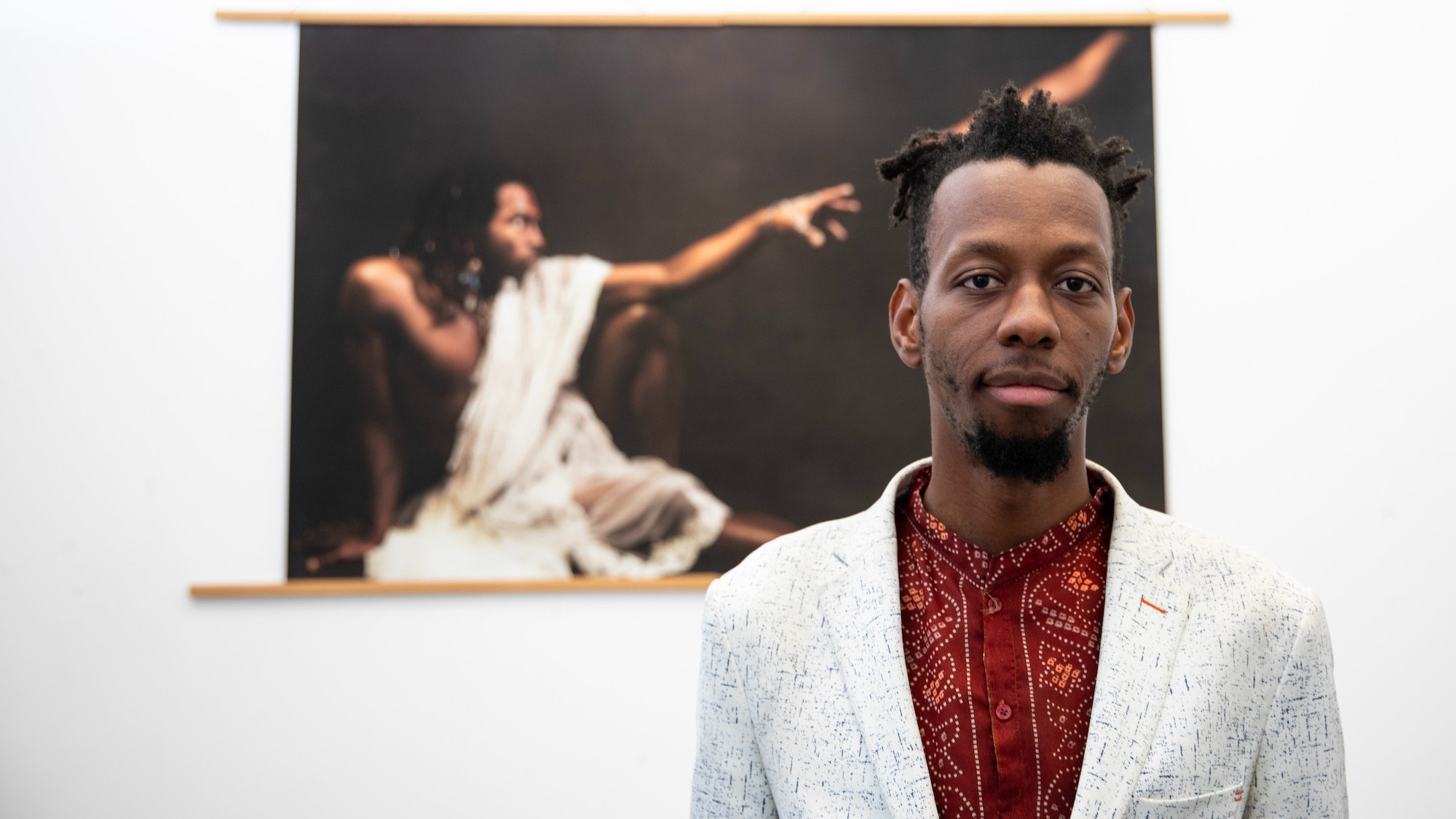
Brenton Zola is descended from a long line of Congolese spiritual leaders and orators. His great grandfather was Charles Kisolokele, who was the first person named to Patrice Lumumba’s democratic government after Congo’s independence from France. In 1921, Charles’ father, Simon Kimbangu, founded Africa’s most successful anti-colonial spiritual movement, Kimbanguism. It’s now followed by millions around the world.
Brenton’s work is heavily informed by this rich family history and infused with spirituality. Although he finds inspiration from tradition, Brenton is an innovator. He takes risks, is excited to learn anything and everything, and refuses to fit into a box.
“I would characterize my work as performance and media-based interactive interventions, usually around the themes of ritual, myth, and the body,” Brenton said. “A lot of my work interrogates how we look at Black and Brown bodies in society and space”
With one such interrogation, Brenton created a photo series where he reinterpreted Renaissance artwork with Black, trans, and queer figures.
“I was thinking about how we can imagine and envision Black bodies in a sanctified space,” he said.
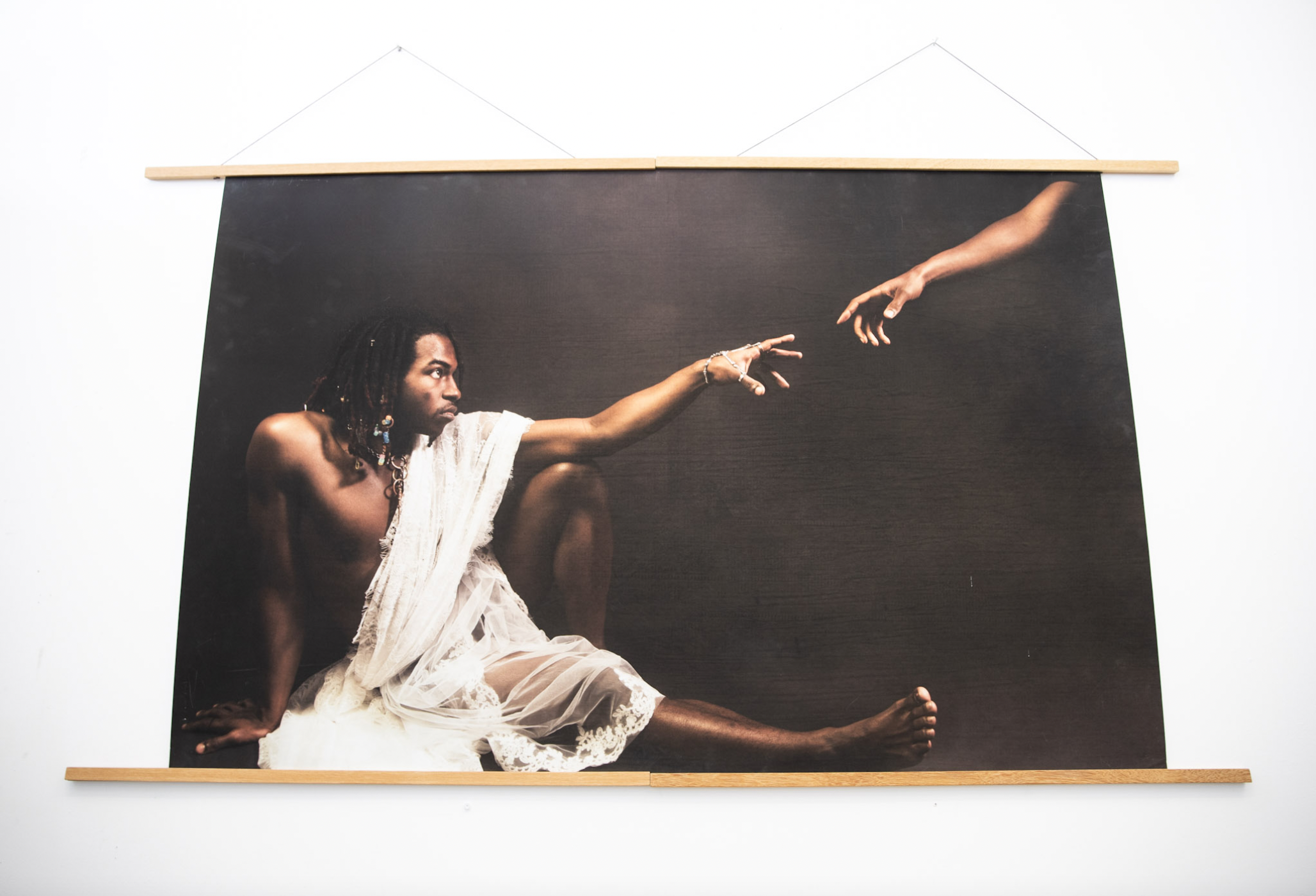
Brenton Zola reinterpreted Michelangelo’s The Creation of Adam. (Lucza Brewer / UCLA Arts)
Being an artist, however, wasn’t always a viable career path for Brenton. He grew up in Denver, Colorado. His parents were both African immigrants and for part of his childhood they were unhoused.
“I didn't have too much time to think about normal childhood things, but once we got settled, I became interested in a lot of different performing arts,” Brenton shared. “I love theater. I was a huge debate nerd. I love to dance.”
The body, for Brenton, is more than a tool to be exercised or even abused; it’s a sacred instrument. For years, he “never actually listened to its wisdom.” That has since changed — especially when it comes to exercising his voice. He joked that he’s been accused of being loud.
“I'm not intending to be loud,” Brenton said, laughing. “My parents are both very loud people. I remember when I was young my mom would take long baths, and I'd always hear her outside the door screaming Bob Marley or Tupac lyrics. Being African, we're so into using our body. We express ourselves in the fullest possible way.”
In late April, Brenton orchestrated The Big Sing, his capstone project for the Department of Design Media Arts (DMA), where he invited 70 strangers to UCLA on a Saturday afternoon to sing together — for three hours.
The impromptu choir was modeled after African song circles. Brenton handled the musical arrangements and spent an hour teaching the group of vocalists, some of whom were experienced singers and many of whom were amateurs. Together, they sounded magnificent.
It was recorded with a 360-degree video camera (provided at the last minute by classmate Jules Johnston) and later presented as a three-panel video at the New Wight Gallery, a student gallery at UCLA’s Broad Art Center.
“I had an African music teacher who would always tell me that singing is not an art form or an activity — it's a birthright,” Brenton said. “I've carried that with me for a long time. There are so many people who think, ‘Oh, I can't sing or I can't make art.’ All of our voices are valid.”
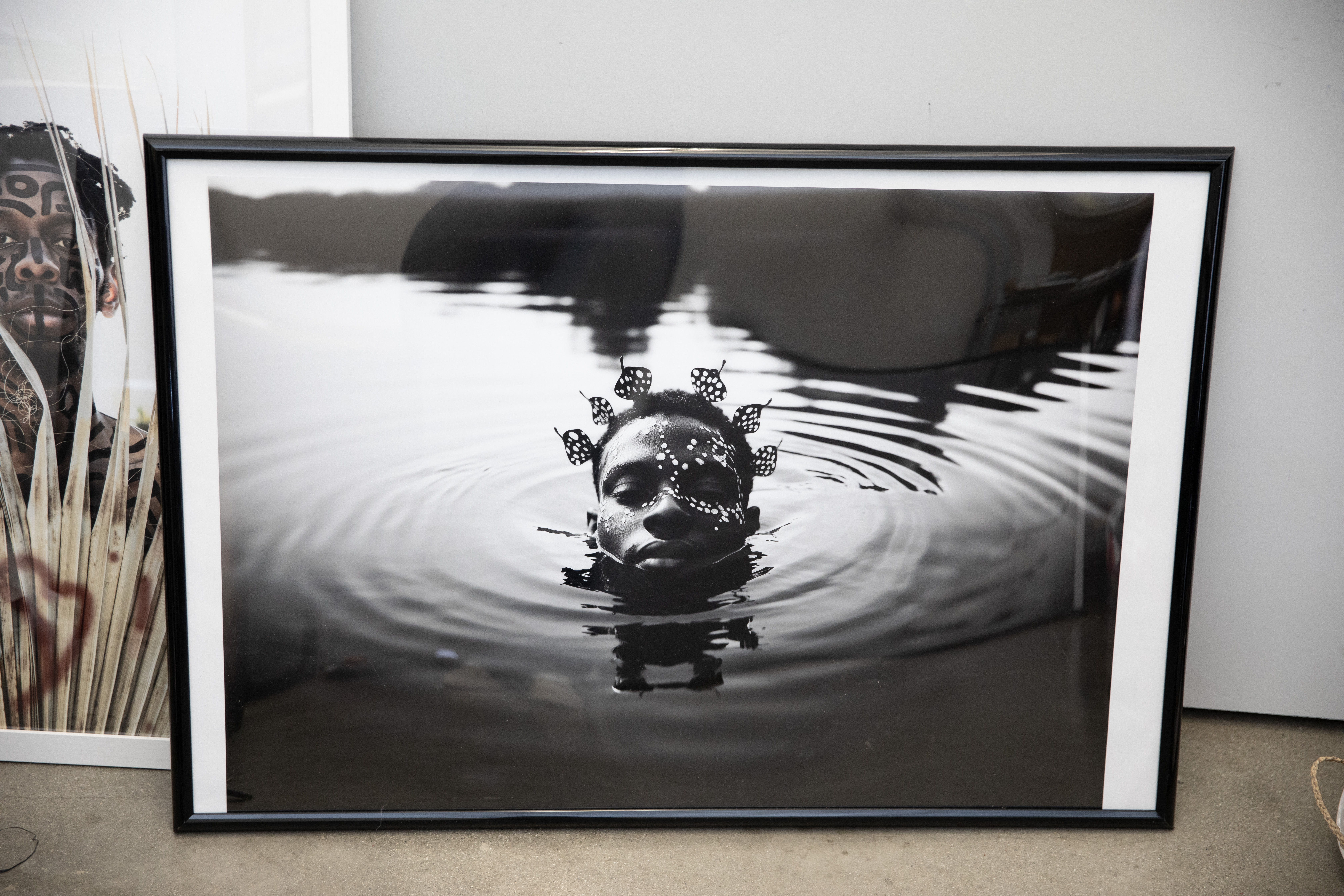
A photowork in Brenton's Broad Art Center studio. (Luzca Brewer / UCLA Arts)
Interdisciplinary projects like The Big Sing — which combine “ancient” with modern technology — were what drew Brenton to DMA’s M.F.A. program. It’s a program that, in many ways, is purposefully difficult to pin down. Students are encouraged to create work that melds a range of disciplines: performance, programming, digital, and analog art among others.
Brenton studied for four years at a small liberal arts college in Walla Walla, Washington He knew after graduation that wherever he went next, it had to be a big city. He spent several years traveling and working around the globe after his undergraduate studies.
Once he was ready to think about graduate school, the UCLA School of the Arts and Architecture made perfect sense: it’s in a global metropolis, the faculty are all respected working artists, and the school offered the resources he needed to develop his practice. Upon arrival, he immediately began to integrate more video, music, and digital media into his work.
“There were some aspects of my media practice that I wanted to improve, to sharpen,” Brenton said, “but also there were things I wanted to learn that I didn't know anything about, like projection mapping or virtual reality.”
After graduation, Brenton has big plans. He wants to remain in Los Angeles and continue his studio practice, but would also like to continue to engage with academia. Teaching is one possibility. He’d also like to publish a book. He already has a few ideas.
But what’s immediately next?
Brenton will serve as the graduate student speaker at the UCLA School of the Arts and Architecture’s commencement ceremony on Saturday, June 15.
He described the opportunity as “kismet.”
“I remember being at graduation last year and thinking, ‘Wow, it would be really cool to be the graduate student speaker,’” Brenton said. “It's a big honor, and coming from a family of orators and political leaders, I feel like I’m honoring their legacy.”
By Sean Arenas
Header image: Brenton Zola stands before his artwork in his studio. (Lucza Brewer / UCLA Arts)
Stay engaged. Use #UCLAarts to stay connected.


