Hammer Museum’s exhibits mesh contemporary art with politics, history
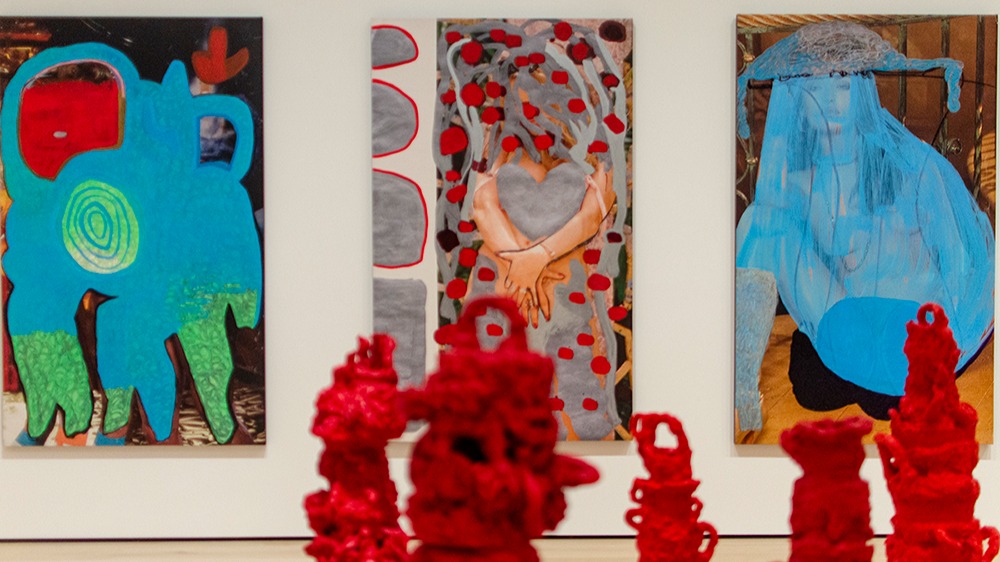
Pauline Boudry / Renate Lorenz, "Telepathic Improvisation," 2017. (Kanishka Mehra/Daily Bruin senior staff) Crisp, cloudless skies, coffee brewing and two new shows at the Hammer Museum – it’s autumn in Westwood.
The two exhibits, “Witch Hunt” and “No Humans Involved,” were years in the making when the 2020 museum closure postponed them, said Hammer Chief Communications Officer Scott Tennet. In addition to a show featuring Los Angeles artist Andrea Bowers scheduled for summer 2022, these are the last exhibits the Hammer planned before the COVID-19 pandemic, and Tennet said these autumn shows feature an international lineup of artists.
“Finally having a chance to show these exhibitions is really great,” Tennet said. “A lot of these artists are having, in ‘No Humans (Involved)’ in particular, their first big shows in Los Angeles.”“Witch Hunt” features work by 16 midcareer women from 13 countries, with 10 pieces displayed at the Hammer and five at the Institute of Contemporary Art, Los Angeles. Planning for “Witch Hunt” began in 2017 in the wake of the United States presidential election, said Connie Butler, Hammer chief curator and co-curator of the exhibit.
As seen in both “Witch Hunt” and “No Humans Involved,” Butler said the Hammer likes to wear politics on its sleeve and readily takes on political issues in its public programs and exhibitions. She said the issues marginalized people face – whether speaking to the Black experience or the experiences of women – are broad but that responding to contemporary culture is a goal of the museum.
“We thought, ‘Let’s mount a really tough, powerful show because we all thought Trump might be reelected,’” Butler said. “Now, with what’s going on in Texas around reproductive rights and different voting rights in this country, these issues are still incredibly topical.”
But the feminism in “Witch Hunt” is broadly defined, Butler said. “Witch Hunt” is critical of the exclusion of women of color in feminist history and brings environmental, queer and anti-colonial issues into its scope, she said. Common threads run through the show, she said, such as the theme of craft and materiality present in Otobong Nkanga’s tapestries “Double Plot” and “The Leftovers.” But the objects are not in conversation with one another as “Witch Hunt” highlights the 10 artists as individuals, she added.
“These are incredibly mature practices of art,” Butler said. “They know what they’re doing. They command space. We wanted to be respectful of all of that, and we wanted to make the case for multiple feminisms, multiple ways of approaching the subject of history.” — David Egan, Oct. 13, 2021



This post is an excerpt. Read the full article on the Daily Bruin website.
HEADER IMAGE: The Hammer Museum launched its two major fall exhibits “Witch Hunt” and “No Humans Involved” on Sunday, which were originally planned for before the COVID-19 pandemic. (Kanishka Mehra/Daily Bruin senior staff)
Stay engaged. Use #UCLAarts to stay connected.


