Gurmukhi Bevli and Catherine Deal to speak at the 2025 UCLA Arts commencement ceremony
Meet this year's student speakers for the UCLA Arts commencement ceremony on June 14

Meet the student speakers for this year's UCLA Arts commencement ceremony: graduate student Gurmukhi Bevli (World Arts and Cultures/Dance) and undergraduate student Catherine Deal (Architecture and Urban Design). They will speak on Saturday, June 14, at Dickson Court North (Perloff Quad). For more information about the 2025 UCLA Arts commencement ceremony, visit the school’s commencement website.
Gurmukhi Bevli Melds Choreography and Cultural Memory
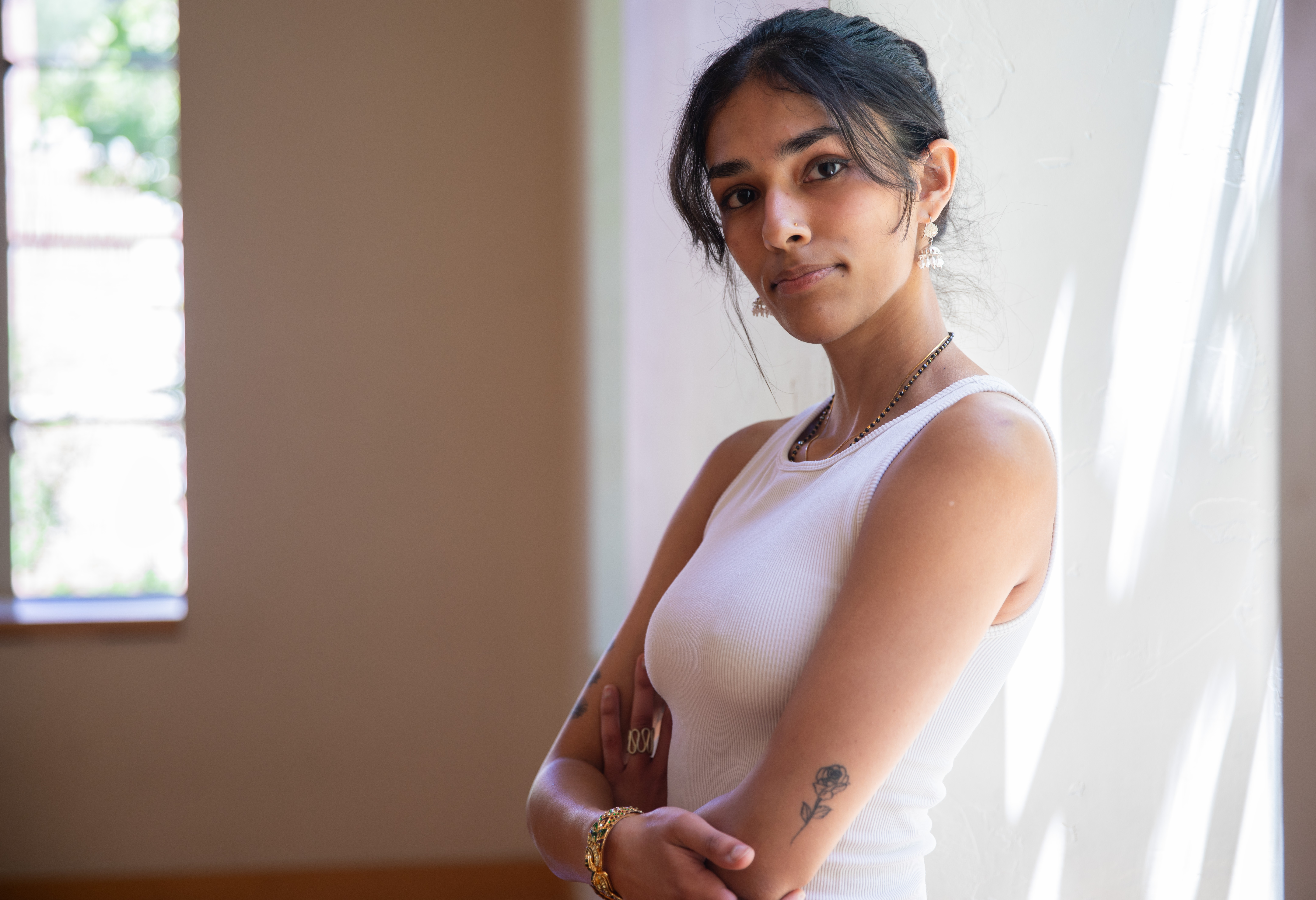
Photo of Gurmukhi Bevli. (Lucza Brewer / UCLA Arts)
When Gurmukhi Bevli arrived at UCLA as an undergraduate in 2018, dance was not part of her academic plan. Raised in a STEM-focused household and set on a path toward engineering, she applied to the UCLA Department of World Arts and Cultures/Dance, or WACD, on a whim.
To her surprise, she was admitted. What started as an impulsive audition became a calling.
“The audition felt holistic,” Bevli recalled. “It wasn’t about having the perfect technique or looking a certain way. The values of the department just felt special.”
Bevli has spent the past several years expanding the boundaries of dance and choreography, both as a performer and as an educator. Her work blends movement with memory, South Asian diasporic identity, and post-colonial politics, often rooted in deeply personal and historical inquiry.
While she initially double-majored in neuroscience and dance, Bevli eventually felt pulled toward the latter—particularly during the isolating years of the COVID-19 pandemic. “I couldn’t envision a life without dance and choreography,” she said.
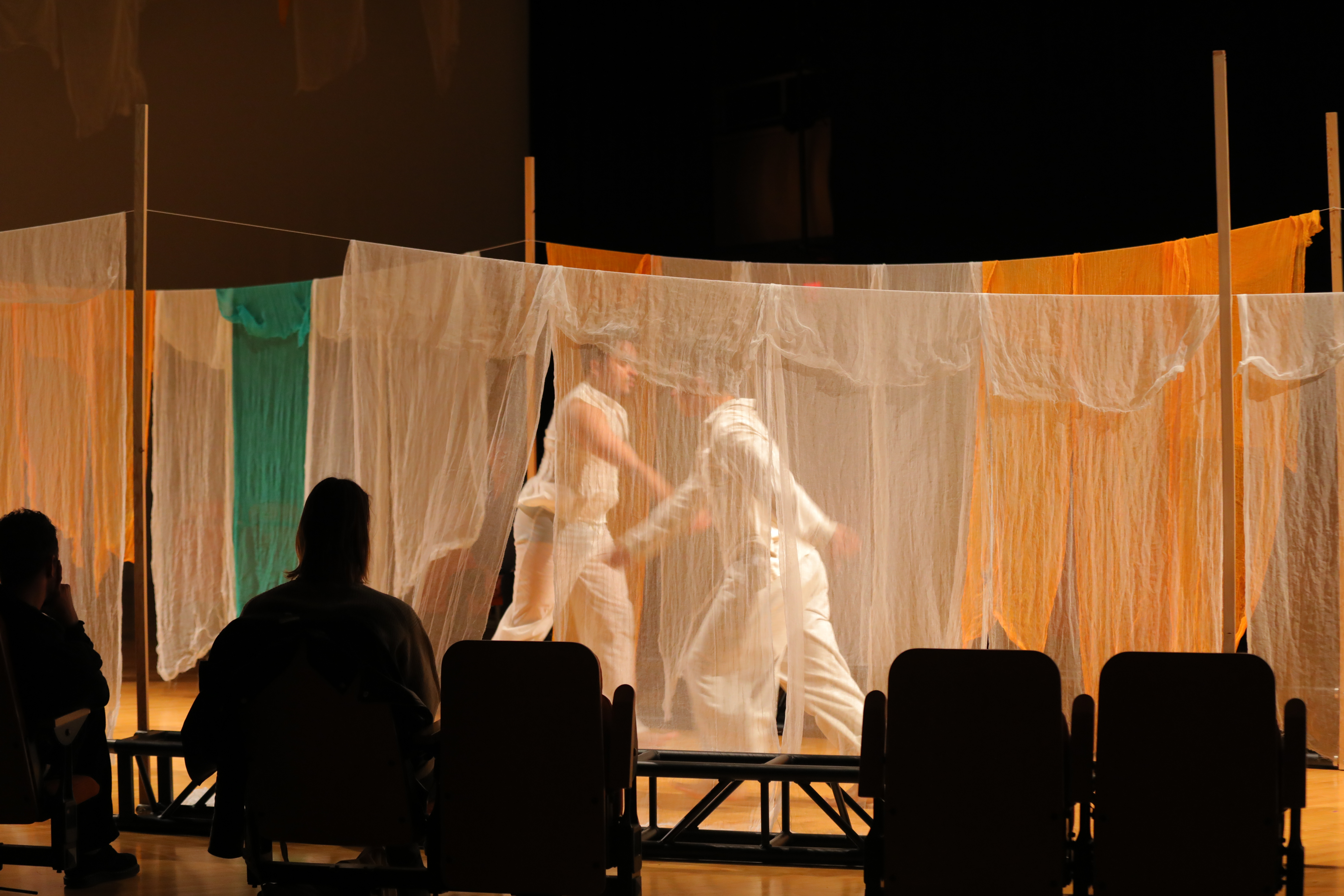
Dress rehearsal for Gurmukhi Bevli's Thread Count. (Gunindu Abeysekera)
That sense of necessity led her back to UCLA for her M.F.A. in Choreographic Inquiry, driven by unanswered questions that emerged during her undergraduate thesis—an investigation into migration and personal history. Her research focuses on the 1947 Partition of India and Pakistan, a historical trauma marked by mass migration, violence, and loss of identity. Through choreography, Bevli examines how generational memory travels across bodies and time, and how diasporic identities hold fractured histories.
“I think about how a body can resist wholeness,” she explained. “What does it look like to fragment movement? To destroy cohesiveness in action? And how does memory embody itself in the process?”
Her thesis performance, Thread Count, staged as part of a shared M.F.A. concert titled With Our Consent?, translated those questions into visceral experience. Constructing a clothesline onstage, Bevli used fabric to divide the audience, evoking the literal and symbolic meanings of the Partition. Attendees were forced to choose where to direct their attention, inevitably missing parts of the performance happening elsewhere.
“I wanted to create a container where you're complicit in what you're ignoring,” she said. “It was a meditation on visibility and how proximity forces attention—but at a cost. The audience literally couldn’t see the bigger picture, and they became invested in trying to see what was happening on the other side. In doing so, they ignored what was right in front of them.”
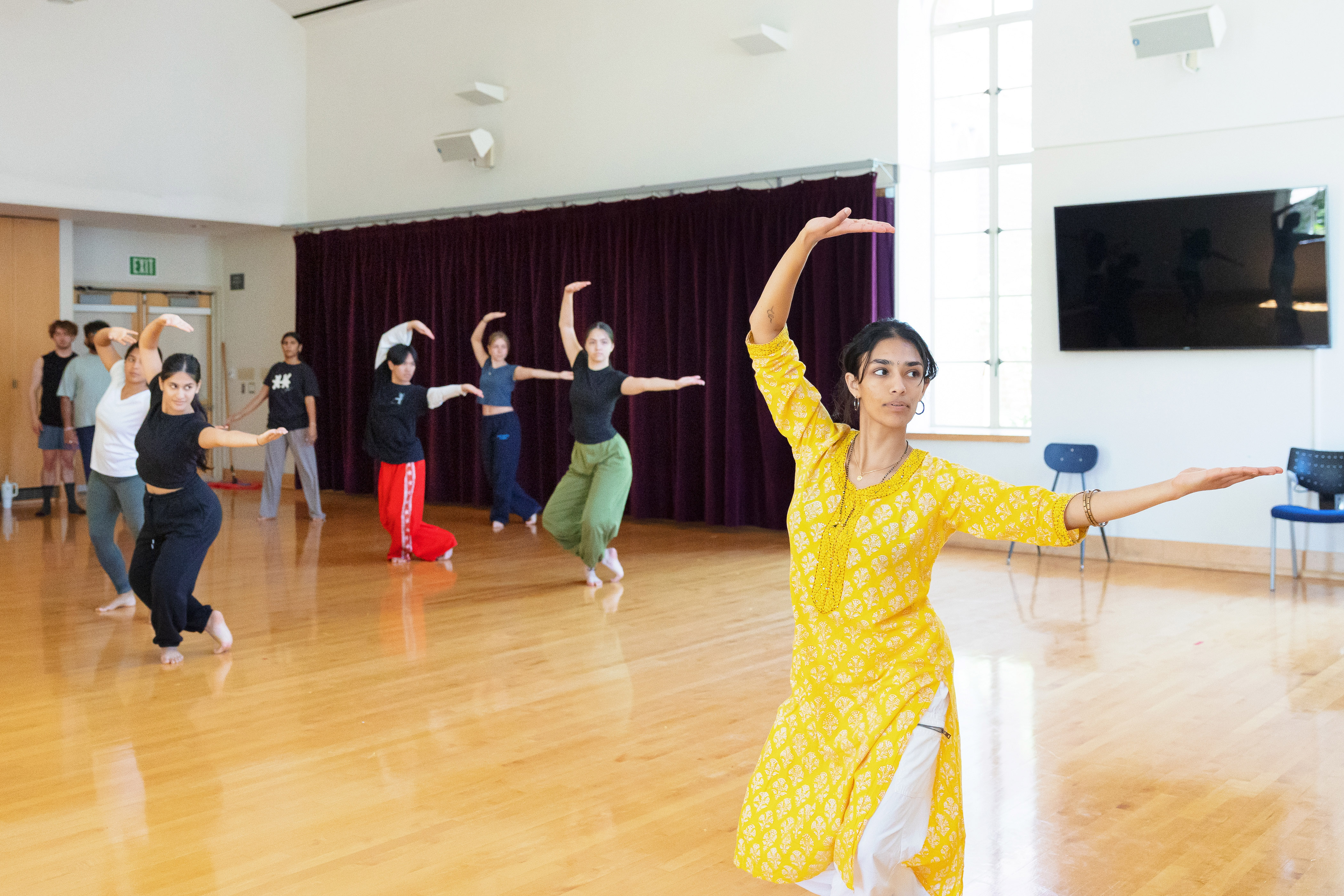
Gurmukhi Bevli teaching Bharatanatyam at UCLA. (Sarah M. Golonka)
Her time at UCLA has been shaped by mentorship and community. Research Professor Dan Froot, her undergraduate thesis advisor, helped her see dance as a viable career. Other faculty members, including Will Rawls, David Roussève, and Anurima Banerji, opened her eyes to new ways of thinking about performance.
Teaching, too, has been transformative. Bevli has led classes in modern dance and Bharatanatyam, an Indian classical dance form. She described her students as curious and refreshingly unafraid of failure. “They’re willing to experiment,” she said. “There’s something liberating about being in a room full of people who aren’t afraid to get it wrong in pursuit of getting it right.”
After graduation, Bevli intends to continue teaching and is interested in exploring what she calls “pedestrian movement”—the simple, unnoticed gestures of daily life like folding laundry or brushing teeth. “Performance is all around us,” she said. “Just because something isn’t labeled as art doesn’t mean it’s not choreographed by lived experience.”
Bevli’s work is a reminder that dance is not just movement—it’s a language for remembering. In a world shaped by borders and migration, her choreography demonstrates the power of embodied knowledge, one step at a time.
Catherine Deal’s Journey from Curiosity to Calling

Photo of Catherine Deal. (Lucza Brewer / UCLA Arts)
For UCLA Architecture and Urban Design (AUD) student Catherine Deal, architecture isn’t just a career path—it’s a legacy. Her earliest inspiration came from her grandmother, Celina Yu (née Hsieh) ‘66, who immigrated from Hong Kong to study architecture in Los Angeles. Yu would go on to break barriers in the field, becoming the first woman to lead a project for Disney Imagineering and contributing to major projects like the Los Angeles Metro system.
“She’s honestly the coolest person I know,” Deal said. Despite this strong familial connection to the field, she didn’t initially see architecture in her future. In high school, Deal explored a range of disciplines—from coding and game development to marine biology and forensic science. She wasn’t just dabbling. She took courses, attended specialized programs, and pursued each interest to see what fit.
But none of these fields resonated with her. It wasn’t until she took an online summer course in architecture during the COVID-19 pandemic that something clicked.
AUD’s B.A. in Architectural Studies is a transfer-only program that begins during a student’s junior year. Deal entered UCLA as a civil engineering major, completing coursework in physics, chemistry, and calculus. During an advanced math class, she realized that creativity existed in many forms—and that architecture was the one that felt most personally fulfilling.

Catherine Deal with one of her architectural models. (Lucza Brewer / UCLA Arts)
Once she committed to architecture, Deal found a second home in AUD. (It helped that she began working in the department’s front office during her first year at UCLA.) Deal described AUD’s faculty and staff as “nurturing,” and, despite its small size, one that fosters a culture of personal growth rather than competition. “They’re not looking to weed anyone out,” she said. “They want you to succeed.”
Among her most influential faculty was Mohamed Sharif, whose introductory class taught her how to see architecture not as a technical skill but as a language. “Sharif taught me that architecture is about recognizing beautiful moments and then learning how to create them,” Deal said.
Another pivotal experience came in a studio with lecturer Max Kuo, where Deal’s team designed an unconventional hangout space centered around the concept of waiting in line. The building they envisioned transformed the experience of waiting from an inconvenience into something immersive. “That studio made me realize I want to do this for the rest of my life,” she said. “It was in Kuo’s studio that I discovered the power of architecture to change how people experience the world.”
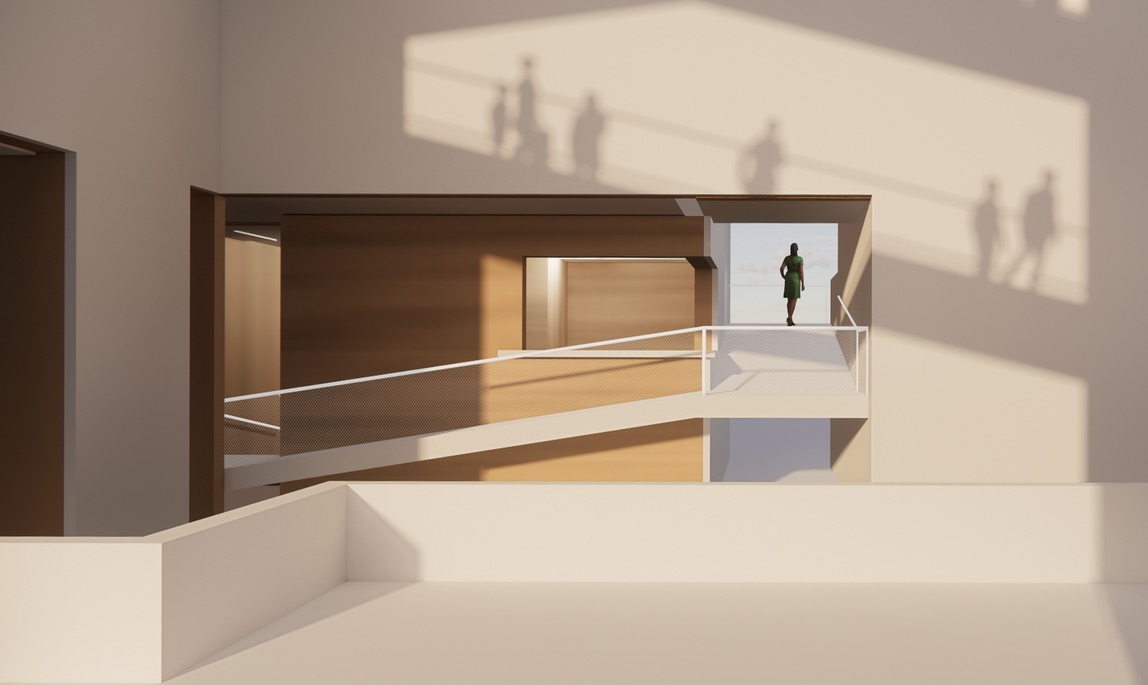
Digital rendering of Catherine Deal, Audrey Willey, and Aide Handwerker's project for Max Kuo's studio.
Now preparing to begin graduate studies at Harvard’s Graduate School of Design, Deal is energized by the challenges ahead. “Harvard will push me out of my comfort zone,” she said. “I’m excited for that.”
As Deal moves on to the next phase of her education, she carries with her not just the skills she’s developed, but advice from her grandmother, who remains a source of encouragement: “Work hard, no matter what field you’re in.”
Header image: From left to right, photos of Gurmukhi Bevli and Catherine Deal. (Lucza Brewer / UCLA Arts)
By Sean Arenas
Stay engaged. Use #UCLAarts to stay connected.


