Guest lecturer explores the interpretation of video games through a queer lens
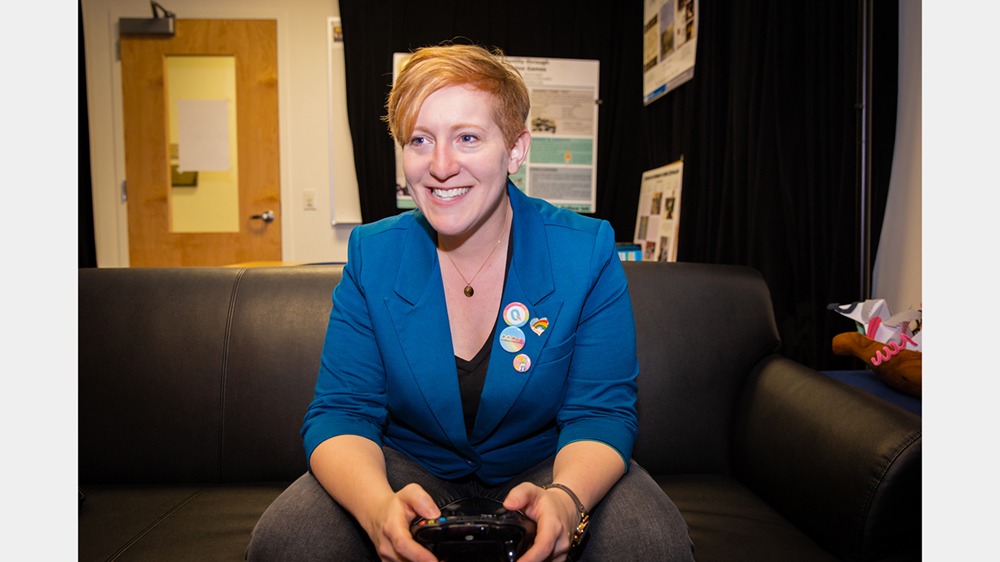
Bonnie Ruberg, Ph.D. is an assistant professor of digital games and interactive media in the Department of Informatics at the University of California, Irvine. Their research explores gender and sexuality in digital media and digital cultures with a focus on queerness and video games. Ruberg is also the co-founder and co-organizer of the annual Queerness and Games Conference. They received their Ph.D. with certification in New Media and Gender and Sexuality Studies from the University of California, Berkeley and served as a Provost’s Postdoctoral Fellow in the Interactive Media and Games Division at the University of Southern California. Ruberg gave a lecture at the UCLA Game Lab on May 1, 2019.
"Bonnie Ruberg sees parallels to their queer experiences in video games like “Octodad.”
Bonnie Ruberg, an assistant professor in the department of informatics at UC Irvine, believes video games can be interpreted through a queer lens, even if they weren't explicitly designed to have queer themes. Ruberg gave a talk May 1 at UCLA. (Courtesy of Han Parker/UCI) Within the game, players fulfill the role of an octopus pretending to be a human father, which Ruberg said resonated with their own experience as a nonbinary person.
Ruberg, an assistant professor in the department of informatics at UC Irvine, discussed how a queer person’s experiences can affect their interpretation of video games during a lecture at the UCLA Game Lab on May 1. Finding queer content in a game is similar to analyzing books or films, they said, where the content is considered through various interpretive lenses. Such analysis can push people to consider messages that could be seen as nontraditional, even if the games are not considered as being explicitly queer, Ruberg said.
“It’s a way of reclaiming video games because games culture can be really exclusionary, really homophobic and transphobic,” Ruberg said. “It’s a way of … saying, ‘You know what, even though you’ve made all these queer people feel unwelcome, this medium (of video games) belongs to us too.’”
The concept of “queer play” helps Ruberg discover the queerness within a game. When a gamer plays a game in ways not intended by the designer, they can incorporate their own identity into the narrative, Ruberg said.
A game called “Realistic Kissing Simulator,” for instance, could theoretically be seen as something that resists gender and sexuality norms through the freedom in its design, as no genders are explicitly stated, they said. The two-player simulator is a lighthearted take on kissing and lacks a clear winner, which Ruberg said deemphasizes the idea that sex is something one should try to be “the best” at. The game evades heteronormative ideas about gender and relationships because any two people can play together, they said.
Ruberg co-founded the Queerness and Games Conference, which fosters conversations on how to apply LGBTQ gaming concepts to the broader queer community, they said."—Brooke Cuzick, May 7, 2019



This post is an excerpt. Read the full article on the Daily Bruin website.
Stay engaged. Use #UCLAarts to stay connected.


