Frank Gehry’s Disney Hall Is Technodreaming: Data Projection by UCLA Alumnus Refik Anadol
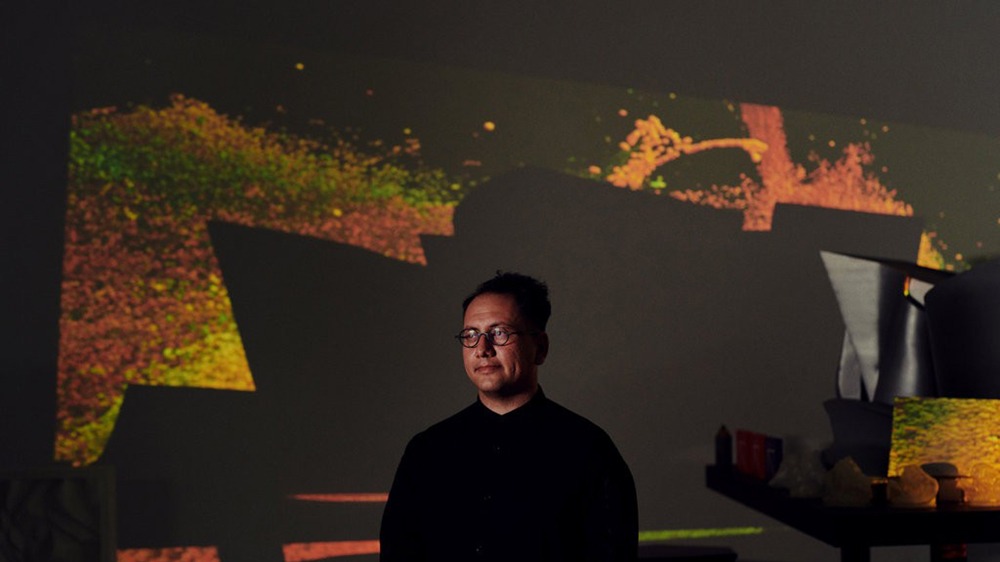
Alumnus and Visiting Assistant Researcher Refik Anadol (Design Media Arts, MFA '14), works in the fields of site-specific public art and live audio/visual performance with an immersive installation approach, particularly his works explore the space among digital and physical entities by creating a hybrid relationship between architecture and media arts. Anadol had made the idea of activating the Walt Disney Concert Hall’s exterior the subject of his master’s of fine arts thesis at the University of California, Los Angeles — and that, in turn, led to his first commission for the Philharmonic: creating a video installation that transformed the interior of the hall into a virtual tapestry during a performance of Edgard Varèse’s “Amériques.” This exterior projection, “WDCH Dreams," will be presented as part of the LA Phil's centennial celebration.
LOS ANGELES — Can a concert hall dream? The Los Angeles Philharmonic has a lot riding on the answer.
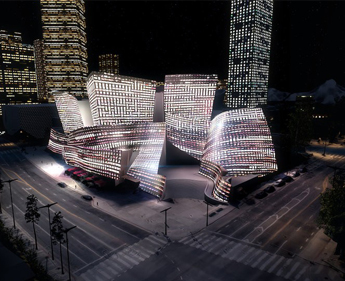
A rendering of a scene from Mr. Anadol’s “WDCH Dreams,” a swirling collage of audio and video elements from the Los Angeles Philharmonic’s past that will be projected onto the surface of the Walt Disney Concert Hall. In this scene, the hall “remembers” photographs from the orchestra’s archives. On Sept. 27, with big-ticket donors watching expectantly from a parking lot across the street, Refik Anadol, a Turkish-American artist, plans to transform the billowing steel superstructure of the orchestra’s Walt Disney Concert Hall into a swirling, phantasmagorical collage.
The 12-minute performance will be fashioned from artifacts from the Philharmonic’s own history: millions of photographs, printed programs and audio and video recordings, each one digitized, microcrunched and algorithmically activated to play in abstract form across the building’s dynamic metal surface. If all goes according to plan, “WDCH Dreams,” as the production is known, will kick off the Philharmonic’s centennial season with the kind of brio that befits the company that Zachary Wolfe describedlast year in The New York Times as “the most important orchestra in America. Period.”
Mr. Anadol, a bubbly and rather cherubic-looking 32-year-old who dresses entirely in black, likes to imagine the building, which was designed by Frank Gehry, as an enormous artificial intelligence, one that recalls the orchestra’s past and slips into reverie about its future. A few weeks ago, armed with animations and storyboards, he showed up at the Philharmonic’s administrative offices, in an elegant but understated building next to the concert hall, to detail his progress.
Gathered in a small conference room were Kenric McDowell, an artificial-intelligence expert from Google, and several Philharmonic officials, chief among them Chad Smith, the orchestra’s chief operating officer and de facto head of programming, a man whose preppy demeanor belies a reputation as one of the most innovative figures in classical music.
The building’s “performance,” staged for patrons paying upward of $2,500 per person for the opening-night gala and free to all on the nine evenings after that, falls into three parts. First, “Centennial Memories,” when data from the Philharmonic’s history — 44.5 terabytes of it, Mr. Anadol reported — is projected onto the building’s skin.
Mr. Smith broke in: “44.5? The last time we were together, it was seven terabytes.”
That was a while ago, Mr. Anadol reminded him. The audio recordings alone — nearly 77,000 of them — now come to seven terabytes.
“That’s an average of two recordings a day,” Mr. Smith observed, doing a quick calculation based on the 99 years the orchestra has been playing. (The actual centennial won’t come until September 2019.) “Interesting. O.K.”
Next comes “Consciousness,” when the building processes the billions of data points it has received to form a vast web of connections: every performance of every symphony, every trumpet, every oboe, every note the orchestra has ever played. And finally, “Dream,” when the concert hall fuses all this together to generate a sort of combinatorial fantasia — to “hallucinate,” as Mr. Anadol put it.
“This,” he declared, “will be a very divine moment.” — Frank Rose


This post is an excerpt. Read the full article on the Los Angeles Times website.
Stay engaged. Use #UCLAarts to stay connected.


