Fowler to Debut the International Traveling Exhibition Striking Iron: The Art of African Blacksmiths
225 Objects of Utility, Empowerment, and Spiritual Potency, June 2–December 30, 2018
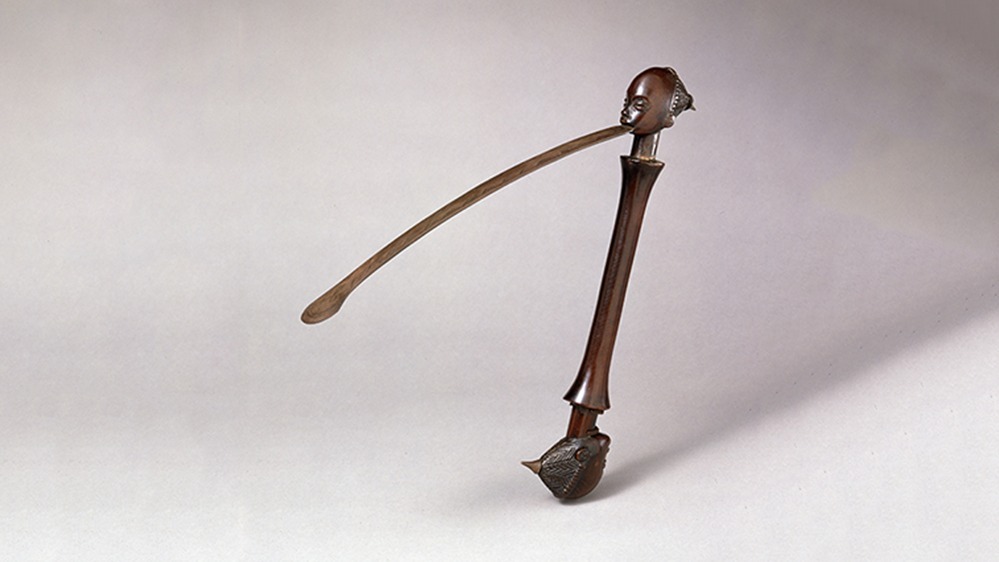
Los Angeles, CA — The Iron Age revolutionized Africa and forever altered human civilization practically and symbolically. Striking Iron: The Art of African Blacksmiths, organized by the Fowler Museum at UCLA and on view June 2–December 30, 2018, reveals the histories of invention and technical sophistication that led African blacksmiths to transform one of Earth’s most fundamental natural resources into objects of life-changing utility, empowerment, prestige, artistry and spiritual potency.
The exhibition, which will travel internationally after its debut at UCLA, features more than 225 works of art, including blades and currencies in myriad shapes and sizes, wood sculptures studded with iron, musical instruments and elaborate body adornments.
Technologies of iron smelting and forging, which likely began on the African continent around 2,500 years ago, were ardently sought and protectively guarded. Their control could promote a king’s ambition, enhance a soldier’s fortune, and secure a community’s well-being. Iron tools and weapons enabled Africans to forage, hunt, and till the soil, assuring prosperity and protection. Nowhere else in the world are there more diverse and accomplished forged iron forms than in Africa, and Striking Iron is the most comprehensive exhibition on this material to date.
Most of us take for granted the fact that iron keeps us alive and that there would be no Earth as we know it. Iron is in our blood, making it red. It is in the earth’s core and rocky crust. Popular culture embraces the strength and power of iron with such phrases as “iron will,” “iron grip,” and even “heavy metal.” The superhuman attributes endowed by iron are the stuff of Marvel’s Iron Man, while the centrality of Vibranium to Black Panther’s technologically advanced Wakanda is surely a metaphor for the centrality of iron in many African cultures.
The majority of objects in Striking Iron date from the 19th and 20th centuries and are drawn from the Fowler’s extensive collection or borrowed from 49 U.S. and European public and private collections. Works have been selected to highlight blacksmiths’ virtuosity and to introduce the ways forged iron objects harness the powers of the natural and spiritual worlds; ensure prestige, status, and endurance; assist with life’s challenges and transitions; and enhance the efficacies of sacred acts such as ancestor veneration, healing, fertility, and prophecy. Blacksmiths’ work and participation in community life continues to be indispensable today.
“There are many stories to tell in Striking Iron, and each one brings respect and admiration to the time-honored and even divine work of smelting and forging iron in Africa,” says Marla C. Berns, Shirley & Ralph Shapiro Director at the Fowler and exhibition co-curator. “The ambition of Striking Iron lies in its scope—with diverse works made by over 100 ethnic groups living in 19 countries, mostly south of the Sahara—and in showing how, through their mastery, blacksmiths have invested great cultural importance and meaning in the objects they make.”
Tom Joyce, the exhibition’s lead guest curator, added, “When iron is heated in a charcoal fire to white-hot temperatures, skilled African blacksmiths move the metal like clay. Using hammers as an extension of their hands, they can model any shape they desire upon their anvils. With astonishing technical prowess these artists have, for over 2,500 years, created the essential and the conceptual, the visually compelling and the sublime. It is a privilege to share their masterful achievements.”
To fully tell such visually rich and complex histories, the exhibition is organized around eight thematic sections and uses a range of interpretive components, including a seven-stop video tour with Joyce, an internationally acclaimed sculptor whose knowledge and experience in forging iron brings the blacksmith’s work to life. The exhibition’s thematic approach offers a layered and comparative view of forms, materials, and uses of iron.
Curatorial Team
Striking Iron is based on decades of research by its curatorial team, led by artist Tom Joyce, a MacArthur Fellow trained in the art of forging iron, and including Allen F. Roberts, UCLA Professor of World Arts and Cultures/Dance; Marla C. Berns, Shirley & Ralph Shapiro Director, Fowler Museum; William J. Dewey, Director, African Studies Program and Associate Professor of African Art History at Pennsylvania State University; and Henry J. Drewal, Evjue-Bascom Professor of Art History and Afro-American Studies at the University of Wisconsin-Madison. Seven additional advising scholars bring their specific areas of expertise to the project.
Tour
Following its presentation in Los Angeles, the exhibition will travel to the Smithsonian Institution’s National Museum of African Art, Washington, D.C. (February 13—October 20, 2019), and the Musée du quai Branly-Jacques Chirac, Paris (November 2019–March 2020).
Publication
The Fowler Museum will publish an illustrated, multi-author scholarly publication to accompany the exhibition.
Opening Weekend Programs
Opening Night Lecture: Potency Conveyed with a Hammer’s Blow | Saturday June 2, 6–7pm
Lead curator and artist Tom Joyce reveals the skills and innovation of African blacksmiths in transforming one of the earth’s most basic natural resources into objects of utility, empowerment, and beauty. Trained in the art of forging iron, MacArthur Fellow Joyce illuminates the subject through a fiery lens.
Opening Party with Mbira Performance | Saturday June 2, 7–9pm
Celebrate Striking Iron with African music spun by Tom Schnabel of KCRW’s Rhythm Planet. At 7:30 enjoy an mbira ensemble led by ethnomusicologist Ric Alviso. Afterwards try your own and at playing the mbira, or “thumb piano,” an African instrument with iron keys. Mix and mingle with cocktails in the Davis Courtyard.
Gallery Tour | Sunday June 3, 1pm
Curatorial team members Tom Joyce, Allen F. Roberts, Marla C. Berns, William J. Dewey, and Henry J. Drewal lead a walk-through of exhibition highlights.
Drop-in Family Program: Sculpting, Molding, Forging | Sunday June 3, 1–4pm
Families are invited to find inspiration in Striking Iron as they learn to mold clay using techniques derived from forging.
Visit fowler.ucla.edu/events for exhibition-related lectures, films, and family programs.
Credit
Striking Iron: The Art of African Blacksmiths is organized by the Fowler Museum at UCLA. It is made possible by major funding from the National Endowment for the Humanities* and in part by an award from the National Endowment for the Arts. Generous support is also provided by the Martha and Avrum Bluming Exhibition Fund with additional funding from the Fowler Exhibition Fund, Cindy Miscikowski, the Ethnic Arts Council of Los Angeles, Lee Bronson, Andrew Adelson, Richard Scheller and Susan McConnell, and Richard and Susan Ulevitch.
The publication is supported by the Ahmanson Foundation on the recommendation of the late Foundation Trustee Emeritus Lloyd E. Cotsen. Education programs are made possible in part by The Ralph M. Parsons Foundation.
*Any views, findings, conclusions, or recommendations expressed in this {article, book, exhibition, film, program, database, report, Web resource}, do not necessarily represent those of the National Endowment for the Humanities.
About the Fowler Museum
The Fowler Museum at UCLA explores global arts and cultures with an emphasis on works from Africa, Asia, the Pacific, and the Americas—past and present. The Fowler enhances understanding of world cultures through dynamic exhibitions, publications, and public programs, informed by interdisciplinary approaches and the perspectives of the cultures represented. Also featured is the work of international contemporary artists, presented within the complex frameworks of politics, culture, and social action.
Fowler Museum at UCLA
308 Charles E Young Drive N | Los Angeles, CA 90024 | fowler.ucla.edu
Admission is free| Hours: Wed 12–8pm and Thu–Sun 12–5pm
Parking available in UCLA Lot 4, 398 Westwood Plaza at Sunset Blvd ($12/day)
Stay engaged. Use #UCLAarts to stay connected.


