Exhibition Preview: Striking Iron: The Art of African Blacksmiths
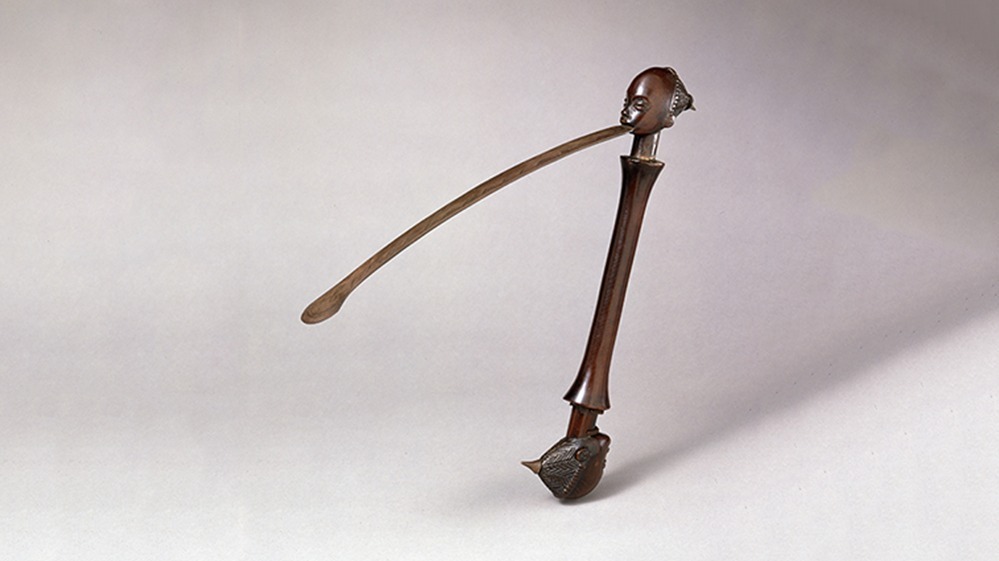
Striking Iron: The Art of African Blacksmiths, is an international traveling exhibition that combines scholarship with objects of great aesthetic beauty to create the most comprehensive treatment of the blacksmith’s art in Africa to date. The exhibition will include over 225 artworks from across the African continent, focusing on the region south of the Sahara and covering a time period spanning early archaeological evidence to the present day. Borrowed from American and European public and private collections, it features wood sculptures studded with iron, blades, and currencies in a myriad of shapes and sizes, diverse musical instruments, body adornments, an array of ritual accoutrements, tools and weapons, and other important objects that enabled Africans to forage and hunt, till the soil, and assure their own protection and prosperity. Co-curators Allen Roberts and Marla Berns, Shirley & Ralph Shapiro Director of the Fowler Museum at UCLA, present a preview of the exhibition in advance of its opening on June 3, 2018.
"Life has an edge, sometimes keen, sometimes blunt. Enter iron—digging, cutting, shining, or rusting, but always transforming circumstances. Iron is “born” when smelting releases it from rock. How did sub-Saharan Africans affect these complex processes, sculpt natural-draft furnaces by hand, and create malleable iron to change the world? How did smelters and smiths know which ore to select, which wood to cut for charcoal, and how to position logs within the furnace to stoke fires of the astounding heat required to smelt iron? Who knew what to do, how to hammer, when to quench, and what to reheat? What arcane sciences were mastered, what dramas performed? Why this shape for a tool, weapon, or emblem of status and not
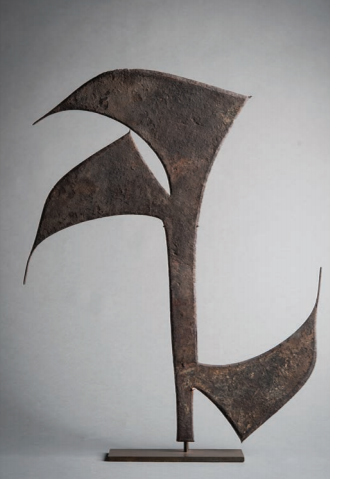
Artist unknown (Ndengese peoples, DRC)
Throwing knife currency (oshele), 19th century
that, and how was perfection realized and recognized? How did ironworking legitimize and empower leadership and rule, and vice versa, however ambiguous such roles most surely are? As a Yorùbá oríkì praise of Ògún has it, the god of iron may “wear a red cap,” reflecting the glow of a blacksmith’s forge and the transformative implements there created, but please Ògún, “let me not see the red of your eye!”
“Striking Iron: The Art of African Blacksmiths,” organized by the Fowler Museum at UCLA, will examine how the smith’s craft extends from the production of the most basic of domestic tools to the creation of a corpus of inventive, diverse, and technically sophisticated vehicles of social and spiritual power. The project draws on decades of research by its curatorial team, led by artist Tom Joyce, a MacArthur Fellow originally trained as a blacksmith, who lends his technical expertise and nearly three decades of substantive research and study of African ironwork to this project. Working closely with him is a team of co-curators: Allen F. Roberts, UCLA Professor of World Arts and Cultures/Dance; William J. Dewey, Associate Professor of African Art History at Pennsylvania State University; Henry J. Drewal, Evjue-Bascom Professor of Art History and Afro-American Studies at the University of WisconsinMadison; and Marla C. Berns, Shirley and Ralph Shapiro Director at the Fowler Museum. In addition, a team of seven international scholars has served as project consultants and content specialists: Rowland Abíódún, Shadreck Chirikure, Candice Goucher, Manuel Jordán, Colleen Kriger, Scott MacEachern, and Patrick McNaughton. Each team member—including additional authors contributing to the book-length publication accompanying the exhibition—brings focused knowledge of a distinctive perspective on African ironworking.
The traveling exhibition will present over 225 diverse artworks from across the African continent, concentrating on the region south of the Sahara and covering a time period spanning early archaeological evidence of ironworking to the present day. The works selected date mostly from the early nineteenth to the late twentieth century, with many documented in the field and others coming from American and European public and private collections, including early European colonial collections." — Allen Roberts & Marla Berns, Spring 2018

This post is an excerpt, read the full article from African Arts, MIT Press Journal on the Fowler Museum website.
Stay engaged. Use #UCLAarts to stay connected.


