Eggs are being fried as art at the Hammer Museum. Let’s see what’s cooking
Sarah Lucas: Au Naturel at the Hammer Museum at UCLA is the first American survey of one of the UK’s most influential artists. Over the past 30 years, Sarah Lucas (b. 1962, London, UK) has created a distinctive and provocative body of work that subverts traditional notions of gender, sexuality, and identity. Bringing together more than 130 works in photography, collage, sculpture, and installation, Sarah Lucas: Au Naturel reveals the breadth and ingenuity of the artist’s practice. The exhibition addresses the ways in which Lucas’s works engage with crucial debates about gender and power--with a particular attentiveness to the legacy of surrealism—from her clever modifications to everyday objects to her exploration of sexual ambiguity and the tension between the mundanely familiar and the disorientingly strange. The exhibition in on view through September 1, 2019.
"It’s 10:30 a.m. at the Hammer Museum, which is relatively still and quiet a half-hour before the doors open to the public. But chief art preparator Jason Pugh is scrambling.
Or, more accurately, frying.
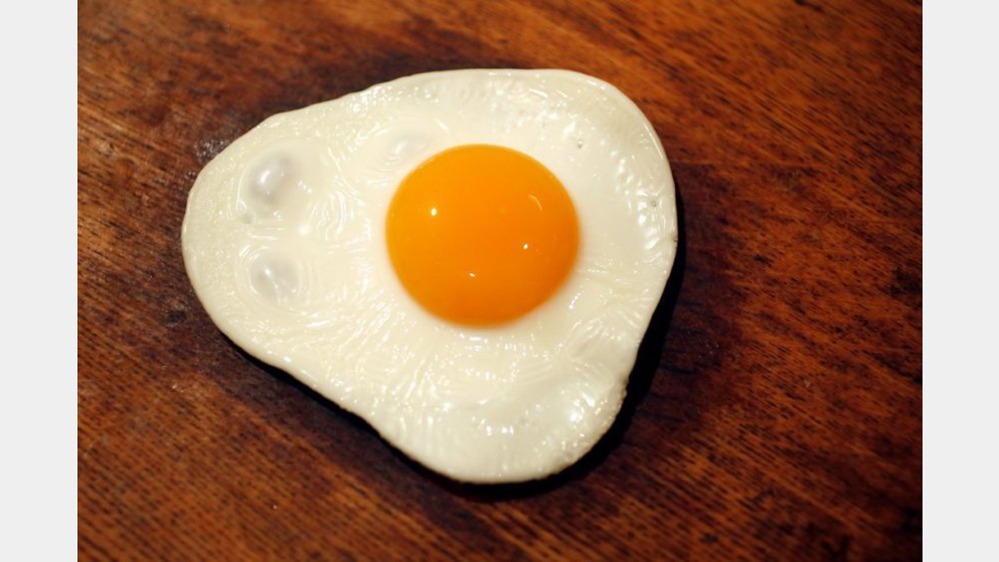
Hovered over a hot pancake griddle in the third-floor staff kitchen — which also houses mail slots and a rumbling copy machine — Pugh is frying two sunny-side-up eggs that will go into a work of art in the exhibition “Sarah Lucas: Au Naturel.”
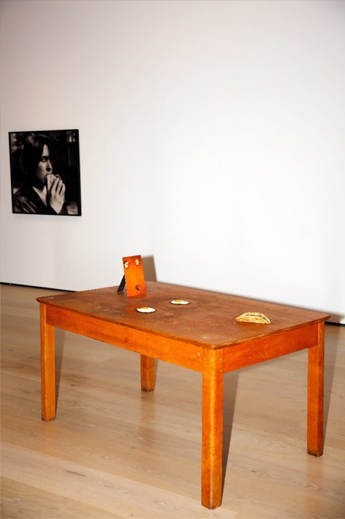
The survey of the British artist’s work includes collage, photography, sculpture, video and installations, many of which humorously juxtapose everyday objects in a way that challenges assumptions about gender, sexuality, religion and power. One standout piece is “Two Fried Eggs and a Kebab” (1992), which features, well, two real fried eggs and a pita pocket below it stuffed with shredded kebab meat arranged on a worn wooden table.
Another is “Au Naturel” (1994), featuring two robust melons above an empty bucket, the loose female form lying beside an erect cucumber flanked by two oranges on an old, sagging mattress.
It’s whimsical, provocative work. But still, the eggs must dutifully be replaced daily; the meat, every other day; and the fresh produce fairly regularly to ensure its perkiness. Which is where Pugh comes in.
Typically, Pugh would be wielding a tape measure or drill when installing art. Today, it’s a plastic kitchen spatula. He gingerly cracks one brown egg on the side of a plate, then gently slips its gooey insides onto the grill, careful to contain its shape. “Runaway eggs,” as he calls them, are a problem.
“These are well-behaved eggs,” he says, eyes peeled on the art materials as they sizzle. “Their shape is fairly egg-like, the yolks are intact. The bottoms are pretty rubbery. I would not eat these eggs.” With his loose, Hawaiian shirt and laid-back demeanor, Pugh appears more “backyard barbecuing dad” than contemporary art professional.
Lucas has a wry sense of humor, but she takes her food prep seriously. The artist gave Pugh very specific instructions: sturdy-bottomed eggs with browned edges; no seasoning or oil, lest the table they sit on become soiled.
“And they are to be sunny side up,” Pugh adds. “A little more like a cartoon, more of a hyper-real kind of an egg.” "— Deborah Vankin, Jul. 9, 2019


This post is an excerpt. Read the full article on the Los Angeles Times website.
Stay engaged. Use #UCLAarts to stay connected.


